Author Archives: Automated Transfer Script

A2L Item 185

Goal: Reasoning and hone the concept of torque.

Source: UMPERG-ctqpe152
A
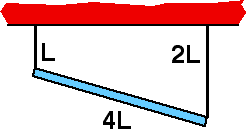
uniform rod of length 4L, mass M, is suspended by two thin strings,
lengths L and 2L as shown. What is net torque about the left end of the
rod?

  1. 0
  2. 4MgL
  3. 8MgL
  4. 12MgL
  5. None of the above

Commentary:

Answer

(1) Since the rod does not rotate the total torque must be zero
about any point. Many students overworry this problem not realizing
that, independent of the angle of the rod, the other string is twice as
far as the center of mass of the rod.

A2L Item 183

Goal: Reason with impulse and energy

Source: CT151.2S02-46

Two
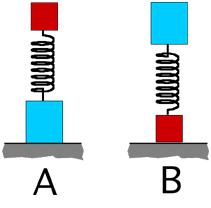
blocks are connected to the ends of a spring as shown. Assume that the
mass is proportional to the size of the block. The spring is compressed
(same amount) and released suddenly. In which orientation will the
system achieve the largest height?

  1. A
  2. B
  3. both go to the same height
  4. cannot be determined

Commentary:

Answer

(2) This is a very rich problem for reasoning. It IS possible for
students to reason to the correct solution if they consider appropriate
concepts. To help them along suggest the following: Draw free body
diagrams for each of the masses separately. Combine them to get a valid
free body diagram for the system. Such a process reveals that the normal
force is responsible for the impulse causing the system to jump. The
spring force is internal to the system and does not appear on the
system’s free body diagram.

Students can deduce the answer using analogy or experience. Pogo sticks
or even the human body are analogous systems.

A2L Item 184

Goal: Problem solving with rotational dynamics

Source: UMPERG-ctqpe148

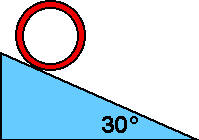
A hoop
of mass 4 kg and radius 10 cm rolls without slipping down an incline
30° to the horizontal. The acceleration of the center of the hoop
is most nearly

  1. 10 m/s2
  2. 5 m/s2
  3. 3.5 m/s2
  4. 2.5 m/s2
  5. none of the above
  6. cannot be determined

Commentary:

Answer

(4) Students should realize that the acceleration must be less
than a sliding mass on a frictionless surface would have which is #2.
Engage the students in a discussion of why the acceleration cannot
depend upon the radius.

A2L Item 182

Goal: Distinguish between mass, gravitational force and weight.

Source: CT151.2S02-21

An astronaut floats inside an orbiting spacestation. Which of the
following are true?

  1. No forces act on the astronaut.
  2. The astronaut has no mass.
  3. The astronaut has no
    weight.
  1. A only
  2. B only
  3. C only
  4. A and B
  5. A and C
  6. B and C
  7. all are true
  8. none are true

Commentary:

Answer

The only possible answers are #3 and #8. The issue turns on the
definition of weight. At the surface of the earth weight and the
gravitational force are often considered equivalent. Further, since the
gravitational force depends upon the mass, mass and weight are
proportional and mass units are sometimes used as a measure of weight.
In orbit bodies still experience a gravitational force but are said to
have no weight. Is it any wonder that students are confused? Invoking
scale readings as weight is not a solution either as one’s weight would
change in an elevator. The best solution to this is to sensitize
students to these issues and charge them with the responsibilty of
determining how to interpret these quantities in context.

A2L Item 181

Goal: Recognizing forces on current elements

Source: 283 Force on a half-loop

A
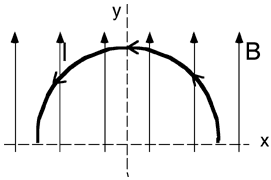
semicircular wire lies in a plane as shown. The positive z-direction is
out of the plane. The wire has current, I, in the counterclockwise
sense, and it is in a uniform external magnetic field, B, directed along
the +y axis. What is the direction of the net force, if any, acting on
the wire?

  1. +x
  2. -x
  3. +y
  4. -y
  5. +z
  6. -z
  7. None of the above.

Commentary:

Answer

(6) Since the current carrying semicircle lies in the x-y plane,
as does the magnetic field, the net force, if any, must point
perpendicular to the plane, or in the z direction. For the semicircular
wire, all force contributions add. There is no contribution to the net
force from current elements near the x-axis.

The force on the missing half of the loop would be out of the page.
Together both forces on a full loop would create a torque tending to
align the field of the current loop with the external field. If
appropriate relate this situation to the torque on a magnetic dipole.

A2L Item 179

Goal: Recognizing the properties of magnetic fields

Source: 283 – field of wire

Oersted discovered that there is a magnetic field in the space
around wires carrying currents. Consider a long thin straight wire with
a current I. Which of the following statements about the magnetic field
lines is true?

  1. Field lines are parallel to the
    wire.
  2. Field lines are perpendicular to the wire.
  3. Field
    lines are directed radially away from the wire.
  4. Field lines are
    circles centered on any point on the wire.
  1. A only
  2. B only
  3. C only
  4. D only
  5. A and C only
  6. B and D only
  7. B and C only
  8. None of them is true.

Commentary:

Answer

(6) It is important to elicit reasons that students selected any
of the other responses. Rather than telling the correct answer have
students draw the field lines. Often they are able to reproduce pictures
they have seen but cannot describe the fields in words.

A2L Item 180

Goal: Reason about magnetic fields

Source: 283 field of bar magnets

Two
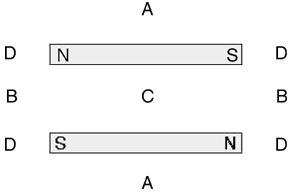
identical bar magnets are placed rigidly and parallel to each other as
shown. At what locations, if any, is the net magnetic field close to
zero?

  1. A only
  2. B only
  3. C only
  4. D only
  5. A and B
  6. A, B, and C
  7. C and D
  8. None of the above.

Commentary:

Answer

(3) C is the point of weakest field. The field is weak at A also.
Find out student reasons is more important than the answer. Have
students sketch the field lines. Ask them how is the strength of the
field indicated on a field line diagram.

A2L Item 178

Goal: Problem solving with rotational dynamics

Source: UMPERG-ctqpe140

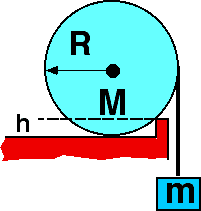
A disk
on a horizontal surface sits against a curb. A string wound around the
disk is attached to a mass as shown. If R=5 cm and h=2 cm, the largest
m for which the disk will not move is

  1. Less than 2M
  2. 2M
  3. 3M
  4. 4M
  5. 5M
  6. Greater than 5M
  7. Cannot be determined.

Commentary:

Answer

(4) When m = 4M the torques about the contact point between the disk and
curb balance. Students find this problem very difficult although rather
simple. Many have the most difficulty with the simple geometry needed to
find the moment arms.

A2L Item 176

Goal: Problem solving with dynamics

Source: UMPERG-ctqpe135.3

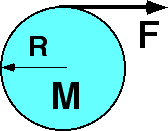
A
disk, with radius 0.25 m and mass 4 kg, lies on a smooth
horizontal table. A string wound about the disk is pulled with a
force of 8N. What is the acceleration of the disk?

  1. 0
  2. 0.5 m/s2
  3. 1 m/s2
  4. 2 m/s2
  5. 4 m/s2
  6. None of the above.
  7. Cannot be determined

Commentary:

Answer

(4) Students find it difficult to grasp that the angular dynamic
relationship does not replace, but rather augments, the 2nd law.

A2L Item 177

Goal: Problem solving with rotational dynamics

Source: UMPERG-ctqpe135.5

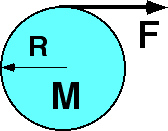
A
disk, with radius 0.25 m and mass 4 kg, lies on a smooth
horizontal table. A string wound about the disk is pulled with a
force of 8N. What is the angular acceleration of the disk about its
center?

  1. 0
  2. 64 rad/s2
  3. 8 rad/s2
  4. 4 rad/s2
  5. 12 rad/s2
  6. None of the above.
  7. Cannot be determined

Commentary:

Answer

(6) The correct value of αcm is 16 rad/s2. Students have the erroneous
concept of ‘conservation of force’. Many think that since the disk
moves, the full force cannot contribute to the torque about the center
of the disk.