Author Archives: Automated Transfer Script

A2L Item 175

Goal: Problem solving

Source: UMPERG-ctqpe135.1
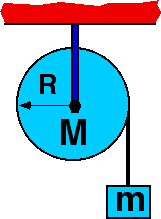
A
disk, having radius R and mass M, is free to rotate about an axis
through its center. A massless string is wound around disk and attached
to mass m. The moment of inertia for a disk given by is
1/2(MR2). If M=4m what is the acceleration of mass m?

  1. 0
  2. g/2
  3. g/8
  4. g/5
  5. g/3
  6. None of the above
  7. Cannot be determined

Commentary:

Answer

(5) Students answering #2 are likely making the common mistake of
thinking that the tension in the string is mg.

A2L Item 174

Goal: Reasoning about electric fields

Source: 283 ring, E on axis

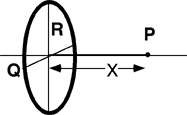
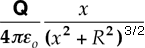
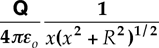
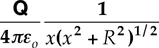
A ring
of radius R with charge +Q (uniformly distributed) is positioned as
shown. What is the electric field at a point on the axis, a distance x
from the origin?

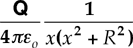
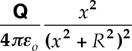
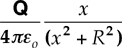
  1. None of the above.


Commentary:

Answer

(4) Discuss how the form of the field can be reasoned from symmetry and units. Together with limiting value as x goes to zero, this uniquely singles out one answer.

A good follow-up activity is to have students sketch a graph of the field and potential along the x-axis.

A2L Item 172

Goal: Hone the concept of torque

Source: UMPERG-ctqpe130

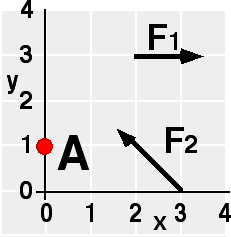
Given
F1 = 6N, and F2 = 8N, what is the total torque
about point A?

  1. 1.0 N-m, out
  2. 0.7 N-m, in
  3. 7.0 N-m, out
  4. 1.0 N-m, in
  5. 6.0 N-m, out
  6. None of the above.

Commentary:

Answer

(6) Many students use the origin rather than the point A. This provides
the opportunity to stress that torque is found with respect to a
specified point. Students using the right hand rule incorrectly may
answer #2.

A2L Item 173

Goal: Hone the concept of angular momentum

Source: UMPERG-ctqpe132

Which situation has the least (magnitude) angular momentum about the
origin?

  1. A 2 kg mass travels along the line y = 3m with speed
    1.5 m/s.
  2. A 1 kg mass travels in a circle of r = 4.5 m about the
    origin with speed 2 m/s.
  3. A disk with I = 3 kg-m2
    rotates about its center (on origin) with ω = 3 rad/s.
  1. A
  2. B
  3. C
  4. Both A and B
  5. Both A and C
  6. Both B and C
  7. All have the same magnitude angular momentum

Commentary:

Answer

(7) Students frequently think that objects traveling in a straight line
have no angular momentum. An interesting follow up question is to ask
how students would answer if the disk in situation were rotating about
the point (1,0).

A2L Item 171

Goal: Reason with electrical potential

Source: 283-470 Lowest voltage at origin

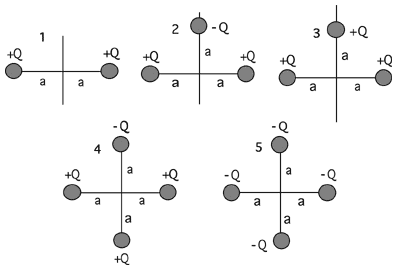
Which of the following charge distributions has the lowest electric
potential at the origin?


Commentary:

Answer

(5) This question serves to motivate a discussion of the
difference between potential energy in a configuration and the
electrostatic potential at a point. It is also important to stress that
potential when point charges are involved presumes that infinity is the
reference point.

A2L Item 170

Goal: Recognize macroscopic and microscopic quantities

Source: 283 Resistance variations with area.

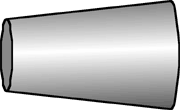
An
ohmic conductor is carrying a current. The cross-sectional area of the
wire changes from one end of the wire to the other. Which of the
following quantities vary along the wire?

  1. The resistivity
  2. The current
  3. The current density
  4. The electric field
  1. A only
  2. B only
  3. C only
  4. D only
  5. A and B only
  6. C and D only
  7. A, B, C, and D
  8. None of the above

Commentary:

Answer

(6) Students are likely to appreciate that the current density
varies and that the total current does not. Many will not recognize that
the electric field is related to the current density.

A2L Item 168

Goal: Interpreting graphs

Source: CT151.2-5

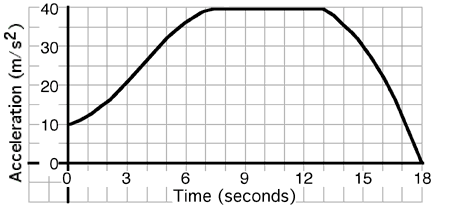
An
object’s motion is described by the graph above. The average
acceleration during the first 10 s is most nearly…

  1. 0 m/s2
  2. 20 m/s2
  3. 30 m/s2
  4. 40 m/s2
  5. 50 m/s2
  6. Other

Commentary:

Answer

(3) Students may have difficulty understanding what they are
asked. Recasting the problem in terms of areas helps. The only
contenders should be #2 or #3. Counting blocks should make it clear that
the result is much closer to #3.

A2L Item 169

Goal: Link acceleration to the slope of a velocity/time graph

Source: CT151.2-6

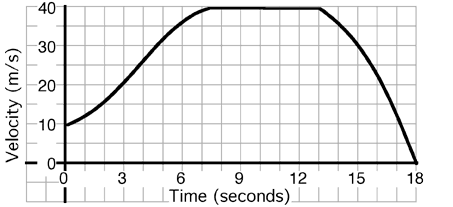
An
object’s motion is described by the graph above. The instantaneous
acceleration at t=10 sec is most nearly…

  1. 0 m/s2
  2. -2 m/s2
  3. 3 m/s2
  4. -4 m/s2
  5. 5 m/s2
  6. Other

Commentary:

Answer

(1) Useful follow-up questions include; when does the object have
positive acceleration, when negative acceleration; does the object ever
stop?; when is it farthest from the origin?

A2L Item 167

Goal: Problem solving

Source: UMPERG-ctqpe118

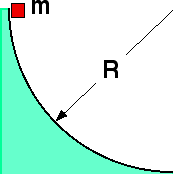
A mass
m slides down a frictionless track of radius R=0.5m. As the mass
reaches the bottom, relative to the center of curvature, its angular
velocity is most nearly:

  1. 6 rad/sec
  2. 8 rad/sec
  3. 12 rad/sec
  4. 15 rad/sec
  5. 20 rad/sec
  6. Cannot be determined

Commentary:

Answer

(1) The velocity near the bottom can be found using energy
conservation.

A2L Item 165

Goal: Problem solving and developing strategic knowledge

Source: UMPERG-ctqpe103

You are given this problem:

A
block sits on a frictionless incline. Given the angle of incline, the
distance along the incline, and that the block is initially at rest,
find the speed after traveling a distance d.

What principle would you use to solve the problem MOST EFFICIENTLY?

  1. Kinematics only
  2. F = ma or Newton’s laws
  3. Work-Energy theorem
  4. Impulse-Momentum theorem
  5. Angular Impulse-Angular Momentum
  6. 1 and 2
  7. 1 and 3
  8. 2 and 3
  9. None of the above
  10. Not enough information given

Commentary:

Answer

(3) The change in gravitational potential can be found directly.
Alternately, the work done by the gravitational force must be equal to
the change in kinetic energy.