Author Archives: Automated Transfer Script

A2L Item 156

Goal: Developing strategic knowledge

Source: UMPERG-ctqpe85

A mass of 0.5 kg moving along a horizontal frictionless surface
encounters a spring having k = 200 N/m. The mass compresses the spring
by 0.1 meters before reversing its direction. Consider the total time
the mass is in contact with the spring. What is the total impulse
delivered to the mass by the spring?

Which of the following principles or combination of principles
could be used to solve this problem MOST EFFICIENTLY.

  1. Newton’s 2nd law & dynamics
  2. Work-Energy theorem
  3. Impulse-Momentum theorem
  4. 1 and 2
  5. 1 and 3
  6. 2 and 3
  7. Other

Commentary:

Answer

(6) This is a two-principle problem. Again, student response is
not as important as discussing what clues there are for deciding what
principles are needed.

A2L Item 154

Goal: Distinguish distance traveled from displacement

Source: CT151.2-1

Andy has the following series of displacements: 3 m to the right; 4 m to
the left; 5 m to the right; and 2 m to the left. What is his distance
traveled?

  1. 0
  2. 2 m
  3. 2 m (to the right)
  4. 2 m (to the left)
  5. 14 m (to the right)
  6. 8 m (to the right)
  7. Impossible to determine
  8. None of the above

Commentary:

Answer

(8) Students just learning about vectors and displacements are
inclined to over specify quantities. Before they knew anything about
vectors they used distance as a scalar but can become confused and give
it the direction of the total displacement.

A2L Item 153

Goal: Hone the concept of impulse

Source: UMPERG-ctqpe80

A MOVING car collides with a STATIONARY truck. Which of the following
statements is true about the magnitudes of the impulse on each due to
the other?

  1. The impulse on the car is larger than the impulse on the truck.
  2. The impulse on the truck is larger than the impulse on the car.
  3. The magnitudes of the two impulses are equal.
  4. Answer depends upon circumstances of the collision.

Commentary:

Answer

(3) The 3rd law requires that the impulses be equal. Even
students who understand the 3rd law have difficulty realizing that the
magnitude of the impulse on two interacting bodies is the same. Many
students, however, do not understand impulse enough to recognize the
association. Others do not read the problem carefully enough and answer
with regard to ALL the forces, not just the one due to the other
vehicle.

A2L Item 151

Goal: Reason with kinematics

Source: UMPERG-ctqpe75

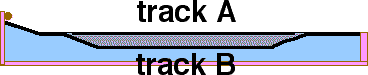
Two identical steel balls are released from rest from the same height,
and travel along tracks as shown and labeled below.

Which ball reaches the end of its track first?

  1. ball on track A
  2. ball on track B
  3. they reach the end at the same time
  4. not enough information

Commentary:

Answer

(2) The ball on track B accelerates down the second slope. A
component of this acceleration is in the x-direction. This means that
the x component of ball B’s velocity is never smaller than that of ball
A. Since the tracks have the same x-dimension, ball B gets there first.

A large majority of students choose answer C incorrectly thinking that
since the balls return to the same height, they have the same speed and,
therefore, arrive at the same time.

A2L Item 152

Goal: Reason with kinematics

Source: UMPERG-ctqpe76

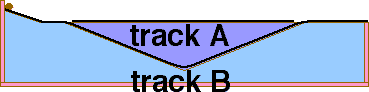
Two identical steel balls are released from rest from the same height,
and travel along tracks as shown and labeled below.

Which reaches the end of its track first?

  1. Ball on track A
  2. Ball on track B
  3. They reach the end at the same time
  4. Not enough information

Commentary:

Answer

(2) The ball on track B accelerates down the second slope. A component
of this acceleration is in the x-direction. This means that the x
component of ball B’s velocity is never smaller than that of ball A.
Since the tracks have the same x-dimension, ball B gets there first.

A large majority of students choose answer C incorrectly thinking that
since the balls return to the same height, they have the same speed and,
therefore, arrive at the same time.

A2L Item 150

Goal: Link work and potential

Source: 283-465 Interpreting voltage

The potential at two points in space is: V1=200 Volts,
V2=300 Volts. Which of the following statements is true for
moving a point charge, q, from point 1 to 2?

  1. The work done by an external agent to
    move q from point 1 to 2 is positive.
  2. Can’t determine the work
    done because you don’t know the direction of V at the two points.
  3. The work done by the electrical force exerted on q in moving it from
    point 1 to 2 is: W = -q(100 Volts).
  1. A
  2. B
  3. C
  4. A and B
  5. A and C
  6. A, B, and C
  7. None of the above

Commentary:

Answer

(3) is the best response. Statement A is true only if the charge
is positive. The important thing is to see if students correctly
envision the electric field lines as directed from higher potential to
lower.

Any response involving statement B should be discussed thoroughly as it
indicates confusion between fields and potentials.

A2L Item 149

Goal: Reason with potential energy

Source: UMPERG-ctqpe68

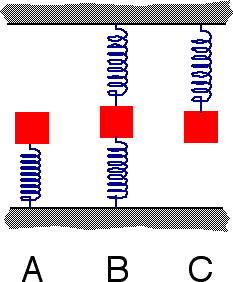
Consider three spring systems having identical springs and
masses. Which of the 3 systems has the largest amount of stored energy?

  1. A
  2. B
  3. C
  4. A and C
  5. All have the same potential energy
  6. Cannot be determined

Commentary:

Answer

(2) Students often forget to include the gravitational potential
energy and also have difficulty selecting a good reference point.

A2L Item 147

Goal: Relate force to potential energy function

Source: UMPERG-ctqpe66

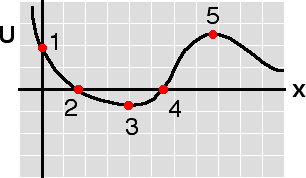
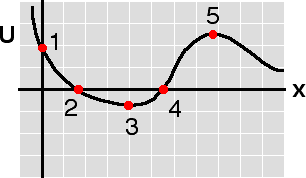
The
potential energy function for a certain body is shown at right. For
which points is Fx = 0?

  1. Point 1 only
  2. Points 2 and 4
  3. Points 1 and 5
  4. Points 3 and 5
  5. Point 3 only
  6. Fx not equal to 0 anywheree

Commentary:

Answer

(4) The force is given by the negative of the slope of the
potential function. Points 3 and 5 are equilibrium points, but only 3 is
a stable equilibrium point. Students frequently choose answer #2
thinking that the force is zero at these points.

A2L Item 148

Goal: Hone the concept of conservative force

Source: UMPERG-ctqpe67

The
potential energy function for a certain body is shown at right. The
force associated with this potential is …

  1. conservative.
  2. dissipative.
  3. neither conservative or dissipative.
  4. Cannot be determined

Commentary:

Answer

(1) It is remarkable how many students will select one of the
other answers. Many students do not recognize that you cannot have a
potential function unless the force is conservative.

A2L Item 145

Goal: Reasoning with energy

Source: UMPERG-ctqpe64

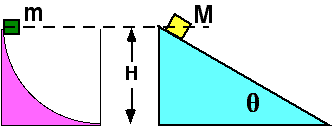
Two
masses, M > m, travel down the surfaces shown. Both surfaces are
frictionless. Which mass has the largest speed at the bottom?

  1. m
  2. M
  3. Both have the same speed
  4. Cannot be determined

Commentary:

Answer

(3) By energy considerations, both would have the same speed.
Students frequently get confused about the mass, thinking that the
larger mass has the greatest potential energy change and therefore has
the greatest speed.