Author Archives: Automated Transfer Script

A2L Item 136

Goal: Reasoning with dynamics

Source: UMPERG-ctqpe43
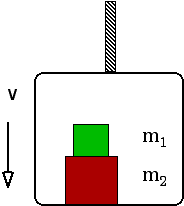
Block
m1 sits on block m2 and both sit on the floor of
an elevator at rest. When the elevator starts to move down, the normal
force on the upper block will …

  1. increase.
  2. remain the same.
  3. decrease.
  4. Cannot be determined

Commentary:

Answer

(3) As it starts the elevator must accelerate downward and so
will the upper block. The only forces on the block are gravity and the
normal force. The normal force must diminish so gravity can provide the
downward acceleration.

Students answering #2 may have interpreted the question to mean ‘as the
elevator moves’ and think that the elevator moves with constant velocity.

A2L Item 134

Goal: Link work and potential change

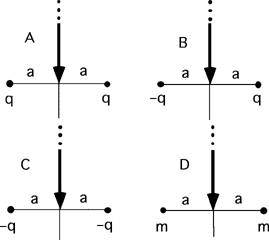
Source: 283-450 Move q, do most work

For
the following situations consider moving a positive charge from very far
away to the origin along the y-axis. For which situation would you do
the most work?

  1. A
  2. B
  3. C
  4. D
  5. A & C
  6. None of the above.
  7. Cannot be determined

Commentary:

Answer

(1) Students indicating #7 because they do not know if the masses
are charged should not be disconfirmed. If students key on magnitude
only they will likely choose answer #5.

A2L Item 133

Goal: Reasoning with circular motion

Source: UMPERG-ctqpe37

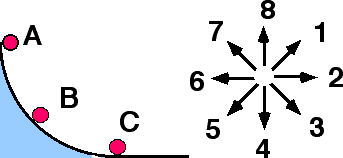
A small ball is released from rest at position A and rolls down a
vertical circular track under the influence of gravity.

When
the ball reaches position B, which of the indicated directions most
nearly corresponds to the direction of the ball’s acceleration?

Enter (9) if the direction cannot be determined.


Commentary:

Answer

(2) At position B the acceleration has a tangential component and
a radial component. Both components can be determined at position B.
Worked out carefully one gets 18 degrees above position #2. It is common
for students to neglect one component or the other.

A2L Item 131

Goal: Reasoning with dynamics

Source: UMPERG-ctqpe30

A
block of mass m, when placed on a rough inclined plane and moved, moves
down the plane with constant speed. If a block of mass 2m were placed
on the same incline and moved, it would …

  1. return to rest.
  2. accelerate until the speed is half.
  3. move with some constant speed.
  4. None of the above.
  5. Cannot be determined

Commentary:

Answer

The block will have the same motion. Both the gravitational force
and the friction force scale with the mass so there is no net force in
either case.

A2L Item 132

Goal: Link energy conservation and electromagnetism

Source: 283-421 Change of total energy

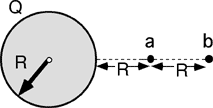
A
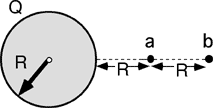
uniform volume distribution of charge has radius R and total charge Q.
A point charge -q is released from rest at point b, which is a distance
3R from the center of the distribution. When the point charge reaches a,
which of the following is true regarding the total energy, E?

  1. Ea = -Eb
  2. Ea = -2Eb/3
  3. Ea = -3Eb/2
  4. Ea = -9Eb/4
  5. Ea = Eb
  6. Ea = 2Eb/3
  7. Ea = 3Eb/2
  8. Ea = 9Eb/4
  9. None of the above
  10. Cannot be determined

Commentary:

Answer

(5) Students often forget to include the kinetic energy,
especially after a lot of discussion of potential energy. Many will
simply misinterpret the energy to mean potential energy. Teasing apart
these issues is important.

A2L Item 129

Goal: Hone the concept of electrostatic potential

Source: 283-420 Change of PE

A uniform volume distribution of
charge has radius R and total charge Q. A point charge -q is released
from rest at point b, which is a distance 3R from the center of the
distribution. When the point charge reaches a, which of the following is
true regarding the potential energy, U?

  1. Ua = -Ub
  2. Ua = -2Ub/3
  3. Ua = -3Ub/2
  4. Ua = -9Ub/4
  5. Ua = Ub
  6. Ua = 2Ub/3
  7. Ua = 3Ub/2
  8. Ua = 9Ub/4
  9. None of the above
  10. Cannot be determined

Commentary:

Answer

(7) Many students use an inverse square dependence appropriate
for fields. Others will take the field at b and multiply by the
displacement. Still others will assert that the potential doubles
because they are using the distance to the surface of the sphere.

A2L Item 130

Goal: Hone the concept of static friction

Source: UMPERG-ctqpe29

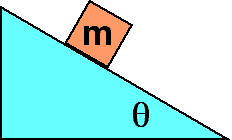
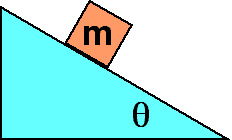
A block of mass m sits at rest on a
rough incline of angle θ. The coefficient of static friction is
μ.

The friction force on the block is

  1. mgcos(θ), down the incline.
  2. mgsin(θ), up the incline.
  3. μmgsin(θ), down the incline.
  4. μmgcos(θ), up the incline.
  5. none of the above.
  6. cannot be determined

Commentary:

Answer

(2) this is all that is needed to hold the block at rest. Some
students will give #4 as the answer having specified the maximum static
friction force.

It helps to classify forces as model forces obtainable from a formula,
and procedure forces. Static friction is an example of a procedure
force, one that cannot be determined without application of the 2nd law.

A2L Item 128

Goal: Hone the concept of static friction

Source: UMPERG-ctqpe27

A mass of 5 kg sits at rest on an incline making an angle of 30° to
the horizontal.

If μs = 0.7 the friction force on the block is

  1. 43.3N, down the incline
  2. 25N, up the incline
  3. 10N, down the incline
  4. 30.3N, up the incline
  5. none of the above
  6. cannot be determined

Commentary:

Answer

(2) this is all that is needed to hold the block at rest. Some
students will give #4 as the answer having calculated the maximum static
friction force.

It helps to classify forces as model forces obtainable from a formula,
and procedure forces. Static friction is an example of a procedure
force, one that cannot be determined without application of the 2nd law.

A2L Item 126

Goal: Problem solving

Source: UMPERG-ctqpe23

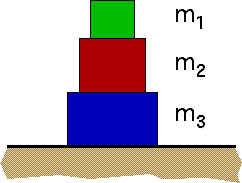
If m2 = 2m1 , m3 = 3m1 and
the force that the surface exerts on the bottom block is 120N, the mass
of the large block is

Use g = 10 N/kg.

  1. 2 kg
  2. 4 kg
  3. 6 kg
  4. 8 kg
  5. 12 kg
  6. 20 kg
  7. none of the above

Commentary:

Answer

(3) the most common other answers are #1 and #6, each of which
represents a typical mistake students make. This problem presents a good
opportunity to encourage students to check their answer.

A2L Item 127

Goal: Link flux to field lines.

Source: 283-415 nonzero flux?

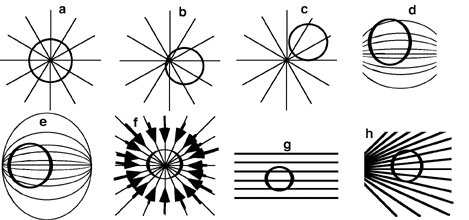
The circles in the picture below are Gaussian surfaces. All other lines
are electric field lines. For which cases is the flux non-zero?

  1. a
  2. a, b, and f
  3. a, b, e, and f
  4. a, b, d, e, and h
  5. a and b
  6. All but g
  7. All of them
  8. None of the above
  9. Cannot be determined

Commentary:

Answer

(2) As “follow-up” it is good to ask questions about comparisons
between two or more of the situations. For example, which is flux is
larger, a or f? Such questions help determine what students are focused
upon; are they keying on number of lines, do they understand that the
flux can be negative.