Author Archives: Automated Transfer Script

A2L Item 116

Goal: Hone vector nature of electric fields

Source: UMPERG-em97Q
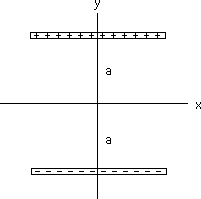
Two uniformly charged rods are positioned horizontally as shown. The
top rod is positively charged and the bottom rod is negatively charged.
The total electric field at the origin

  1. Is 0.
  2. Has both an x and a y component.
  3. Points totally in the i direction.
  4. Points totally in the -i direction.
  5. Points totally in the j direction.
  6. Points totally in the -j direction.
Commentary:

Answer

(6) Along the y-axis, by symmetry, the electric field due to either rod
points along the y-axis. At the origin the contribution to each rod is
the same and points down.

A2L Item 114

Goal: Problem solving with the ideal gas law

Source: UMPERG-ctqpe184

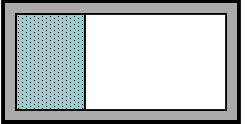
Two moles of an ideal gas fill volume V = 10 liters at pressure P = 2.4
atm. The gas is thermally insulated from the surroundings. A membrane
is broken which allows the gas to expand into the new volume which is 3
times as large as the old volume. The new pressure is:

  1. .4 atm
  2. .8 atm
  3. 1.2 atm
  4. 1.6 atm
  5. 2.4 atm
  6. None of the above
  7. Cannot be determined

Commentary:

Answer

(2) Some students may wonder about the applicability of the ideal gas
law for free expansion. Some may respond (7) thinking that since gas
cools as it expands, they do not know what the final temperature is and
cannot, therefore, use the ideal gas law.

A2L Item 111

Goal: Problem solving

Source: UMPERG-ctqpe182

What temperature reading (if any) would have the same numerical value on
both the Celcius and Fahrenheit temperature scales?

  1. -40°
  2. 180°
  3. 72°
  4. -25.6°
  5. 568°
  6. None of the above
  7. Cannot be determined

Commentary:

Answer

(2) This is a standard problem useful for determining whether students
are comfortable converting between the two temperature scales.

A2L Item 112

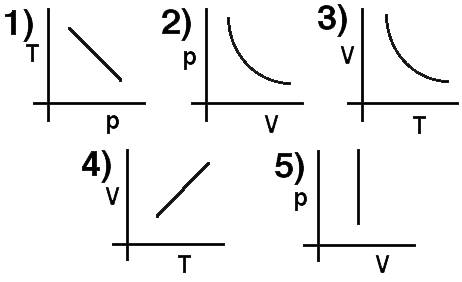
Goal: Hone the concept of work on a gas

Source: UMPERG-ctqpe220

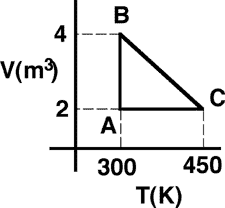
One mole of an ideal monatomic gas is taken around the cycle shown.

The work done on the system during the process B to C is

  1. Positive
  2. Negative
  3. No work is done on the system
  4. Cannot be determined

Commentary:

Answer

(1) Positive work is done ON the system. Since the path on a V-T diagram
is a straight line, the process is isobaric.

A2L Item 110

Goal: Hone the concept of heat capacity

Source: UMPERG-ctqpe210

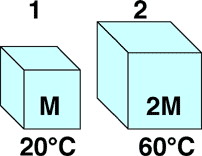
Two thermodynamic systems are made from the same material. The specific
heat of this material is independent of temperature. The bodies have
different masses and, initially, different temperatures as shown. If the
bodies are placed in thermal contact the final equilibrium temperature
is most nearly

  1. 27 C
  2. 33 C
  3. 40 C
  4. 47 C
  5. None of the above
  6. Cannot be determined

Commentary:

Answer

(4) It is valuable to ask students how they obtained their answer. Each
of the offered answers is obtained by a common conceptual or algebraic
mistake.

A2L Item 109

Goal: Problem solving with thermal energy.

Source: UMPERG-ctqpe208

A cup of water is about 225 grams. The minimum amount of heat needed to
boil a cup of water at room temperature for tea is most nearly

  1. 10,000 cal
  2. 17,000 cal
  3. 25,000 cal
  4. 31,000 cal
  5. None of the above
  6. Cannot be determined

Commentary:

Answer

(2) This problem requires that students know the specific heat of water
and assume that the water is initially at room temperature.

A2L Item 107

Goal: Reason with the concept of moment of inertia

Source: UMPERG-ctqpe116

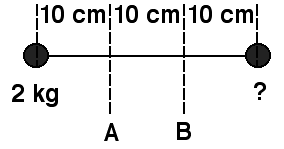
The rotational inertia of the dumbbell (see figure) about axis A is
twice the rotational inertia about axis B. The unknown mass is

  1. 2 kg
  2. 4 kg
  3. 5 kg
  4. 7 kg
  5. 10 kg
  6. None of the above
  7. Cannot be determined

Commentary:

Answer

(4) Students can get bogged down in calculations when it is unnecessary
to do detailed calculations. Proportional distances to the axes is all
that is needed. This problem presents a good opportunity to discuss
problem solving procedures.

A2L Item 108

Goal: Problem solving with rotational kinematics

Source: UMPERG-ctqpe110

A flywheel rotating about an axis through its center starts from rest,
rotates with constant angular acceleration for 2 seconds while making
one complete revolution and thereafter maintains constant angular
velocity. How long does it take the wheel to make a total of 6 full
revolutions?

  1. 4 secs
  2. 5 secs
  3. 6 secs
  4. 7 secs
  5. 9 secs
  6. None of above
  7. Cannot be determined

Commentary:

Answer

(4) This problem provides an excellent opportunity to discuss the power
of graphs for problem solving. Making a sketch of angular velocity vs.
time provides the easiest way to answer the problem. Conversely, an
algebraic solution is complicated.

A2L Item 106

Goal: Hone rotational dynamics

Source: UMPERG-ctqpe1246

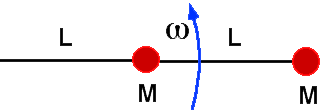
A system consisting of two masses on a string is rotating with angular
velocity ω on a frictionless horizontal surface. The center of
rotation is the left-hand side of the string (nailed to the table).

The ratio of the tension in the inner string to that in the outer string
is

  1. 0.25
  2. 0.5
  3. 1.5
  4. 2.0
  5. 3.0
  6. None of the above

Commentary:

Answer

(3) Many students think the ratio is determined just by the string
lengths and give as an answer either (2) or (4). They fail to draw a
free body diagram for the inner mass and, consequently, fail to realize
that it is the net force on the inner mass that must maintain the
circular motion of the inner mass.