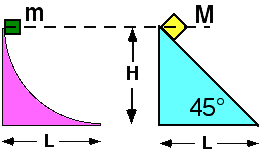
Two masses, m and M, are released from rest at a height H above the
ground. Mass m slides down a curved surface while M slides down an
incline as shown. Both surfaces are frictionless and M > m.
Which of the following statements is true?
- The time it takes for m to reach the end of the surface is longer because the path it takes is longer.
- The time it takes is the same since both masses are released from the same height.
- The time it takes for M to reach the end of the incline is less because its horizontal acceleration is larger.
- The time it takes for m to reach the end of the surface is shorter because it has a larger acceleration initially and therefore builds speed more quickly.
- The time it takes is the same since both masses have the same displacement.
- The time it takes is the same because both masses have the same speed at the end.
- The times cannot be compared without knowing the masses of the blocks.
- More than one statement above is correct
- None of the above statements is correct.



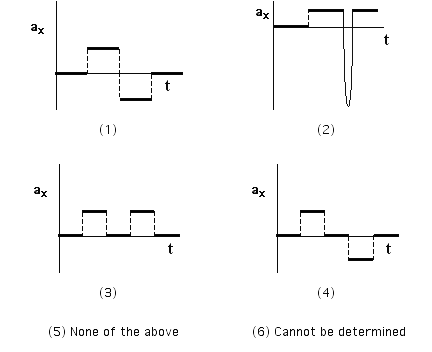
Commentary:
Answer
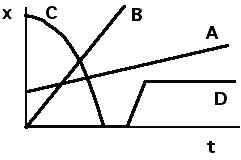
(8) is the appropriate response because both C and D experience a force
during the time interval. A and B have constant velocity because the
slope of their x vs. t plot is constant. Some students may not realize
that D experiences a force because they will reason that D has constant
velocity at any given time. However, D must experience a force to
change its velocity.
Background
Recognizing the signature of acceleration from a plot of position vs.
time is an important skill for students to develop. Because of
familiarity, they may recognize the plot of position for a falling body
and reason that the object experiences a gravitational force. This
question requires two logical steps. First recognizing the consequence
of constant velocity and second recognizing that a change of velocity
indicates acceleration and therefore force.
Questions to Reveal Student Reasoning
Which objects have constant velocity throughout the time interval?
Which of the objects has the largest speed sometime during the time
interval?
Are all of the objects moving away from the origin?
Suggestions
Have students plot the velocity of each object over the same time
interval.
Have students move objects in a manner in accord with the plots. This
may cause them to realize when a force must be applied.