Goal: Unspecified.
Source: Unspecified.
An object’s motion is described by the graph:
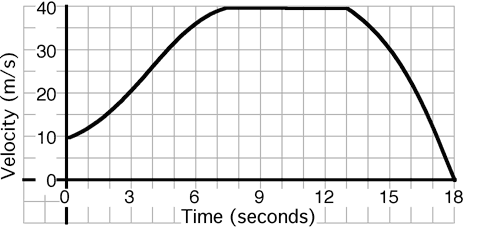
What is the instantaneous velocity at t = 10s?
- 0 m/s
- 2 m/s
- 3 m/s
- 4 m/s
- 5 m/s
- Other
Goal: Unspecified.
Source: Unspecified.
An object’s motion is described by the graph:
What is the instantaneous velocity at t = 10s?
Goal: Unspecified.
Source: Unspecified.
An object’s motion is described by the graph:
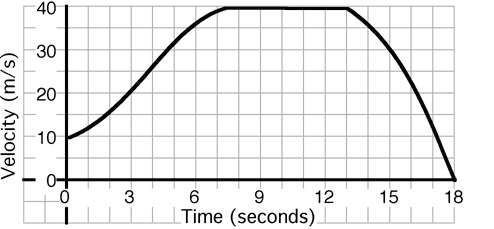
What is the average velocity during the first 10s?
None provided.
Goal: Hone the concept of a collision
Source: CT151.2S02-43

A cart
of mass m is moving with speed v. Is it possible for the kinetic energy
or the momentum to be larger after a collision?
(4) Many students get fixated on the idea that all collisions are head
on and cause the object to lose energy and momentum.
Goal: Reason regarding interactions
Source: CT151.2S02-43
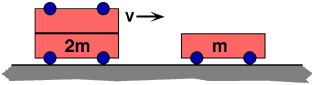
A
cart of mass 2m collides and sticks to a cart of mass m that is
initially at rest. Which cart exerts the larger force on the other?
(3) Yet another instance of Newton’s Third Law. Some students still
stumble because they the question considers the object exerting the
larger force as opposed to the one having the larger force applied to
it.
Goal: Interrelate representations of kinematical quantities
Source: CT151.2-10
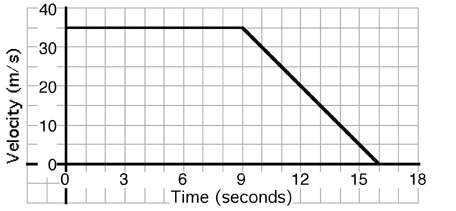
An object’s motion is described by the graph above. The displacement
of the object during the entire 16 seconds is most nearly…
(7) Students have difficulty reading graphs and finding areas.
Goal: Recognize a lack of information
Source: CT151.2S02-24
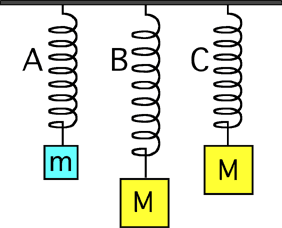
Consider the situations at right. Let m < M. Which spring has
the largest spring constant?
(8) The objective of this question is to reveal what students are
assuming about the springs. The reasoning behind any incorrect answer
should be thoroughly discussed.
Goal: Hone the concept of average velocity
Source: CTtil2;12;02
While traveling from Boston to Hartford, Person A drives at a constant
speed of 55 mph for the entire trip. Person B drives at 65 mph for half
the trip and then drives 45 mph for the second half of the trip. When
would B arrive in Hartford relative to A?
(3) Many students are inclined to average the speeds and conclude that
they arrive at the same time. It is often useful to compare this
situation to the one in which time is halved.
Goal: Interrelate representations of kinematical quantities
Source: CT151.2-8
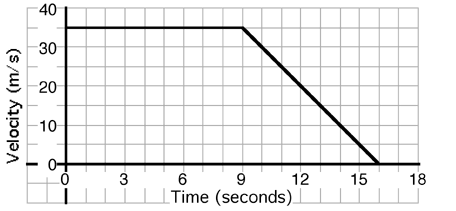
An object’s motion is described by the graph above. The position of the
object at t = 9 seconds is most nearly…
(6) This problem is primarily to determine if students appreciate the
information available from a graph. Many students will determine the
displacement forgetting that the initial position is unknown.
Goal: Hone the vector nature of the electric field
Source: CTQ283-6
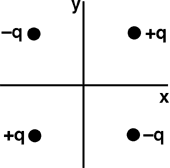
Four charges are positioned as
shown. What is the direction of the electrical field at the origin?
(6) Difficulty with this question usually indicates that students are
not familiar with vectors. Good follow up question: ask whether it
matters if the charges are along a 45 degree line.
Goal: Hone the vector nature of the electric field
Source: CTQ283-7
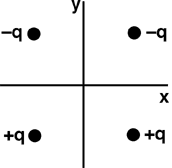
Four
charges are positioned as shown. What is the direction of the
electrical field at the origin?
(3) Difficulty with this question indicates that students do not know
how the direction of the electric field relates to the sign of the
charge.
Commentary:
None provided.