Author Archives: Automated Transfer Script

A2L Item 236

Goal: Hone understanding of Faraday’s Law

Source: 283-710 Conducting bar on rails
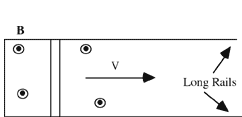
A
conducting bar is placed on a set of horizontal rails. After a uniform
magnetic field is set up perpendicular to the rails, the bar is given a
push. As the bar moves along the rails, which of the following
statements are true.

  1. There is an E field in the bar
  2. There is a current in the bar
  3. The bar moves with a constant
    speed
  1. A only
  2. B only
  3. C only
  4. A and B
  5. A and C
  6. B and C
  7. A, B, and C
  8. None are true

Commentary:

Answer

(4) In the absence of a force sustaining the motion, the bar slows down.
It is interesting to discuss what happens to the kinetic energy as the
bar slows down. Advanced students can work out that the energy is
dissipated in the resistance of the bar.

A2L Item 234

Goal: Reason regarding forces between current elements

Source: 283-660 Force between two wires

A very long wire lies in a plane with a short wire segment. The long
wire carries current I, while the short wire of length L carries current
i. The two wires are parallel to each other. Which of the following
statements are true?

  1. The direction of the magnetic force
    exerted by the long wire on the short wire is directed away from the
    long wire.
  2. The magnitude of the force on the short wire is
    μ0IiL/2πd.
  3. The long wire experiences a force
    of exactly the same magnitude as the force experienced by the short
    wire.
  1. A only
  2. B only
  3. C only
  4. A and B
  5. A and C
  6. B and C
  7. A, B, and C
  8. None of them are true

Commentary:

Answer

(6) The force is attractive between the wires so statement A is false.
Students need to interpret the phrase ‘very long’ as implying that the
wire is infinite.

A2L Item 233

Goal: Reasoning regarding magnetic fields caused by current elements

Source: 283-655 Ordering magnetic field magnitudes

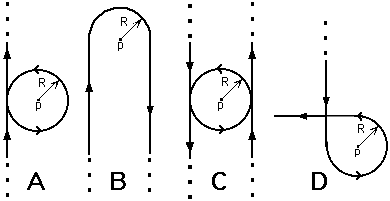
Order the following situations according to the magnitude of the
magnetic field at the point P. Order from highest to lowest.

  1. ABCD
  2. ADBC
  3. BDAC
  4. CADB
  5. DABC
  6. None of the above

Commentary:

Answer

(6) This question poses a good exercise for students. They can reason
comparatively without having specific expressions for the field
contributions from wires or loops. The order is CDBA.

A2L Item 231

Goal: Reason regarding the fields due to current elements

Source: 283-650 Maximum B field

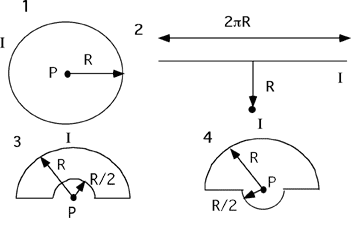
In all cases the wire shown carries a current I. For which situation
is the magnitude of the magnetic field maximum at the point P?


Commentary:

Answer

(4) #4 is larger than #3 because contributions from the two half circles
reinforce in #4 rather than oppose each other as in #3. #4 is larger
than #1 because #4 has a half loop at half the radius. Situation #2
having a finite length of wire is a distracter. The field in #2 is
smaller than #3 and would be even if the wire in #2 were infinite. An
interesting follow-up is to ask students to well order the cases
according to the strength of the field.

A2L Item 232

Goal: Reason regarding the Biot-Savart law

Source: 283-650 B from an infinite wire.

If B = μ0I/4πD at point P which is a distance D from
the end of a “half-infinite” wire, then what would be the magnetic field
at P if the wire went to infinity in both directions?

  1. It would be 0 because the left-portion of the wire would cancel the
    magnetic field from the right-portion of the wire.
  2. It would be twice the answer above.

  3. It is not 0, but it is also not twice the answer above – you have some
    cancellation and you need to figure it out putting in the appropriate
    sines and cosines.


Commentary:

Answer

(2) This question is only of value if one has obtained the field at the
end of a semi-infinite wire by direct integration. It is important for
students to recognize situations where the Biot-Savart Law must be used
versus cases where Ampere’s Law can be used.

A2L Item 230

Goal: Applying the Biot-Savart law

Source: 283-645 Magnetic field from wire loop

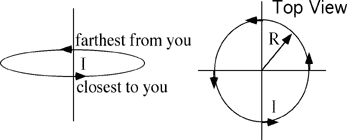
The diagram shows a circular wire loop of radius R carrying current I.
What is the magnitude of the magnetic field, B, at the center of the
loop?

  1. 0
  2. μ0I/4πR
  3. μ0I/2πR
  4. μ0I/4R
  5. μ0I/2R
  6. None of the above.

Commentary:

Answer

(5) This question serves to identify students who do not know how to
apply the Biot-Savart law and/or those who are recalling the field due
to an infinite wire. This provides a good opportunity to discuss why
Ampere’s law is inappropriate for this case.

A2L Item 229

Goal: Hone the right-hand-rule for vector cross products

Source: 283-640 B direction from wire loop

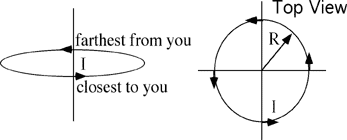
The diagram shows a circular wire loop of radius R carrying current I.
What is the direction of the magnetic field, B, at the center of the
loop?

  1. Left
  2. Right
  3. Up
  4. Down
  5. None of the above

Commentary:

Answer

(3) This is the best response given the choices. The question poses
little difficulty for students who have learned about the magnetic field
of current loops as a magnetic dipole. For these students this question
just confirms their knowledge. For students who are trying to apply the
Biot-Savart law to the loop as a set of current elements the question is
more challenging.

A2L Item 228

Goal: Reason regarding electrodynamics

Source: 283-635 Path of a charge in E&B fields.

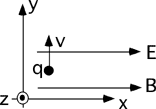
A
charge has an initial velocity parallel to the y-axis in E and B fields.
Both fields point along the x axis. Which of the following statements
regarding the charge’s motion are correct?

  1. The charge will travel along a straight-line path.
  2. The charge’s speed will change as it travels.
  3. The charge will travel in a helical path.
  4. The charge will travel in a helical path of increasing pitch.
  5. The charge will travel in a circle in the x-y plane.
  6. 1 and 2 only
  7. 2 and 4 only
  8. None of the above

Commentary:

Answer

(7) A common response is #4 because they forget that increasing pitch
implies that the speed changes.

A2L Item 227

Goal: Reason regarding electrodynamics

Source: 283-630 Path of a charge in E&B fields.

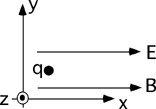
A
charge is released from rest in E and B fields. Both fields point along
the x axis. Which of the following statements regarding the charge’s
motion are correct?

  1. The charge will travel along a straight-line path.
  2. The charge’s speed will change as it travels.
  3. The charge will travel in helical path.
  4. The charge will travel in helical path of increasing pitch.
  5. The charge will travel in a circle in the x-y plane.
  6. 1 and 2 only
  7. 2 and 4 only
  8. None of the above

Commentary:

Answer

(6) The different responses reveal the extent to which students
understand vector cross products and/or read the problem carefully. Some
students choose #8 because they do not like the way the motion is
expressed. They prefer descriptions such as, the charge first moves in a
straight line until it gets some speed then …

A2L Item 225

Goal: Reason about electric circuits

Source: 283-580 100-watt and 40-watt bulbs in series

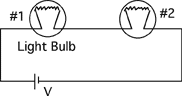
Two light bulbs are connected to a wall outlet as shown below. Bulb #1
is 100W and Bulb #2 is 40W. Which statement is true?

  1. Both bulbs are at their normal brightness.
  2. The 100W bulb is brighter than the 40W bulb.
  3. The 40W bulb is brighter than the 100W bulb.
  4. Both bulbs are at equal brightness.
  5. Cannot determine their relative brightness.

Commentary:

Answer

(3) Since the resistance of the bulbs goes as the reciprocal of its
wattage, students can reason that the most power is dropped in the 40W
bulb. Another way to reason is this. Suppose the potential source was
such that the potential difference over the 40W bulb was 120V, i.e. its
normal operating condition. The potential difference over the 100W bulb
is then 48V, which means that it is operating at (48/120)2 of its normal
condition. The bulb is dissipating about 16W.