Category Archives: High School

Items appropriate for use in a high school physics course.

A2L Item 044

Goal: Hone the concept of normal force.

Source: UMPERG

A small ball is released from rest at position A and rolls down a
vertical circular track under the influence of gravity.
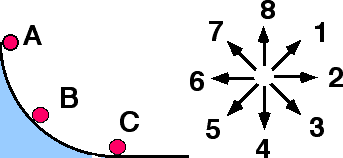
When the ball reaches position B, which of the indicated directions most
nearly corresponds to the direction of the normal force on the ball?

Enter (9) if the direction cannot be determined.

Commentary:

Answer

(1) By definition the normal force is always perpendicular to the
surface at the point of contact, independent of the motion of the object
and the shape of the surface. The direction of the normal force is away
from the surface and toward the object in contact with it.

Background

When the normal force is introduced to students, a flat surface is used
to illustrate the concept. Flat surfaces are also used in the majority
of problems that students solve. This item extends the context so that
students consider the normal force exerted on an accelerated object
moving on a curved surface.

Those who answer (8) may be thinking that the normal force always
opposes the gravitational force, as when an object is resting on a
horizontal surface.

Students who answer (5) may be indicating the direction of the normal
force exerted on the curved track by the ball.

Questions to Reveal Student Reasoning

If a ball were on a flat horizontal surface, what would be the direction
of the normal force? What would be the direction of the normal force if
the ball were rolling across a flat horizontal surface? What would be
the direction of the normal force exerted on a block at rest on an
incline? What would be the direction of the normal force on a ball
rolling down an incline?

What direction(s) are perpendicular to the track at point B?

Suggestions

The direction of the normal force is essentially a matter of definition.
The track exerts a force on the ball. Dividing this force into a
component perpendicular to the surface (called the normal force) and a
component tangential to the surface (called the friction force) is a
choice, which is made because it is useful to do so. Definitions are
difficult to get across to students because there are no demonstrations
one can do to show that the normal force points in a particular
direction. The only thing one can verify is how the definition is
applied by students in a diverse set of contexts.

A2L Item 042

Goal: Reasoning

Source: UMPERG

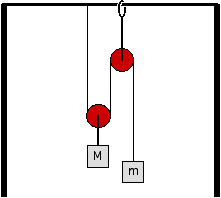
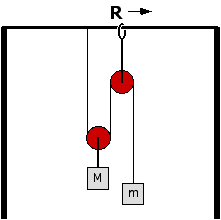
Consider the arrangement of pulleys and masses shown below. The masses
of the pulleys are small. Ignore friction.

This system is initially at rest. What will happen if the ring R is
moved to the right?

  1. Nothing will happen.
  2. Mass M will go up and m will go down.
  3. Mass M will go down and m will go up.
  4. Both masses will go down.
  5. Both masses will go up.
  6. Cannot be determined because what happens depends on the masses.

Commentary:

Answer

(3) If the ring is moved to the right the upward force on M is
decreased,so M will accelerate downward. Initially the tension is Mg/2.
When the strings are at an angle the tension is insufficient to support
M.

Background

Answers are not as important as approach. What did students do to
understand the physical situation? Did they draw pictures? Did they draw
a free-body diagram?

Questions to Reveal Student Reasoning

Does the tension stay the same? …increase? …decrease? After moving
the ring, would I need a smaller or larger mass M to keep the system
from moving?

Suggestions

After students make predictions and discuss their reasoning have
students vote a second time. Then demonstrate what happens.

A2L Item 041

Goal: Reasoning qualitatively.

Source: UMPERG

Consider the arrangement of pulleys and masses shown below. The masses
of the pulleys are small. Ignore friction.

For what relationship of the masses would the masses remain at rest?

  1. m/M > 2
  2. m/M = 2
  3. m/M = 1.5
  4. m/M = 1
  5. m/M = 0.5
  6. m/M = 0.25
  7. m/M < 0.25
  8. none of the above
  9. Cannot be determined

Commentary:

Answer

(5); This problem can be reasoned although it is easy enough to solve algebraically. The problem is useful for demonstrating the value of free body diagrams for reasoning.

A2L Item 039

Goal: Reasoning.

Source: UMPERG-ctqpe28

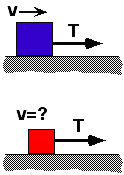
A block is on a horizontal surface. When the block is pulled by a rope under
tension T, the block moves with constant speed. If the same tension were
applied to a smaller block made of the same material and at rest on the
same surface, the block would:

  1. Remain at rest.
  2. Accelerate.
  3. Move with constant speed.
  4. None of the above.
  5. Cannot be determined.

Commentary:

Answer

(5); in the first case, the net force is 0, so T=μkMg. In
the second case, the static friction force must be overcome for m to
move. Since μsk, but m<M, it cannot
be determined if μsmg is smaller or larger than T.

Background

This item requires that students combine knowledge from different
topics: Static Friction, Kinetic Friction, and Newton’s Second Law.
Students have to deduce information (e.g., in the first situation
students must deduce that the kinetic friction force is balanced by the
tension force to give a net force of 0). Students must also know that,
since the static friction coefficient is larger than the kinetic
friction coefficient, the maximum static friction force is larger than
the kinetic friction force. Finally, students must be able to reason
about compensating quantities-in this case, although m goes down, μ
goes up, so the product of m, μ, and g may, or may not, be larger
than T. The relationship between students’ answers and their
assumptions should be the focus of the class discussion, not the
correctness of any particular answer.

Questions to Reveal Student Reasoning

Why does the block of mass M move with constant speed? If the block of
mass M were at rest would the tension force cause it to move?

What quantities affect the size of the friction force?

What determines whether the block of mass m will move?

Suggestions

Ask students to consider the limiting case where m is less than, but
almost equal to M. What would happen if m were pulled with tension T.
Students should be able to reason (perhaps with some coaching) that m
will remain stationary since the maximum static friction force is larger
than T.

Then ask them to consider the limiting case where m is much less than M.
What would happen if m were pulled with tension T. Students should be
able to reason that m will accelerate.

Finally, ask what happens “in between” these two limiting cases.

A2L Item 040

Goal: Understanding action-reaction forces.

Source: UMPERG

A hammer strikes a nail driving it into a piece of wood. Which statement
below is true about the forces exerted during the impact?

  1. The nail exerts a larger force on the wood than the wood does on the
    nail.
  2. The wood exerts a larger force on the nail than the nail does on the
    wood.
  3. The force that they exert on each other is the same size.
  4. One of the two forces is larger, but which is larger can’t be determined
    unless more information is provided.
  5. None of the above.
  6. Cannot be determined.

Commentary:

Answer

(3) The forces are the same size (according to Newton’s third law).

Background

Students’ natural inclination in situations like this is that a moving
object is a more active agent and therefore exerts a larger force, while
a stationary object is the more passive agent and exerts a smaller
force. Students also look at effects: the object that has the largest
change in motion has experienced the largest force.

Questions to Reveal Student Reasoning

How can you determine which object experiences the larger force? What
are some of the clues? Do we have any way to relate the effects we
observe to the size of the forces each object experiences?

Suggestions

Newton’s third law, while easily memorized as a principle, is hard to
develop as an intuition and to employ in reasoning about situations.
There is no single experience that can help. One needs to revisit the
third law often in many different contexts.

There are many situations one can use with students. Try a moving block
with a spring colliding with a wall (or another block that is
stationary). In this situation one can use the spring law to help
relate the forces.

A2L Item 038

Goal: Reason qualitatively. Consider alternate solution paths.

Source: UMPERG

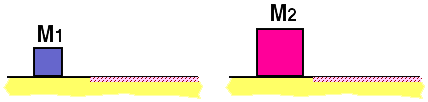
Two blocks, M2 > M1, having the same speed move
from a frictionless surface onto a surface having friction coefficient
μk as shown below.

Which block stops in the shorter time?

  1. M1
  2. M2
  3. Both blocks stop in the same time.

Commentary:

Answer

(3); both blocks have the same acceleration and the same initial
velocity, so they must stop in the same length of time.

Background

This problem can be reasoned through without the use of equations.
However, the problem can be solved easy enough algebraically. The item
provides an opportunity for students to reflect on different approaches
for solving problems.

Questions to Reveal Student Reasoning

Which block experiences the largest net force?

Which block experiences the largest acceleration?

What determines which block stops first?

Suggestions

Ask students to consider the following questions, and to determine if
their answer to the problem is inconsistent with their answers to these
questions:

If two blocks enter the rough region side by side and have the same
mass, which one will stop first?

If the blocks are connected by a rope, will the time it takes for the
blocks to stop change? Would the time it takes to stop change if the
blocks were glued together?

A2L Item 037

Goal: Translate a verbal description of physical motion to graph of force.

Source: UMPERG

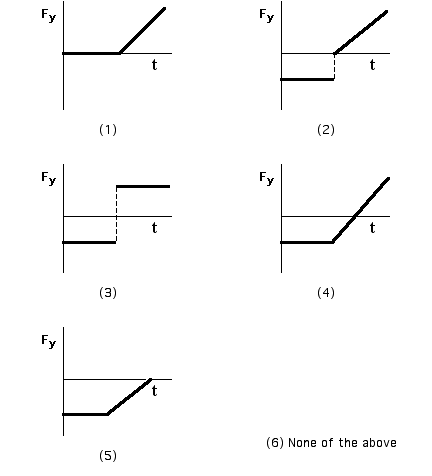
A block is dropped onto a vertical spring. Which net force vs. time
graph best represents the net force on the block as a function of time?
Consider only the motion of the block from the time it is dropped until
it first comes to rest.


Commentary:

Answer

(4); Some students may select (5) confusing the equilibrium point with the point where the block comes to rest. Students selecting (2) are ignoring gravity after the block hits the spring.

A2L Item 035

Goal: Interpreting strobe diagrams in conjunction with verbal information.

Source: UMPERG

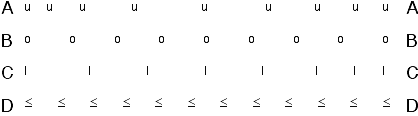
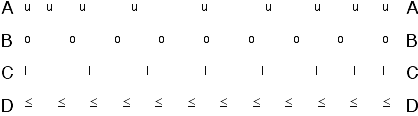
Below is shown a strobe diagram indicating the position of four objects
at successive time intervals. The objects move from left to right.

Each of the objects shown experiences a constant friction force as they
slide across the floor. Which of the objects definitely experiences a
force in addition to sliding friction?

  1. Object A only
  2. Object B only
  3. Object C only
  4. Object D only
  5. Objects A and B
  6. Objects B and C
  7. Objects A and C
  8. None of the above
  9. Cannot be determined

Commentary:

Answers

(8); Object (C) slows down and this could be due to a sliding friction force acting to the left. Given that there is a friction force, the objects moving with constant velocity (B and D) must have an additional force. Likewise (A), which accelerates duting the first part of its motion, must have an additional force to the right.

A2L Item 036

Goal: Translate between representations of motion

Source: UMPERG

The strobe diagram below shows the position of an object at successive
equal time intervals. The object moves from left to right.

Consider the following situations:

A. A book slides down an incline, moving from a rough region onto a
smooth region.

B. A cart is connected to a compressed spring and released.

C. A ball is dropped, hits the ground and rebounds to its initial
position.

D. A runner runs a race.

Which of these situations could be roughly described by the strobe
diagram?

  1. A
  2. B
  3. C
  4. D
  5. A & B
  6. C & D
  7. B & D
  8. A, B, C & D
  9. None of the above

Commentary:

Answer

(2),(4) or (7); Depending upon assumptions (B) or (D) are possible. The cart leaving the spring would speed up then eventually slow down due to friction. Also, the runner will speed up and eventually slow down.

A2L Item 034

Goal: Comparing the relative size of forces from changes in position.

Source: UMPERG

Below is shown a strobe diagram indicating the position of four objects
at successive time intervals. The objects move from left to right.

During the intervals shown, which of the objects experiences the largest
net force?

  1. Object A only
  2. Object B only
  3. Object C only
  4. Object D only
  5. Objects A and B
  6. Objects B and C
  7. Objects A and C
  8. None of the above
  9. Cannot be determined

Commentary:

Answer

(9); It is not possible to determine the size of the net forces without
knowledge of the masses of the objects. Because the horizontal force in
(A) points initially to the left, then to the right, students may say
that the net force is zero, which is true only for a time average.