Category Archives: High School

Items appropriate for use in a high school physics course.

A2L Item 033

Goal: Perceiving the presence of forces from changes in position.

Source: UMPERG

Below is shown a strobe diagram indicating the position of four objects
at successive time intervals. The objects move from left to right.
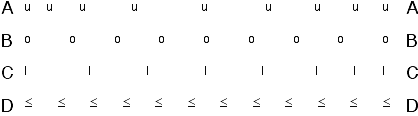
During the intervals shown, which of the objects experience no net force
in the horizontal direction?

  1. Object A only
  2. Object B only
  3. Object C only
  4. Object D only
  5. Objects A and B
  6. Objects B and C
  7. Objects A and C
  8. None of the above
  9. Cannot be determined

Commentary:

Answer

(8); Objects with no net horizontal force will move with constant velocity. The objects moving with constant velocity are B and D. This question helps to reinforce the idea that it is change in motion, not motion itself, that requires a force.

A2L Item 032

Goal: Hone the vector nature of force and how the net force can be determined from the 2nd law.

Source: UMPERG

A soccer ball rolls across the road and down a hill as shown below.

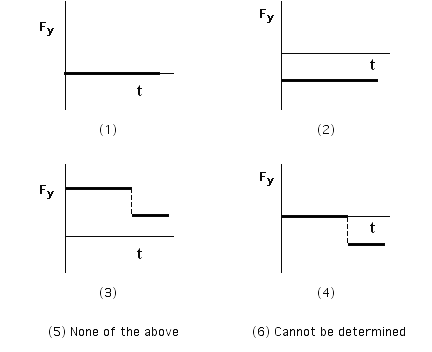
Which of the following sketches of Fy vs. t represents the net vertical
force on the ball as a function of time?


Commentary:

Answer

(4); on the horizontal partion there is no net force, and therefore no Fy. On the slope the net force in the y direction is due to gravity and a component of the normal force. Alternatively, since the ball accelerates along the slope, the net force must be parallel to the slope and have a component in the vertical direction.

A2L Item 030

Goal: Reasoning with 2nd law and honing of the concept of tension.

Source: UMPERG

Consider the three cases presented below. Assume the friction force
between the table and block in situations (B) and (C) can be ignored.

Which of the following statements about the tensions in the strings is
true?

  1. TA = TB = TC
  2. TB = TC < TA
  3. TA < TB < TC
  4. TB < TC < TA
  5. TA = TC < TB
  6. None of the above
  7. The relationship of the tensions cannot be determined

Commentary:

Answer

(4) By applying Newton’s second law to the hanging block one obtains a
relationship between the tension in the string and the acceleration of
the hanging block: The larger the acceleration the smaller the tension
force. The acceleration is determined by the total mass of the system.

Background

This is a good problem for challenging students to reason without
resorting to writing down a lot of equations. As one of the procedure
forces (tension, normal, static friction), the value of tension requires
application of the 2nd law.

Questions to Reveal Student Reasoning

What is the tension in situation (A)? Explain. Is the tension equal to
the weight in situation (B)? (If some students think so explore what
the net force is on the hanging mass, which will lead to a net force of
O, and a contradiction since this implies O acceleration.) Of systems
(A) and (B), which has the larger acceleration?

Suggestions

Ask students to consider limiting cases. What if the string was not
attached to a block on the table (or if the block had almost no mass)?
What would happen if the block on the table had a very large mass ?

A2L Item 031

Goal: Hone the vector nature of force and interrelate model and procedure forces.

Source: UMPERG

A marble rolls on to a piece of felt and slows down.

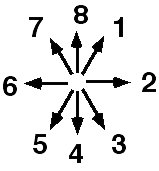
Indicate the direction that most nearly corresponds to the direction of
the force that the marble exerts on the felt. If none of the directions
are appropriate, or if the answer cannot be determined, respond (9).


Commentary:

Answer

(3) The force the felt exerts on the marble is up (normal force) and to
the left (friction force). Newton’s third law tells us that the force
the marble exerts on the felt must be down and to the right. Students
may focus on the normal force alone (4) or the friction force alone (2).
These are not two forces, but the components of a single force.
Students also find it difficult to extract some information from the
dynamical statement “slows down” and integrate this with the familiar
normal force.

Background

This presents an interesting twist to students. The friction force is
usually formulated in terms of a moving object and a fixed surface.
Students may not know for sure whether there is a friction force on the
felt – the felt is not moving. The analysis on the marble is reasonably
straightforward. Newton’s third law can be used to determine the force
on the felt if the force cannot be determined from the situation
directly.

Questions to Reveal Student Reasoning

Question students about how they got their answer. Did they use the
force laws that they learned previously? Did they use Newton’s second
or third laws?

Suggestions

Instead of a marble consider a sliding block and see if students think
differently – some students will have difficulty thinking about friction
with a rolling object.

A2L Item 029

Goal: Analyze the role of internal and external forces and the difference between static and kinetic friction.

Source: UMPERG

A person sits in an office chair with small wheels that swivel. The
person claims she can move the chair across the room without touching
anything but the chair, simply by kicking her legs outward. This claim:

  1. Is consistent with Newton’s laws and can be done.

  2. Is consistent with Newton’s laws but cannot be done.

  3. Is not consistent with Newton’s laws and, therefore, cannot be done.

  4. Is not consistent with Newton’s laws but nevertheless can be done.

  5. It is not possible to determine the correctness of the claim.


Commentary:

Answer

(1); the process is possible because sudden impulse due to internal
forces can exceed the static friction limit. By rapidly extending legs,
alternated by slow retraction, the chair can be moved. Students are
often aware of this but find it difficult to explain in terms of forces
and dynamics.

A2L Item 028

Goal: Reasoning using the 2nd law.

Source: UMPERG

A tow truck (2,000kg) pushing a car (1000kg) experiences an average
friction force of 13,000N while accelerating from rest to a final
velocity of 36 mi/hr (16 m/s). The air and the road exert an average
resistive force of 1,000N on the car. What force does the car exert on
the tow truck?

  1. 1,000N
  2. 2,000N
  3. 4,000N
  4. 5,000N
  5. 6,000N
  6. 12,000N
  7. 14,000N
  8. None of the above
  9. Cannot be determined

Commentary:

Answer

(4) The net force on the car and tow truck is 12,000N (13,000N –
1,000N). The acceleration is 4m/s2. The magnitude of the force between
the two vehicles is 5,000N.

Background

Answers are not as important as approach. What did students do to
understand the physical situation? Did they draw pictures. Did they
draw a free-body diagram.

Questions to Reveal Student Reasoning

Ask a couple of students to describe how they approached the problem.
Ask them to describe the steps they took without getting into
mathematical details. For example, did they draw a free-body diagram?
What forces did they consider? What system did they analyze?

Suggestions

After a couple of descriptions of how to approach solving the problem,
work through the problem with help from the class.

A2L Item 026

Goal: Reasoning with 2nd law.

Source: UMPERG

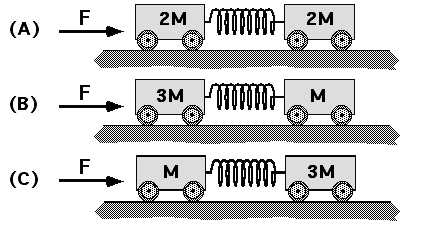
Consider the three situations shown below. In each case two small carts
are connected by a spring. A constant force F is applied to the
leftmost cart in each case. In each situation the springs are
compressed so that the distance between the two carts never changes.

Which of the following statements must be true regarding the compression
of the spring in each case? Assume the springs are identical.

  1. Compression A = Compression B = Compression C
  2. B = C < A
  3. A < B = C
  4. A < B < C
  5. B < A < C
  6. C < A < B
  7. A < C < B
  8. None of the above
  9. Cannot be determined

Commentary:

Answer

(5) The total mass is the same so the acceleration of the systems must
be the same. In each case the spring exerts the only horizontal force
on the cart to the right. The spring force must be largest for the 3M
cart and smallest for the M cart: B < A < C.

Background

This item requires students to reason. It is difficult to resort to
equation manipulation to answer this question. One difficulty with the
problem is that it involves a complex system (two carts connected by a
spring).

Questions to Reveal Student Reasoning

Is it really possible to compress the carts so that they stay a fixed
distance apart? What forces act on each cart? Will the carts
accelerate or move with a constant velocity? Compare the carts
acceleration.

Suggestions

Draw a free-body diagram for each cart.

Define a new problem in terms of the carts on the right: Each cart is
given an applied force so that each has the same acceleration. How do
the applied forces compare?

A2L Item 027

Goal: Contrast internal, external forces and net force.

Source: UMPERG

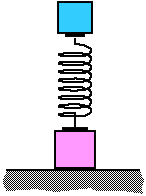
A toy
is made from two blocks and a spring as shown at right. When the spring
is compressed and suddenly released, the toy will jump off the table
surface. Which of the following is true about the net force on the toy
just after it is released?

  1. The net force is zero.
  2. The net force points up.
  3. The net force points down.
  4. The direction of the net force cannot be determined.

Commentary:

Answer

(2); This question seems difficult but it is available
to beginning students. Students can analyze the problem considering the
entire toy as a single system or decompose into the separate masses.
Viewed as a single system, since the center of mass accelerates up, the
net force must point up. Free body diagrams for each mass individually
would show no net force on the bottom mass (because the normal force
assumes a value necessary to balance gravity and spring force) and a
large net force on the upper mass (spring force exceeds gravity). If
sketched to scale, the two can be added showing that the net force
derives from the normal force on the lower block.

Background

This question is intended to have students distinguish between internal
and external forces. The question also can be approached in a variety
of ways.

Questions to Reveal Student Reasoning

Can the toy ever leave the surface? Would there be a net force if it
did leave the surface?

A2L Item 025

Goal: Relate position/time graphs to force.

Source: UMPERG

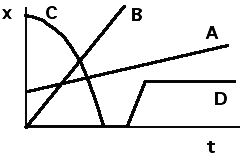
Position vs. time graphs are given below for four different objects.

Which of the objects experiences a net force sometime during the time
period shown?

  1. Only object A
  2. Only object B
  3. Only object C
  4. Only object D
  5. Objects B and D
  6. Objects A and C
  7. Objects B and C
  8. None of the above
  9. Cannot be determined

Commentary:

Answer

(8) is the appropriate response because both C and D experience a force
during the time interval. A and B have constant velocity because the
slope of their x vs. t plot is constant. Some students may not realize
that D experiences a force because they will reason that D has constant
velocity at any given time. However, D must experience a force to
change its velocity.

Background

Recognizing the signature of acceleration from a plot of position vs.
time is an important skill for students to develop. Because of
familiarity, they may recognize the plot of position for a falling body
and reason that the object experiences a gravitational force. This
question requires two logical steps. First recognizing the consequence
of constant velocity and second recognizing that a change of velocity
indicates acceleration and therefore force.

Questions to Reveal Student Reasoning

Which objects have constant velocity throughout the time interval?

Which of the objects has the largest speed sometime during the time
interval?

Are all of the objects moving away from the origin?

Suggestions

Have students plot the velocity of each object over the same time
interval.

Have students move objects in a manner in accord with the plots. This
may cause them to realize when a force must be applied.

A2L Item 024

Goal: Reason and evaluate statements about a real-world situation.

Source: UMPERG

At the scene of an accident the car causing the crash left skid marks of
a length D. The accident reconstruction team did a test and found that a
police cruiser traveling at the speed limit produces skid marks of
length d < D. Which of the following statements is valid?

  1. Since D > d the car must have been traveling over the speed limit.
  2. One cannot conclude that the car was speeding because the test failed
    to take reaction time into account.
  3. One cannot conclude that the car was speeding because the test failed
    to take the mass of the car into account.
  4. One cannot conclude that the car was speeding because the test failed
    to take into account possible differences in the coefficient of friction
    for different tires.
  5. Two of the above statements are valid.
  6. None of the above statements is valid.
  7. It cannot be determined if any of the statements is valid.

Commentary:

Answer

(4) is valid assuming that the usual kinetic friction model is
applicable. Some students may think that (3) is valid and indicate (3)
or (5). All of the others are definitely invalid. Since (1) is
invalid, (7) is also invalid.

Background

This question seeks to encourage students to reason and analyze the
situation. It offers the opportunity to engage the students in a
discussion of the meaning of validity as well as the physics underlying
the various assertions.

Questions to Reveal Student Reasoning

How would reaction time influence the skid marks?

Suppose the car had several people inside. Would that have affected the
skid marks?

Suppose the test had been made with the same model car as the one in the
accident. Would that make the test more valid?

Suggestions

Allow students to form small groups according to their views and let
them present their arguments to the class. Have student ‘consultants’
suggest appropriate tests to determine if the car was speeding.