Category Archives: High School

Items appropriate for use in a high school physics course.

A2L Item 229

Goal: Hone the right-hand-rule for vector cross products

Source: 283-640 B direction from wire loop

The diagram shows a circular wire loop of radius R carrying current I.
What is the direction of the magnetic field, B, at the center of the
loop?
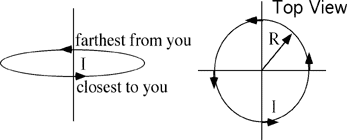
  1. Left
  2. Right
  3. Up
  4. Down
  5. None of the above

Commentary:

Answer

(3) This is the best response given the choices. The question poses
little difficulty for students who have learned about the magnetic field
of current loops as a magnetic dipole. For these students this question
just confirms their knowledge. For students who are trying to apply the
Biot-Savart law to the loop as a set of current elements the question is
more challenging.

A2L Item 225

Goal: Reason about electric circuits

Source: 283-580 100-watt and 40-watt bulbs in series

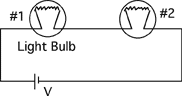
Two light bulbs are connected to a wall outlet as shown below. Bulb #1
is 100W and Bulb #2 is 40W. Which statement is true?

  1. Both bulbs are at their normal brightness.
  2. The 100W bulb is brighter than the 40W bulb.
  3. The 40W bulb is brighter than the 100W bulb.
  4. Both bulbs are at equal brightness.
  5. Cannot determine their relative brightness.

Commentary:

Answer

(3) Since the resistance of the bulbs goes as the reciprocal of its
wattage, students can reason that the most power is dropped in the 40W
bulb. Another way to reason is this. Suppose the potential source was
such that the potential difference over the 40W bulb was 120V, i.e. its
normal operating condition. The potential difference over the 100W bulb
is then 48V, which means that it is operating at (48/120)2 of its normal
condition. The bulb is dissipating about 16W.

A2L Item 224

Goal: Hone understanding of series circuits.

Source: 283-575 Two bulbs in series

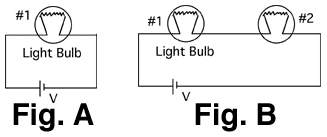
A light bulb is connected to a battery as shown in Figure A below. When
a second bulb is connected as shown in Figure B, what happens to the
brightness of the original bulb?

  1. Increases
  2. Decreases
  3. Stays the same
  4. Bulb goes out
  5. Can’t determine

Commentary:

Answer

(2) Depending upon the bulbs and battery, the bulbs could appear to go
out.

A2L Item 223

Goal: Hone understanding of parallel circuits.

Source: 283-570 lights in parallel

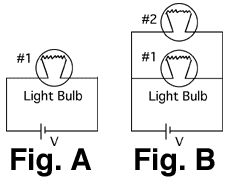
A light bulb is connected to a battery as shown in Figure A below. When
a second bulb is connected as shown in Figure B, what happens to the
brightness of the original bulb?

  1. Increases
  2. Decreases
  3. Stays the same
  4. Bulb goes out
  5. Can’t determine

Commentary:

Answer

(3) If the battery cannot sustain the potential difference the bulb will
dim somewhat. This can confuse students so any demonstration should not
use a marginal battery.

A2L Item 221

Goal: Reason regarding circuits

Source: 283-560 Circuit voltages

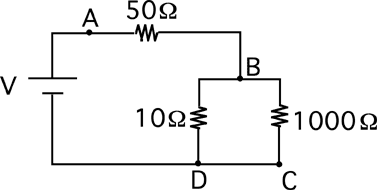
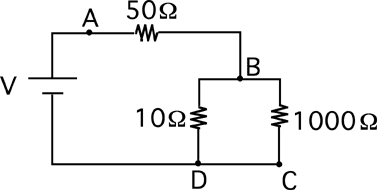
Consider the circuit below. How does the voltage difference between
points A and C compare to the voltage difference between points A and D?

  1. VAC < VAD

  2. VAC = VAD

  3. VAC > VAD

  4. Cannot be determined


Commentary:

Answer

(2) It is interesting to find out how many students recognized that the
comparison did not require the use of Ohm’s law. To gauge student
understanding it is interesting to ask questions such as; does any
current flow in the wire between C and D? If C and D are at the same
potential, why does any current flow?

A2L Item 222

Goal: Reasoning regarding circuits

Source: 283-565 circuit currents

Consider the circuit below. Which statement(s) is correct?

  1. IAB = IBD +
    IBC
  2. IBC < IBD
  3. IBC > IBD
  1. 1 only
  2. 2 only
  3. 3 only
  4. 1 and 2
  5. 1 and 3

Commentary:

Answer

(4) Students should be encouraged to reason about the currents and not
calculate the value of the currents in circuits. Interestingly, if a
problem similar to this is given with the potential specified as a
number, many students will immediately calculate the currents.

A2L Item 216

Goal: Hone the relationship between E and V

Source: 283-475 Must V=0 if E=0?

True or false: it is possible to have the electric field be 0 at some
point in space and the electric potential be non-zero at that same
point.

  1. True
  2. False

Commentary:

Answer

(1) Whichever answer students give, ask them to draw a charge
configuration which satisfies their answer. Often this is sufficient to
cause them to change their mind. If appropriate raise for discussion the
case of the interior of a uniformly charged spherical shell.

A2L Item 212

Goal: Reason with electric fields

Source: 283-370 E due to circular rods

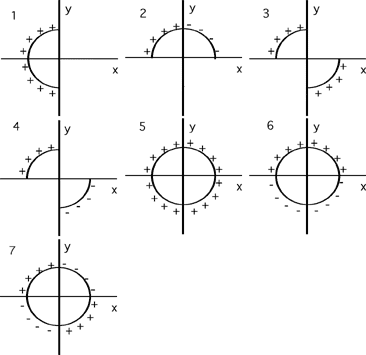
All of the curved charged rods shown in the image below have the same
radius and linear charge density (though some are positively charged and
others are negatively charged). For which configuration would the
magnitude of E at the origin be greatest?


Commentary:

Answer

(6) This problem constitutes a good exercise for students learning the
vector nature of the electric field. There are many good followup
questions, such as; Which configurations have zero field at the origin?,
Order the configurations by increasing magnitude of electric field at
the origin. Stress the value of symmetry for reasoning to the answer. A
negative distribution in a quadrant is equivalent to a positive
distribution in the opposite quadrant, which means that distributions #5
and #7 are equivalent (for purposes of finding the E field at the
origin).

A2L Item 211

Goal: Problem solving with rotational kinematics

Source: CT151.2S02-39

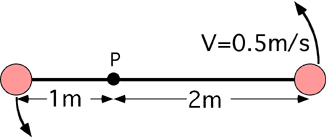
Two masses, attached to the ends of a rigid massless rod, are rotating
about pivot P as shown in the picture below. The mass two meters from P
has speed 0.5m/s. What is the acceleration of the mass one meter from
P?

  1. 0.05 m/s2
  2. 0.0625 m/s2
  3. 0.125 m/s2
  4. 0.250 m/s2
  5. 0.5 m/s2
  6. 1 m/s2
  7. None of the above
  8. Cannot be determined

Commentary:

Answer

(2) Every one of the possible wrong responses indicates a common error
that students make. After the problem has been discussed it is useful to
have students find the acceleration of the mass at 2m and see that the
accelerations are in the same ratio as the velocities. Drawing vector
diagrams showing the Δv for each mass is useful for explaining this
relationship.

A2L Item 208

Goal: Hone the concept of electric field

Source: 283-340 Where is E zero near a dipole? 9/21

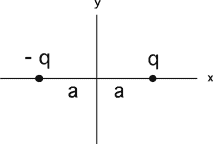
Where,
other than at infinity, is the electric field 0 in the vicinity of the
dipole shown?

  1. Along the y-axis.
  2. At the origin.
  3. At two points, one to the right of (a, 0), the other to the left of (-a,
    0).
  4. At two points on the y-axis, one below the origin, one above the origin.
  5. None of the above.

Commentary:

Answer

(5) Students have a lot of difficulty distinguishing electric field from
potential. Students already exposed to the concept of potential
frequently respond that the field is zero along the y-axis. If there are
many confused students, before identifying the correct response, it
helps to have the students draw the field lines.