Category Archives: High School

Items appropriate for use in a high school physics course.

A2L Item 204

Goal: Hone the concept of a conductor

Source: 283-225, Charge induced in a neutral conductor

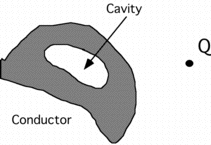
A positive charge +Q is placed outside a neutral conductor. Inside the
conductor is a cavity containing no charge. What is the net charge on
the surface bounding the cavity?
  1. A positive charge +Q
  2. A positive charge +q < +Q
  3. Zero charge
  4. A negative charge |-q| < |+Q|
  5. A negative charge -Q
  6. Cannot determine the charge.

Commentary:

Answer

(3) Students have difficulty envisioning induced charge distributions,
especially when the conductor has an irregular shape.

A2L Item 202

Goal: Reason regarding electric fields

Source: 283-11, E at origin due to charged rods

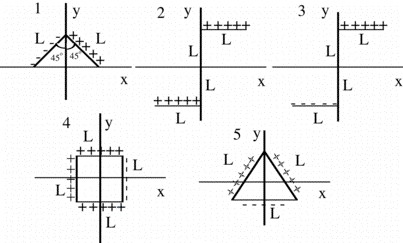
For which of the configuration(s) below does the total electric field
vector at the origin have non-zero components in both the x and y
directions?

  1. 2 only
  2. 1 and 3 only
  3. 5 only
  4. 4 only
  5. 1 and 5 only
  6. None of the above

Commentary:

Answer

(6) Only situation 3 meets the condition. A good exercise is to have
students draw the contribution to the field at the origin due to each
rod. The contributions should have the correct relative size and
direction.

A2L Item 203

Goal: Reason regarding electric fields

Source: 283 –

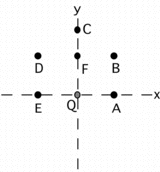
Charge, Q, is at the origin. Points A-E are positions where other
charges may be present. Etotal at point F is non-zero and
points in the +i direction. Which of the following situations
could account for this?

  1. Another charge is present at position
    A.
  2. Two other charges are present at C & D.
  3. Two other
    charges are present at D & B.
  4. Two other charges are present at
    E & A.
  1. A only
  2. B only
  3. C only
  4. D only
  5. A and B
  6. A, C and D
  7. A, B, and D
  8. A, B, C, and D

Commentary:

Answer

(2) Only a charge at C can counter the y component of the field of Q at
F. A charge at B or D can then create a field at F that points in the i
direction.

A2L Item 201

Goal: Reason regarding electric fields

Source: 283-10, E at origin due to charged rods

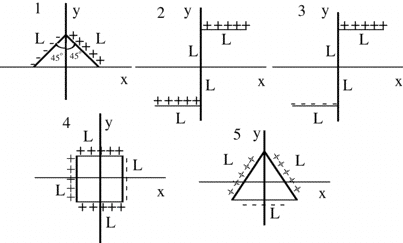
All of the configurations shown below consist of charged rods of the
same length L. The magnitude of the total charge is also the same for
each rod. The total charge in each rod is distributed uniformly.

For which
configuration(s) is the electric field vector at the origin in the
positive x direction?

  1. 2 only
  2. 1 and 3 only
  3. 5 only
  4. 4 only
  5. 1 and 5 only
  6. None of the above

Commentary:

Answer

(4) Because they are given lots of examples involving point charges,
spheres and rings, students often miss the fact that there are many
situations for which the direction of the field can be deduced even
though determining the value or formal expression for the field is way
beyond them.

A2L Item 199

Goal: Hone the concept of electric field

Source: UMPERG-283-365

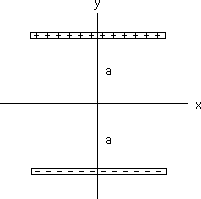
Two
uniformly charged rods are positioned horizontally as shown. The top
rod is positively charged and the bottom rod is negatively charged. The
total electric field at the origin

  1. is 0
  2. has both an x, and a y component
  3. points totally in the i direction
  4. points totally in the -i direction
  5. points totally in the j direction
  6. points totally in the -j direction

Commentary:

Answer

(6) By symmetry the field must point along the y-axis. Students
who do not understand that the field points away from positive charges
and towards negative charges would select #1 thinking that the fields
cancel.

A2L Item 183

Goal: Reason with impulse and energy

Source: CT151.2S02-46

Two
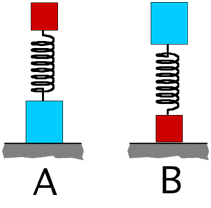
blocks are connected to the ends of a spring as shown. Assume that the
mass is proportional to the size of the block. The spring is compressed
(same amount) and released suddenly. In which orientation will the
system achieve the largest height?

  1. A
  2. B
  3. both go to the same height
  4. cannot be determined

Commentary:

Answer

(2) This is a very rich problem for reasoning. It IS possible for
students to reason to the correct solution if they consider appropriate
concepts. To help them along suggest the following: Draw free body
diagrams for each of the masses separately. Combine them to get a valid
free body diagram for the system. Such a process reveals that the normal
force is responsible for the impulse causing the system to jump. The
spring force is internal to the system and does not appear on the
system’s free body diagram.

Students can deduce the answer using analogy or experience. Pogo sticks
or even the human body are analogous systems.

A2L Item 182

Goal: Distinguish between mass, gravitational force and weight.

Source: CT151.2S02-21

An astronaut floats inside an orbiting spacestation. Which of the
following are true?

  1. No forces act on the astronaut.
  2. The astronaut has no mass.
  3. The astronaut has no
    weight.
  1. A only
  2. B only
  3. C only
  4. A and B
  5. A and C
  6. B and C
  7. all are true
  8. none are true

Commentary:

Answer

The only possible answers are #3 and #8. The issue turns on the
definition of weight. At the surface of the earth weight and the
gravitational force are often considered equivalent. Further, since the
gravitational force depends upon the mass, mass and weight are
proportional and mass units are sometimes used as a measure of weight.
In orbit bodies still experience a gravitational force but are said to
have no weight. Is it any wonder that students are confused? Invoking
scale readings as weight is not a solution either as one’s weight would
change in an elevator. The best solution to this is to sensitize
students to these issues and charge them with the responsibilty of
determining how to interpret these quantities in context.

A2L Item 179

Goal: Recognizing the properties of magnetic fields

Source: 283 – field of wire

Oersted discovered that there is a magnetic field in the space
around wires carrying currents. Consider a long thin straight wire with
a current I. Which of the following statements about the magnetic field
lines is true?

  1. Field lines are parallel to the
    wire.
  2. Field lines are perpendicular to the wire.
  3. Field
    lines are directed radially away from the wire.
  4. Field lines are
    circles centered on any point on the wire.
  1. A only
  2. B only
  3. C only
  4. D only
  5. A and C only
  6. B and D only
  7. B and C only
  8. None of them is true.

Commentary:

Answer

(6) It is important to elicit reasons that students selected any
of the other responses. Rather than telling the correct answer have
students draw the field lines. Often they are able to reproduce pictures
they have seen but cannot describe the fields in words.

A2L Item 180

Goal: Reason about magnetic fields

Source: 283 field of bar magnets

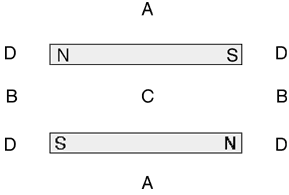
Two
identical bar magnets are placed rigidly and parallel to each other as
shown. At what locations, if any, is the net magnetic field close to
zero?

  1. A only
  2. B only
  3. C only
  4. D only
  5. A and B
  6. A, B, and C
  7. C and D
  8. None of the above.

Commentary:

Answer

(3) C is the point of weakest field. The field is weak at A also.
Find out student reasons is more important than the answer. Have
students sketch the field lines. Ask them how is the strength of the
field indicated on a field line diagram.

A2L Item 168

Goal: Interpreting graphs

Source: CT151.2-5

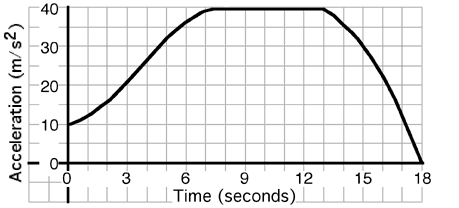
An
object’s motion is described by the graph above. The average
acceleration during the first 10 s is most nearly…

  1. 0 m/s2
  2. 20 m/s2
  3. 30 m/s2
  4. 40 m/s2
  5. 50 m/s2
  6. Other

Commentary:

Answer

(3) Students may have difficulty understanding what they are
asked. Recasting the problem in terms of areas helps. The only
contenders should be #2 or #3. Counting blocks should make it clear that
the result is much closer to #3.