Goal: Reasoning with energy
Source: UMPERG-ctqpe64
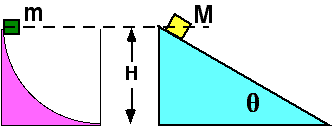
Two
masses, M > m, travel down the surfaces shown. Both surfaces are
frictionless. Which mass has the largest speed at the bottom?
- m
- M
- Both have the same speed
- Cannot be determined
Goal: Reasoning with energy
Source: UMPERG-ctqpe64
Two
masses, M > m, travel down the surfaces shown. Both surfaces are
frictionless. Which mass has the largest speed at the bottom?
Goal: Reasoning with energy
Source: UMPERG-ctqpe62
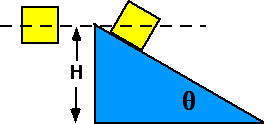
Two
identical blocks fall a distance H. One falls directly down, the other
slides down a frictionless incline. Which has the largest speed at the
bottom?
(3) The only force doing work is gravity and both block undergo
the same vertical displacement.
Goal: Reasoning with dynamics
Source: UMPERG-ctqpe43
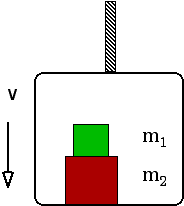
Block
m1 sits on block m2 and both sit on the floor of
an elevator at rest. When the elevator starts to move down, the normal
force on the upper block will …
(3) As it starts the elevator must accelerate downward and so
will the upper block. The only forces on the block are gravity and the
normal force. The normal force must diminish so gravity can provide the
downward acceleration.
Students answering #2 may have interpreted the question to mean ‘as the
elevator moves’ and think that the elevator moves with constant velocity.
Goal: Reasoning with dynamics
Source: UMPERG-ctqpe30
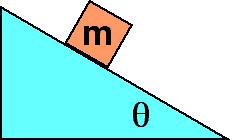
A
block of mass m, when placed on a rough inclined plane and moved, moves
down the plane with constant speed. If a block of mass 2m were placed
on the same incline and moved, it would …
The block will have the same motion. Both the gravitational force
and the friction force scale with the mass so there is no net force in
either case.
Goal: Hone the concept of static friction
Source: UMPERG-ctqpe29
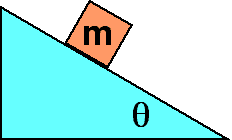
A block of mass m sits at rest on a
rough incline of angle θ. The coefficient of static friction is
μ.
The friction force on the block is
(2) this is all that is needed to hold the block at rest. Some
students will give #4 as the answer having specified the maximum static
friction force.
It helps to classify forces as model forces obtainable from a formula,
and procedure forces. Static friction is an example of a procedure
force, one that cannot be determined without application of the 2nd law.
Goal: Hone the concept of static friction
Source: UMPERG-ctqpe27
A mass of 5 kg sits at rest on an incline making an angle of 30° to
the horizontal.
If μs = 0.7 the friction force on the block is
(2) this is all that is needed to hold the block at rest. Some
students will give #4 as the answer having calculated the maximum static
friction force.
It helps to classify forces as model forces obtainable from a formula,
and procedure forces. Static friction is an example of a procedure
force, one that cannot be determined without application of the 2nd law.
Goal: Problem solving
Source: UMPERG-ctqpe23
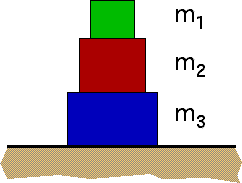
If m2 = 2m1 , m3 = 3m1 and
the force that the surface exerts on the bottom block is 120N, the mass
of the large block is
Use g = 10 N/kg.
(3) the most common other answers are #1 and #6, each of which
represents a typical mistake students make. This problem presents a good
opportunity to encourage students to check their answer.
Goal: Problem solving with dynamics
Source: UMPERG-ctqpe21
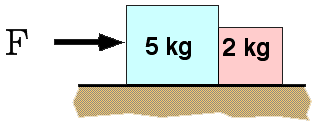
Two blocks rest on a frictionless surface. Both blocks move to the right
with acceleration of 2 m/s2. The force on the big block due
to the small block is
(7) The force on the small block must cause the specified acceleration.
The 3rd law requires that the force on the big block be equal and
opposite. The magnitude is 4N but it is directed to the left.
Goal: Reasoning with electric fields.
Source: UMPERG-A2LEM7
The diagrams show two uniformly charged spheres. The charge on the
right sphere is three times as large as the charge on the left sphere.
Each vector represents the electric field at the center of one sphere
caused by the other sphere. Which choice best represents the
magnitude and direction of the electric field vectors caused by one
sphere at the position of the other sphere?
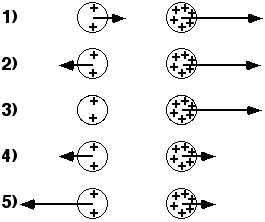
(5) The electric field at the sphere with smaller charge is three times
larger than the field at the sphere with larger charge.
Goal: Reasoning with Coulomb’s law
Source: UMPERG-A2LEM6
The diagrams show two uniformly charged spheres. The charge on the
right sphere is three times as large as the charge on the left sphere.
The arrows on each charge represent the force on the charge. Which
force diagram best represents the magnitude and direction of the
electric forces on the two spheres?
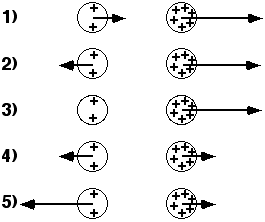
(4) By Newton’s third law the forces are equal and opposite.
Commentary:
Answer
(3) By energy considerations, both would have the same speed.
Students frequently get confused about the mass, thinking that the
larger mass has the greatest potential energy change and therefore has
the greatest speed.