Category Archives: High School

Items appropriate for use in a high school physics course.

A2L Item 101

Goal: Reason with rotational dynamics.

Source: UMPERG-ctqpe136
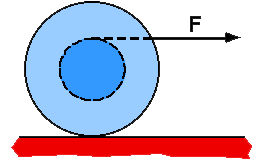
A spool has string wrapped around its center axle and is sitting on a
horizontal surface. If the string is pulled in the horizontal direction
when tangent to the top of the axle, the spool will

  1. roll to the right.
  2. not roll, only slip.
  3. roll to the left.
  4. cannot be determined.

Commentary:

Answer

(1) For many students this remains counterintuitive.

A2L Item 102

Goal: Reason with rotational dynamics.

Source: UMPERG-ctqpe137

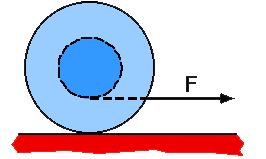
A spool has string wrapped around its center axle and is sitting on a
horizontal surface. If the string is pulled in the horizontal direction
when tangent to the bottom of the axle, the spool will

  1. roll to the right.
  2. not roll, only slip.
  3. roll to the left.
  4. can’t be determined.

Commentary:

Answer

(1) For many students this is really counterintuitive.

A2L Item 097

Goal: Hone the concept of torque.

Source: UMPERG-ctqpe150

A uniform rod of length L, mass M, is suspended by two thin strings.
Which of the following statements is true regarding the tensions in the
strings?

  1. T2 = T1
  2. T2 = 2.5T1
  3. T2 = 0.6T1
  4. T2 = 0.8T1
  5. None of the above

Commentary:

Answer

(3) The ratio is most easily found by considering torques about the
center of the bar. The distances of the strings to the center of the
bar need to be determined visually from the figure.

A2L Item 098

Goal: Reasoning with forces

Source: UMPERG-ctqpe154

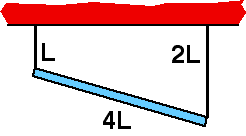
A uniform rod of length 4L, mass M, is suspended by two thin strings,
lengths L and 2L as shown. What is the tension in the string at the
left end of the rod?

  1. Mg
  2. Mg/2
  3. Mg/3
  4. Mg/4
  5. None of the above

Commentary:

Answer

(2) For many this is straightforward but a few students are confused
about the effect of the unequal lengths of string.

A2L Item 092

Goal: Hone the concept of heat and distinguish from internal energy.

Source: UMPERG-ctqpe191

Which of the following phrases best describes heat?

  1. The total energy possessed by a body.
  2. The flow of temperature to or from a body.
  3. The amount of energy dissipated by friction.
  4. The total energy flowing between two bodies at different temperatures.
  5. The useful work that could be extracted from a body.

Commentary:

Answer

(4) Many students are confused about what heat is because the term is
not used consistently. ‘Heat’ is usually used to refer to the thermal
energy that flows into or out of a body. So ‘heat’ is not equivalent to
‘energy’ and it is inappropriate to refer to the heat possessed by a
body. Unfortunately, the redundant phrase ‘heat flow’ is often used in
texts. In addition, students frequently attribute any loss of coherent
energy to friction, which has converted the energy into ‘heat’.

A2L Item 091

Goal: Hone the concept of internal energy and heat.

Source: UMPERG-ctqpe180

Body A has a higher temperature than body B. Which of the following
statements is true?

  1. Body A will feel hotter than body B.
  2. Body A contains more energy than body B.
  3. If placed in contact with each other, energy will flow from body A to
    body B.
  4. If placed in contact with a third body having temperature greater
    than body A, body B will absorb more heat than A.
  5. More than one statement is true.

Commentary:

Answer

(3) Only statement (3) is always true. Placed in contact, heat will flow
from the higher temperature body to the other regardless of the masses
of the bodies.

The ‘feel’ of a body’s temperature depends upon the material and the
rate of heat conduction. Body A could be much smaller than body B and,
therefore, contain much less energy than body B even though at a higher
temperature. Likewise, if body B is smaller it can absorb less energy
from a third body than body A even though it has a lower temperature.

A2L Item 085

Goal: Reasoning and recognizing the implications of momentum conservation.

Source: UMPERG

For ANY collision between two objects there is a time when both of the
objects are traveling with the velocity of the center of mass.

(Assume no external forces act on either object.)

  1. True
  2. False
  3. Depends upon the details of the collision

Commentary:

Answer

(2) This statement is false despite the fact that it is true for just
about all of the instances of collision that students see. In a
perfectly inelastic collision it is certainly true that both bodies have
the velocity of the center of mass after the collision. In a general one
dimensional collision with only spring forces it is also true. For the
statement to be true about a specific collision, there must be a time
when the relative velocity of the two objects is zero. The statement is
clearly false in general for two-dimensional collisons. As an example of
a one-dimensional collision for which the statement is false, consider a
bullet that passes through a block of wood initially at rest. The bullet
slows down and the block speeds up but they never have the same
velocity.

A2L Item 084

Goal: Reasoning with dynamics.

Source: UMPERG

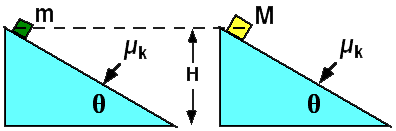
Two masses (M > m) are on an incline. Both surfaces have the same
coefficient of kinetic friction. Both objects start from rest, at the
same height. Which mass has the largest speed at the bottom?

  1. m
  2. M
  3. Both have the same speed.
  4. Cannot be determined

Commentary:

Answer

(3) Both will have the same speed. All the forces acting on the mass
(normal, friction, gravity) are proportional to the mass so the mass
cannot affect the acceleration experienced by the mass.

A2L Item 079

Goal: Distinguish average velocity from velocity.

Source: UMPERG

A car is initially located at the 109 mile marker on a long straight
highway. Two and one half minutes later the car is located at the 111
mile marker.

What is the velocity of the car?

  1. 24 mph
  2. 32 mph
  3. 40 mph
  4. 48 mph
  5. 55 mph
  6. 64 mph
  7. Cannot be determined

Commentary:

Answer

The correct answer is (7) because only the average velocity can be
determined. However, students who respond (4) should not be
disconfirmed but prodded to be more discriminating when interpreting
questions. They have assumed that the car is traveling with a uniform
speed.

Background

Students should be able to extract kinematical quantities from everyday
situations. They should also have a sense of the size of these
quantities.

Questions to Reveal Student Reasoning

What is the speed of the car when it is at the 109 mile marker? How do
you know?

Is it possible for the car to be at rest initially and reach the 111
mile marker two and one half minutes later? If it had constant
acceleration, what would its speed be when it reached the 111 mile
marker?

Suggestions

Have students make a sketch of position vs. time. They probably assume
that the speed is uniform throughout the time interval. Have them
consider other paths that still connect the two known points on the
position vs. time plot. Draw some reasonable path and have the students
describe what the car is doing during that interval.

A2L Item 078

Goal: Hone the concepts of speed and velocity.

Source: UMPERG

The radius of the Earth is 6,400 km. The speed and direction would you
have to travel along the equator to make the sun appear fixed in the sky
is most nearly

  1. 1680 km/hr, East
  2. 840 km/hr, East
  3. 533 km/hr, East
  4. 267 km/hr, East
  5. 267 km/hr, West
  6. 533 km/hr, West
  7. 840 km/hr, West
  8. 1680 km/hr, West
  9. Cannot be determined

Commentary:

Answer

(8) You would attempt to remain underneath the sun as it traveled from
East to West. Some students may be confused by the tilt of the Earth’s
axis and think that the Sun could not remain fixed in the sky if you
were constrained to move along the equator. These students would likely
answer (9).

Background

Students should be able to determine the speed and direction even if
they do not yet have a solid grasp of velocity as a vector.

Questions to Reveal Student Reasoning

What is the circumference of the Earth? Does everyone on the Earth
travel at the same speed?

Suggestions

Build a simple model. Most students can readily grasp the result when
the Earth’s axis is perpendicular to the plane of the Earth’s orbit. A
model helps them understand that the tilt of the axis doesn’t matter.