Category Archives: Introductory Physics

Items appropriate for use in an introductory-level undergraduate university physics course.

A2L Item 179

Goal: Recognizing the properties of magnetic fields

Source: 283 – field of wire

Oersted discovered that there is a magnetic field in the space
around wires carrying currents. Consider a long thin straight wire with
a current I. Which of the following statements about the magnetic field
lines is true?

  1. Field lines are parallel to the
    wire.
  2. Field lines are perpendicular to the wire.
  3. Field
    lines are directed radially away from the wire.
  4. Field lines are
    circles centered on any point on the wire.
  1. A only
  2. B only
  3. C only
  4. D only
  5. A and C only
  6. B and D only
  7. B and C only
  8. None of them is true.

Commentary:

Answer

(6) It is important to elicit reasons that students selected any
of the other responses. Rather than telling the correct answer have
students draw the field lines. Often they are able to reproduce pictures
they have seen but cannot describe the fields in words.

A2L Item 180

Goal: Reason about magnetic fields

Source: 283 field of bar magnets

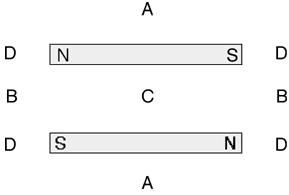
Two
identical bar magnets are placed rigidly and parallel to each other as
shown. At what locations, if any, is the net magnetic field close to
zero?

  1. A only
  2. B only
  3. C only
  4. D only
  5. A and B
  6. A, B, and C
  7. C and D
  8. None of the above.

Commentary:

Answer

(3) C is the point of weakest field. The field is weak at A also.
Find out student reasons is more important than the answer. Have
students sketch the field lines. Ask them how is the strength of the
field indicated on a field line diagram.

A2L Item 178

Goal: Problem solving with rotational dynamics

Source: UMPERG-ctqpe140

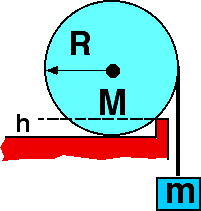
A disk
on a horizontal surface sits against a curb. A string wound around the
disk is attached to a mass as shown. If R=5 cm and h=2 cm, the largest
m for which the disk will not move is

  1. Less than 2M
  2. 2M
  3. 3M
  4. 4M
  5. 5M
  6. Greater than 5M
  7. Cannot be determined.

Commentary:

Answer

(4) When m = 4M the torques about the contact point between the disk and
curb balance. Students find this problem very difficult although rather
simple. Many have the most difficulty with the simple geometry needed to
find the moment arms.

A2L Item 176

Goal: Problem solving with dynamics

Source: UMPERG-ctqpe135.3

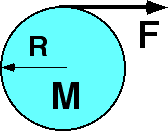
A
disk, with radius 0.25 m and mass 4 kg, lies on a smooth
horizontal table. A string wound about the disk is pulled with a
force of 8N. What is the acceleration of the disk?

  1. 0
  2. 0.5 m/s2
  3. 1 m/s2
  4. 2 m/s2
  5. 4 m/s2
  6. None of the above.
  7. Cannot be determined

Commentary:

Answer

(4) Students find it difficult to grasp that the angular dynamic
relationship does not replace, but rather augments, the 2nd law.

A2L Item 177

Goal: Problem solving with rotational dynamics

Source: UMPERG-ctqpe135.5

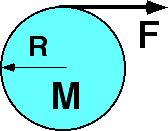
A
disk, with radius 0.25 m and mass 4 kg, lies on a smooth
horizontal table. A string wound about the disk is pulled with a
force of 8N. What is the angular acceleration of the disk about its
center?

  1. 0
  2. 64 rad/s2
  3. 8 rad/s2
  4. 4 rad/s2
  5. 12 rad/s2
  6. None of the above.
  7. Cannot be determined

Commentary:

Answer

(6) The correct value of αcm is 16 rad/s2. Students have the erroneous
concept of ‘conservation of force’. Many think that since the disk
moves, the full force cannot contribute to the torque about the center
of the disk.

A2L Item 175

Goal: Problem solving

Source: UMPERG-ctqpe135.1

A
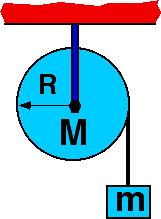
disk, having radius R and mass M, is free to rotate about an axis
through its center. A massless string is wound around disk and attached
to mass m. The moment of inertia for a disk given by is
1/2(MR2). If M=4m what is the acceleration of mass m?

  1. 0
  2. g/2
  3. g/8
  4. g/5
  5. g/3
  6. None of the above
  7. Cannot be determined

Commentary:

Answer

(5) Students answering #2 are likely making the common mistake of
thinking that the tension in the string is mg.

A2L Item 174

Goal: Reasoning about electric fields

Source: 283 ring, E on axis

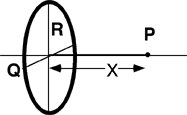
A ring
of radius R with charge +Q (uniformly distributed) is positioned as
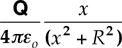
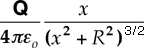
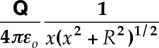
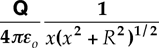
shown. What is the electric field at a point on the axis, a distance x
from the origin?

  1. None of the above.


Commentary:

Answer

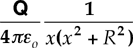
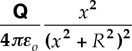
(4) Discuss how the form of the field can be reasoned from symmetry and units. Together with limiting value as x goes to zero, this uniquely singles out one answer.

A good follow-up activity is to have students sketch a graph of the field and potential along the x-axis.

A2L Item 172

Goal: Hone the concept of torque

Source: UMPERG-ctqpe130

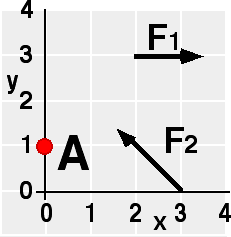
Given
F1 = 6N, and F2 = 8N, what is the total torque
about point A?

  1. 1.0 N-m, out
  2. 0.7 N-m, in
  3. 7.0 N-m, out
  4. 1.0 N-m, in
  5. 6.0 N-m, out
  6. None of the above.

Commentary:

Answer

(6) Many students use the origin rather than the point A. This provides
the opportunity to stress that torque is found with respect to a
specified point. Students using the right hand rule incorrectly may
answer #2.

A2L Item 173

Goal: Hone the concept of angular momentum

Source: UMPERG-ctqpe132

Which situation has the least (magnitude) angular momentum about the
origin?

  1. A 2 kg mass travels along the line y = 3m with speed
    1.5 m/s.
  2. A 1 kg mass travels in a circle of r = 4.5 m about the
    origin with speed 2 m/s.
  3. A disk with I = 3 kg-m2
    rotates about its center (on origin) with ω = 3 rad/s.
  1. A
  2. B
  3. C
  4. Both A and B
  5. Both A and C
  6. Both B and C
  7. All have the same magnitude angular momentum

Commentary:

Answer

(7) Students frequently think that objects traveling in a straight line
have no angular momentum. An interesting follow up question is to ask
how students would answer if the disk in situation were rotating about
the point (1,0).

A2L Item 171

Goal: Reason with electrical potential

Source: 283-470 Lowest voltage at origin

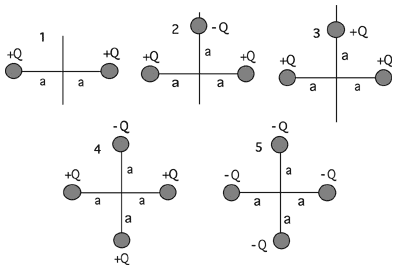
Which of the following charge distributions has the lowest electric
potential at the origin?


Commentary:

Answer

(5) This question serves to motivate a discussion of the
difference between potential energy in a configuration and the
electrostatic potential at a point. It is also important to stress that
potential when point charges are involved presumes that infinity is the
reference point.