Category Archives: Introductory Physics

Items appropriate for use in an introductory-level undergraduate university physics course.

A2L Item 170

Goal: Recognize macroscopic and microscopic quantities

Source: 283 Resistance variations with area.
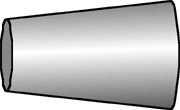
An
ohmic conductor is carrying a current. The cross-sectional area of the
wire changes from one end of the wire to the other. Which of the
following quantities vary along the wire?

  1. The resistivity
  2. The current
  3. The current density
  4. The electric field
  1. A only
  2. B only
  3. C only
  4. D only
  5. A and B only
  6. C and D only
  7. A, B, C, and D
  8. None of the above

Commentary:

Answer

(6) Students are likely to appreciate that the current density
varies and that the total current does not. Many will not recognize that
the electric field is related to the current density.

A2L Item 167

Goal: Problem solving

Source: UMPERG-ctqpe118

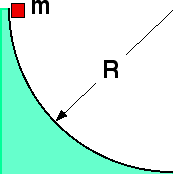
A mass
m slides down a frictionless track of radius R=0.5m. As the mass
reaches the bottom, relative to the center of curvature, its angular
velocity is most nearly:

  1. 6 rad/sec
  2. 8 rad/sec
  3. 12 rad/sec
  4. 15 rad/sec
  5. 20 rad/sec
  6. Cannot be determined

Commentary:

Answer

(1) The velocity near the bottom can be found using energy
conservation.

A2L Item 165

Goal: Problem solving and developing strategic knowledge

Source: UMPERG-ctqpe103

You are given this problem:

A
block sits on a frictionless incline. Given the angle of incline, the
distance along the incline, and that the block is initially at rest,
find the speed after traveling a distance d.

What principle would you use to solve the problem MOST EFFICIENTLY?

  1. Kinematics only
  2. F = ma or Newton’s laws
  3. Work-Energy theorem
  4. Impulse-Momentum theorem
  5. Angular Impulse-Angular Momentum
  6. 1 and 2
  7. 1 and 3
  8. 2 and 3
  9. None of the above
  10. Not enough information given

Commentary:

Answer

(3) The change in gravitational potential can be found directly.
Alternately, the work done by the gravitational force must be equal to
the change in kinetic energy.

A2L Item 166

Goal: Problem solving and developing strategic knowledge

Source: UMPERG-ctqpe104

You are given this problem:

A
block sits on a frictionless incline. Given the mass of the block, the
angle of incline, the distances d1 and d2, and
that the block starts from rest, find the time to travel from
d1 to d2.

What principle would you use to solve the problem MOST EFFICIENTLY?

  1. Kinematics only
  2. F = ma or Newton’s laws
  3. Work-Energy theorem
  4. Impulse-Momentum theorem
  5. Angular Impulse-Angular Momentum
  6. 1 & 2
  7. 1 & 3
  8. 2 & 3
  9. None of the above
  10. Not enough information given

Commentary:

Answer

(6) Students responding #1 are relying on memory and would have
difficulty if a force other than gravity was involved.

A2L Item 163

Goal: Problem solving and developing strategic knowledge

Source: UMPERG-ctqpe101

You are given this problem:

A
block sits on a frictionless incline. Given the angle of incline, the
distance along incline, and the mass of block, find the acceleration
after traveling a distance d.

What principle would you use to solve the problem MOST EFFICIENTLY?

  1. Kinematics only
  2. F = ma or Newton’s laws
  3. Work-Energy theorem
  4. Impulse-Momentum theorem
  5. Angular Impulse-Ang. Momentum
  6. More than one of the above
  7. Not enough information given

Commentary:

Answer

(2) The 2nd law is needed to find the acceleration. Students who
answer that only kinematics is needed are relying on memory.

A2L Item 164

Goal: Problem solving and developing strategic knowledge

Source: UMPERG-ctqpe102

You are given this problem:

A
block sits on an incline with friction. Given the height of the
block, the angle of incline, the coefficient of kinetic friction, and
that block starts from rest, find the speed at the bottom of the
incline.

What principle(s) would you use to solve the problem MOST EFFICIENTLY?

  1. Kinematics only
  2. F = ma or Newton’s laws
  3. Work-Energy theorem
  4. Impulse-Momentum theorem
  5. Angular Impulse-Angular Momentum
  6. 1 & 2
  7. 1 & 3
  8. 2 & 3
  9. none of the above
  10. Not enough information given

Commentary:

Answer

(3) The velocity can be determined using kinematics, but the 2nd
law is also needed, i.e. #6.

A2L Item 162

Goal: Problem solving and developing strategic knowledge

Source: UMPERG-ctqpe100

You are given this problem:

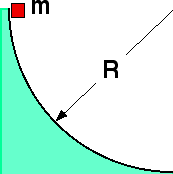
A
mass m slides down a frictionless track of radius R=0.5m. Relative to
the center of curvature, what is the angular acceleration of the mass as
it reaches the bottom of the track.

What principle would you use to solve the problem MOST
EFFICIENTLY.

  1. Kinematics only
  2. F = ma or Newton’s laws
  3. Work-Energy theorem
  4. Impulse-Momentum theorem
  5. Angular Impulse-Angular Momentum
  6. 1 & 2
  7. 1 & 3
  8. 2 & 3
  9. none of the above
  10. not enough information given

Commentary:

Answer

(7) Students often think this problem requires angular momentum
or angular dynamics. Many cue on anything circular. Some students may
answer #10 thinking that the mass is needed.

A2L Item 160

Goal: Developing a strategic approach to problem solving

Source: CT151.2S02-44 spinoff

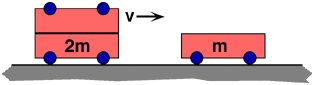
A cart
of mass 2m collides and sticks to a cart of mass m that is initially at
rest. The combination of the two then moves together. Which of the
following principles would be the most efficient way to find the final
speed of the combination?

  1. The Work/Energy Theorem
  2. Newton’s Laws and the basic equations of motion
  3. Conservation of Energy
  4. Conservation of Momentum
  5. Conservation of Angular Momentum
  6. A different principle entirely.
  7. Two (or more) of them would be equally efficient.
  8. Need more information.

Commentary:

Answer

(4) It is valuable to always associate conservation of momentum
with the third law. In addition, it is worthwhile to distinguish totally
inelastic collisions from typical inelastic collisions.

A2L Item 157

Goal: Hone the concept of impulse

Source: UMPERG-ctqpe86

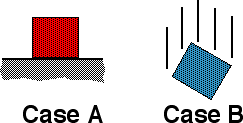
The
two blocks shown below are identical. In case A the block sits on a
horizontal surface and in case B the block is in free fall. Which
statement is correct regarding the impulse delivered to the block by the
gravitational force during a time interval Δt?

  1. In case A the impulse is zero.
  2. In case B the impulse depends upon v.
  3. The impulse is larger in case B than A.
  4. None of the above
  5. Cannot be determined

Commentary:

Answer

(4) Even students who understand forces and would respond
correctly to this question if asked in terms of forces have difficulty
with this question. Many think that motion matters, or answer the
question as if it was about the net impulse.

A2L Item 155

Goal: Problem solving

Source: UMPERG-ctqpe84

A mass of 0.5 kg moving along a horizontal frictionless surface
encounters a spring having k = 200 N/m. The mass compresses the spring
by 0.1 meters before reversing its direction. Consider the total time
the mass is in contact with the spring. What is the total impulse
delivered to the mass by the spring?

  1. -4 N-s
  2. -2 N-s
  3. 0 N-s
  4. 2 N-s
  5. 4 N-s
  6. none of the above
  7. cannot be determined.

Commentary:

Answer

(2) This problem requires students to put together the concepts
of kinetic and potential energy, and change of momentum. Some may be
tempted to resort to the definition of impulse and try to determine the
force due to the spring.