Category Archives: Introductory Physics

Items appropriate for use in an introductory-level undergraduate university physics course.

A2L Item 143

Goal: Reasoning with energy

Source: UMPERG-ctqpe62
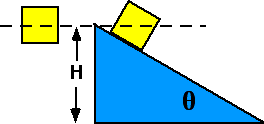
Two
identical blocks fall a distance H. One falls directly down, the other
slides down a frictionless incline. Which has the largest speed at the
bottom?

  1. The one falling vertically
  2. The one on the incline
  3. Both have the same speed
  4. Cannot be determined

Commentary:

Answer

(3) The only force doing work is gravity and both block undergo
the same vertical displacement.

A2L Item 142

Goal: Reasoning with forces and kinematics

Source: UMPERG-ctqpe60 variant

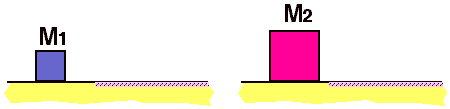
Two
blocks, M2 = M1 but of different sizes, having the
same speed, move from a frictionless surface onto a surface having
friction coefficient μk.

Which stops in the shorter time?

  1. M1
  2. M2
  3. Both stop in the same time
  4. Cannot be determined

Commentary:

Answer

(3) Both blocks will experience the same acceleration. If they
have the same initial velocity, they will stop in the same time.

A2L Item 141

Goal: Reasoning with kinetic energy and work

Source: UMPERG-ctqpe58

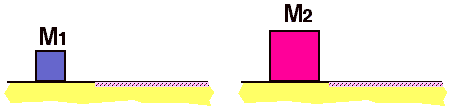
Two
blocks, M2 > M1, having the same kinetic energy
move from a frictionless surface onto a surface having friction
coefficient μk.

Which goes further before stopping?

  1. M1
  2. M1
  3. Both go the same distance
  4. Cannot be determined

Commentary:

Answer

(1) For a given amount of kinetic energy M1 will have a larger
velocity. The penetration distance depends upon the square of the
velocity.

Many students will notice that the relationship equating the kinetic
energy to work by friction has mass as a factor on both sides and will
answer #3. They are assuming that the masses have the same velocity, not
the same kinetic energy.

A2L Item 139

Goal: Reasoning with work

Source: UMPERG-ctqpe50

In which case would you do the least amount of work?

  1. You push a box 10 m across a floor.
  2. You pick up the box, walk 10 m and put the box down on the floor.
  3. You pick up the box, walk 10 m and drop the box.
  4. Both 2 and 3
  5. Work done is the same in all cases.
  6. Cannot be determined from info given.

Commentary:

Answer

(6) This problem is intended to elicit a vigorous discussion of
work. Students have a difficult time reconciling the formal definition
of work with the colloquial one. Every one of the answers is defensible
depending upon one’s perspective. Lifting a heavy box requires doing
work against gravity. Putting it down actually requires that you do the
same amount of work. Gravity does no net work, but humans are not
conservative systems. Depending upon the surface it may be more
advantageous to push the box.

A2L Item 140

Goal: Link potential energy with work needed to assemble a charge configuration.

Source: 283-460 Lowest potential energy

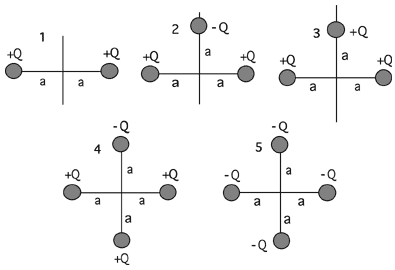
Which of the following charge distributions has the lowest potential
energy?


Commentary:

Answer

(2) Encourage students to reason to the answer rather than write
formal expressions for each case. They should be able to perceive that
cases #1, #3 and #5 all have positive PE. Situation #4 has zero energy
as can be seen by assembling subunits, then moving the two positive
charges along the zero equipotential of the charges on the y-axis.
Finally, situation #2 is clearly negative.

A good follow-up question is to ask students to order the cases
according to increasing potential energy.

A2L Item 138

Goal: Problem solving with momentum

Source: UMPERG-ctqpe46

A
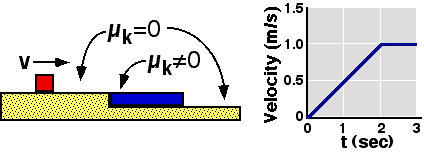
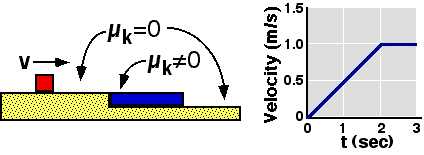
block slides along a frictionless surface and onto a slab with a rough
surface. The plot on the right shows the velocity of the blue slab as a
function of time. The slab has mass of 4kg and the block has mass of
2kg. If the block remains on top of the slab, what was its initial
speed?

  1. 2 m/s
  2. 4 m/s
  3. 6 m/s
  4. 8 m/s
  5. 12 m/s
  6. None of the above
  7. Cannot be determined

Commentary:

Answer

(6) The block initially has velocity 3 m/s. This problem is
difficult for students. They generally have difficulty obtaining
relevant information from a diagram. In this case they must use the plot
to tell that the final velocity is 1 m/s.

A2L Item 137

Goal: Problem solving

Source: UMPERG-ctqpe44-46

A
block slides along a frictionless surface and onto a slab with a rough
surface. The plot on the right shows the velocity of the blue slab as a
function of time. The slab has mass of 4kg and the block has mass of
2kg. What is the friction force on the small block at t = 1 second?

  1. 0.5 kg-m/s2
  2. 0 kg-m/s2
  3. 1 kg-m/s2
  4. 4 kg-m/s2
  5. 2 kg-m/s2
  6. None of the above
  7. Cannot be determined

Commentary:

Answer

(5) The acceleration of the slab can be found from the plot. The
only force on the slab in the horizontal direction is the friction force
so it must be responsible for the acceleration. The force on the block
can then be found using the 3rd law.

A2L Item 135

Goal: Link electric fields, work and potential energy

Source: 283-455 Change in Potential Energy when moving a charge

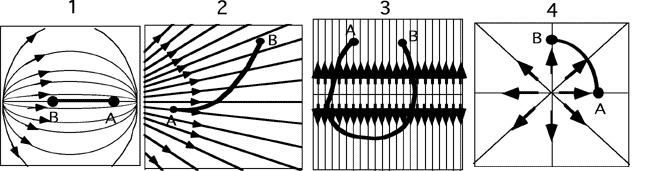
In each of the situations below a negative charge is moved along a path
from point A to point B in the presence of an electric field, as shown.
For which situation is the increase in potential energy the greatest?


Commentary:

Answer

(2) In case 1 the charge moves to a lower potential energy. In
case 3 the charge returns to a point having the same distance to the
plane of charge as it originally had, meaning no net work. In case 4 the
charge moves along an equipotential and no work is done. Students should
be asked to identify the charge configuration that could account for
each of these field situations. They can also be asked for which case is
the electrostatic potential change the greatest.

A2L Item 134

Goal: Link work and potential change

Source: 283-450 Move q, do most work

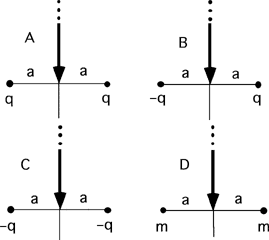
For
the following situations consider moving a positive charge from very far
away to the origin along the y-axis. For which situation would you do
the most work?

  1. A
  2. B
  3. C
  4. D
  5. A & C
  6. None of the above.
  7. Cannot be determined

Commentary:

Answer

(1) Students indicating #7 because they do not know if the masses
are charged should not be disconfirmed. If students key on magnitude
only they will likely choose answer #5.

A2L Item 133

Goal: Reasoning with circular motion

Source: UMPERG-ctqpe37

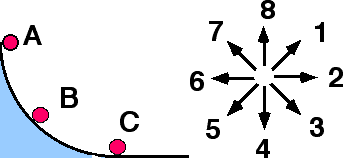
A small ball is released from rest at position A and rolls down a
vertical circular track under the influence of gravity.

When
the ball reaches position B, which of the indicated directions most
nearly corresponds to the direction of the ball’s acceleration?

Enter (9) if the direction cannot be determined.


Commentary:

Answer

(2) At position B the acceleration has a tangential component and
a radial component. Both components can be determined at position B.
Worked out carefully one gets 18 degrees above position #2. It is common
for students to neglect one component or the other.