Category Archives: Introductory Physics

Items appropriate for use in an introductory-level undergraduate university physics course.

A2L Item 122

Goal: Reasoning with Coulomb’s law

Source: UMPERG-A2LEM6

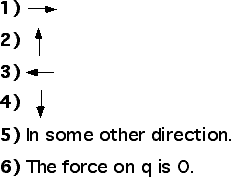
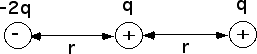
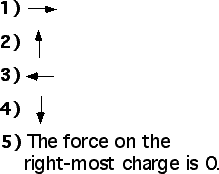
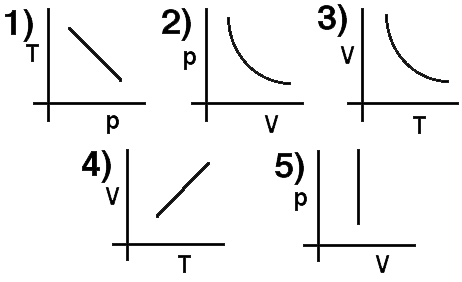
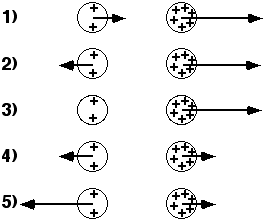
The diagrams show two uniformly charged spheres. The charge on the
right sphere is three times as large as the charge on the left sphere.
The arrows on each charge represent the force on the charge. Which
force diagram best represents the magnitude and direction of the
electric forces on the two spheres?
Commentary:

Answer

(4) By Newton’s third law the forces are equal and opposite.

A2L Item 115

Goal: Reasoning about temperature.

Source: UMPERG-ctqpe186

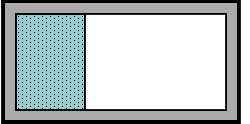
Two moles of an ideal gas fill a volume of 10 liters with a pressure of
2.4 atm. The gas is thermally insulated from the surroundings. A
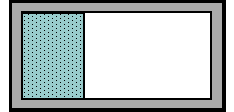
membrane is broken which allows the gas to expand into the new volume
which is 3 times as large as the old volume. The new temperature is …

  1. The same as before.
  2. Lower than before.
  3. Higher than before.
  4. Cannot be determined.

Commentary:

Answer

(1) Students may erroneously apply prior knowledge that gas cools as it
expands. Some will likely think that the answer cannot be determined
without more information.

A2L Item 116

Goal: Hone vector nature of electric fields

Source: UMPERG-em97Q

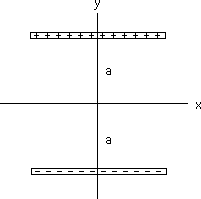
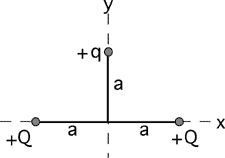
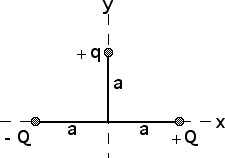
Two uniformly charged rods are positioned horizontally as shown. The
top rod is positively charged and the bottom rod is negatively charged.
The total electric field at the origin

  1. Is 0.
  2. Has both an x and a y component.
  3. Points totally in the i direction.
  4. Points totally in the -i direction.
  5. Points totally in the j direction.
  6. Points totally in the -j direction.

Commentary:

Answer

(6) Along the y-axis, by symmetry, the electric field due to either rod
points along the y-axis. At the origin the contribution to each rod is
the same and points down.

A2L Item 114

Goal: Problem solving with the ideal gas law

Source: UMPERG-ctqpe184

Two moles of an ideal gas fill volume V = 10 liters at pressure P = 2.4
atm. The gas is thermally insulated from the surroundings. A membrane
is broken which allows the gas to expand into the new volume which is 3
times as large as the old volume. The new pressure is:

  1. .4 atm
  2. .8 atm
  3. 1.2 atm
  4. 1.6 atm
  5. 2.4 atm
  6. None of the above
  7. Cannot be determined

Commentary:

Answer

(2) Some students may wonder about the applicability of the ideal gas
law for free expansion. Some may respond (7) thinking that since gas
cools as it expands, they do not know what the final temperature is and
cannot, therefore, use the ideal gas law.

A2L Item 112

Goal: Hone the concept of work on a gas

Source: UMPERG-ctqpe220

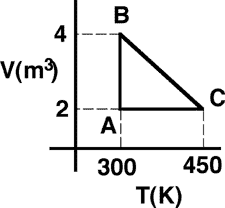
One mole of an ideal monatomic gas is taken around the cycle shown.

The work done on the system during the process B to C is

  1. Positive
  2. Negative
  3. No work is done on the system
  4. Cannot be determined

Commentary:

Answer

(1) Positive work is done ON the system. Since the path on a V-T diagram
is a straight line, the process is isobaric.

A2L Item 110

Goal: Hone the concept of heat capacity

Source: UMPERG-ctqpe210

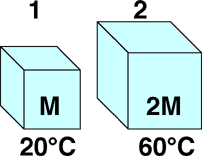
Two thermodynamic systems are made from the same material. The specific
heat of this material is independent of temperature. The bodies have
different masses and, initially, different temperatures as shown. If the
bodies are placed in thermal contact the final equilibrium temperature
is most nearly

  1. 27 C
  2. 33 C
  3. 40 C
  4. 47 C
  5. None of the above
  6. Cannot be determined

Commentary:

Answer

(4) It is valuable to ask students how they obtained their answer. Each
of the offered answers is obtained by a common conceptual or algebraic
mistake.