Category Archives: Introductory Physics

Items appropriate for use in an introductory-level undergraduate university physics course.

A2L Item 261

Goal: Recognize a lack of information

Source: CT151.2S02-24
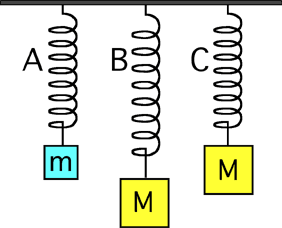
Consider the situations at right. Let m < M. Which spring has
the largest spring constant?

  1. A
  2. B
  3. C
  4. A and B are equal
  5. A and C are equal
  6. B and C are equal
  7. All of them have the same spring constant
  8. Cannot be determined

Commentary:

Answer

(8) The objective of this question is to reveal what students are
assuming about the springs. The reasoning behind any incorrect answer
should be thoroughly discussed.

A2L Item 258

Goal: Hone the concept of average velocity

Source: CTtil2;12;02

While traveling from Boston to Hartford, Person A drives at a constant
speed of 55 mph for the entire trip. Person B drives at 65 mph for half
the trip and then drives 45 mph for the second half of the trip. When
would B arrive in Hartford relative to A?

  1. B arrives before A.
  2. B arrives at the same time as A.
  3. B arrives after A.
  4. Not enough information.

Commentary:

Answer

(3) Many students are inclined to average the speeds and conclude that
they arrive at the same time. It is often useful to compare this
situation to the one in which time is halved.

A2L Item 259

Goal: Interrelate representations of kinematical quantities

Source: CT151.2-8

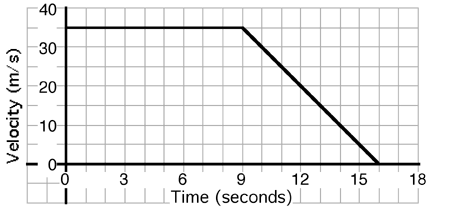
An object’s motion is described by the graph above. The position of the
object at t = 9 seconds is most nearly…

  1. 0 meters
  2. 200 meters
  3. 300 meters
  4. 400 meters
  5. 500 meters
  6. Cannot be determined

Commentary:

Answer

(6) This problem is primarily to determine if students appreciate the
information available from a graph. Many students will determine the
displacement forgetting that the initial position is unknown.

A2L Item 253

Goal: Reason regarding inductors

Source: 283-755 RL equivalent circuit at t small

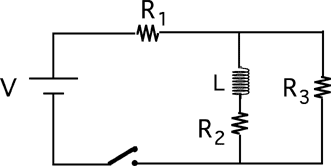
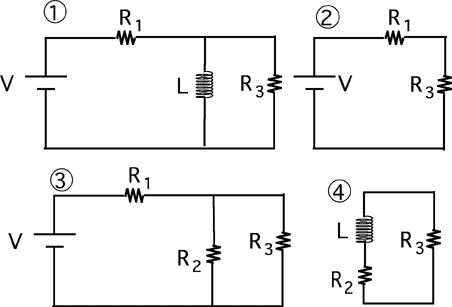
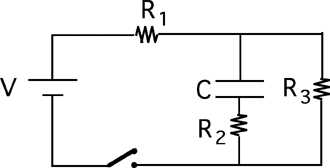
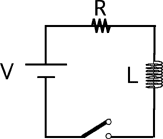
Consider the following circuit.

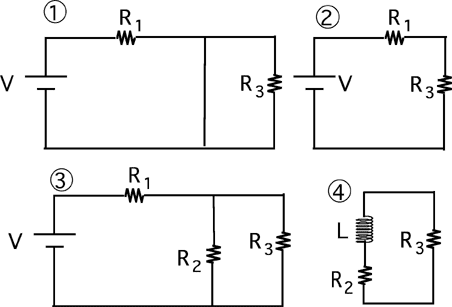
The switch is closed at t=0. Which circuit is equivalent to this circuit
for the instant immediately after the switch is closed?


Commentary:

Answer

(2) Some students misunderstand the statement that inductors behave
initially as an open circuit and select #1 or #3.

This item is best used in conjunction with the next one. Both should be
asked before discussion of either to reveal whether students just have
the behaviors reversed or evidence a more serious problem.

A2L Item 254

Goal: Reasoning regarding inductors

Source: 283-750 LR equivalent at time = infinity

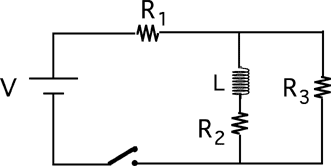
Consider the following circuit.

The switch is closed at t=0. Which circuit is equivalent to this circuit
as t approaches infinity?


Commentary:

Answer

(3) Some students misunderstand the statement that inductors behave as a
short circuit after a long time and select #1 or #2.

This item is best used in conjunction with the previous one. Both should
be asked before discussion of either to reveal whether students just
have the behaviors reversed or evidence a more serious problem.

A2L Item 251

Goal: Reason regarding capacitors

Source: 283-585 RC equivalent circuit at early time

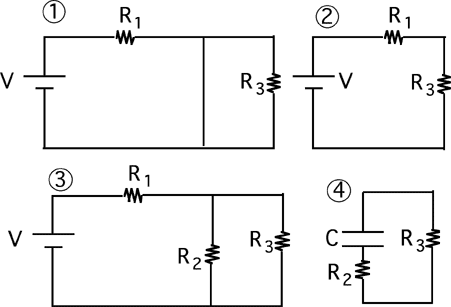
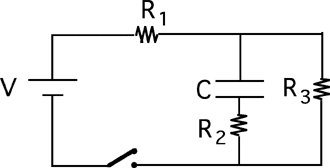
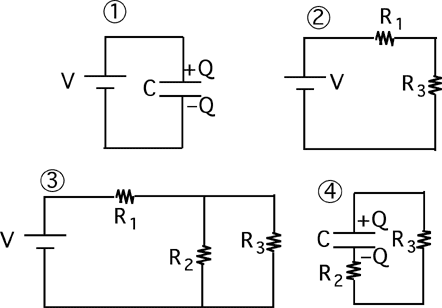
Consider the following circuit.

The capacitor is uncharged when the switch is closed at t=0. Which
circuit is equivalent to this circuit for the instant immediately after
the switch is closed?


Commentary:

Answer

(3) Some students misunderstand the statement that capacitors behave
initially as a short circuit and select #1 or #2.

This item is best used in conjunction with the next one. Both should be
asked before discussion of either to reveal whether students just have
the behaviors reversed or evidence a more serious problem.

A2L Item 252

Goal: Reason regarding capacitors

Source: 283-590 RC equivalent at t infinity

Consider the following circuit.

The capacitor is uncharged when the switch is closed at t=0. Which
circuit is equivalent to this circuit as t approaches infinity?


Commentary:

Answer

(2) Students often misunderstand the statement that capacitors behave
like an open circuit after a long time.

This item is best used in conjunction with the previous one. Both should
be asked before discussion of either to reveal whether students just
have the behaviors reversed or evidence a more serious problem.

A2L Item 249

Goal: Reason regarding RC circuits.

Source: 283 – energy dissipated in RC circuit

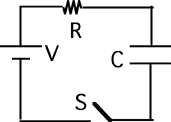
Consider the following circuit. The capacitor is uncharged when
switch S is closed at t = 0. During the charging process the total
energy dissipated in the resistor is:

  1. V^2^/R
  2. CV^2^/2
  3. QV
  4. V/RC
  5. none of the above

Commentary:

Answer

(2) Students should recognize that if the capacitor ultimately is
charged to Q, the total work done by the battery is QV. Half of this is
stored in the capacitor and half is dissipated in the resistor.

A2L Item 250

Goal: Reason regarding RL circuits.

Source: 283 – energy dissipated in inductor

Consider the following circuit. The switch S is closed at t = 0.
The total energy dissipated in the resistor before the current reaches
its maximum value is:

  1. V^2^/2R
  2. LV^2^/2R2
  3. LV
  4. V/RL
  5. none of the above

Commentary:

Answer

(5) The total work done by the battery is QV where Q is a function of
time which is not limited. The total energy stored in the inductor is
finite. The difference must be the energy dissipated in the resistor.
Since it takes an infinite amount of time for the current to reach its
maximum value, the total amount of energy dissipated is also maximum.

A good follow up question is: Is there a time when the dissipated energy
is equal to the stored energy? If so, what is that time?

A2L Item 247

Goal: Link energy with electrical quantities

Source: 283 – energy in capacitor

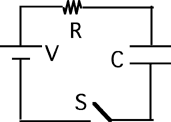
Consider the following circuit. The capacitor is uncharged when switch S
is closed at t = 0. After current stops flowing and the capacitor is
fully charged the energy stored in the capacitor is:

  1. V^2^/R
  2. CE^2^/2
  3. QV/2
  4. V/RC
  5. none of the above

Commentary:

Answer

(3) The intent of this question is to provide students the opportunity
to distinguish a correct but uncommon form for the stored energy from a
number of other familiar forms.