Goal: Link energy with electrical quantities
Source: 283-energy in L
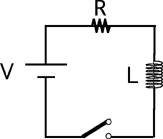
Consider the following circuit. The switch S is closed at t = 0.
After a long time the energy stored in the inductor is:
-
L^2^/R
-
RL^2^/2
-
LV/2R
-
V/RL
-
none of the above
Goal: Link energy with electrical quantities
Source: 283-energy in L
Consider the following circuit. The switch S is closed at t = 0.
After a long time the energy stored in the inductor is:
L^2^/R
RL^2^/2
LV/2R
V/RL
none of the above
Goal: Reason and link electrical quantities.
Source: 283-Del C, E, U, etc – cstQ
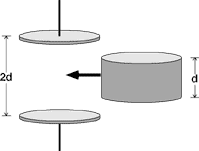
Two parallel conducting plates form a capacitor. It is isolated and a
charge Q is placed on it. A metal cylinder of length half the plate
separation is then inserted between the plates. Which of the quantities
C, ΔV, Q, E, and U change?
(8) Students who are formula bound find this a difficult question.
Obviously Q does not change. Depending on how students interpret the
question, they may conclude that E does or does not change. The value of
E in regions outside the cylinder does not change [Students taking this
interpretation may respond #5.], but inside the cylinder it is now zero.
Since E is now zero for half of the distance between the original
plates, both ΔV and U must change. That C also changes can be
appreciated in many different ways.
There are many good follow up questions, such as: Does it make a
difference where the cylinder is placed? How would the quantities change
if the cylinder was made of a dielectric material? Suppose a half
cylinder of length 2d were placed between the plates. How would
quantities change?
Goal: reason and link electrical quantities
Source: 283-Del C, E, U, etc. – cstV
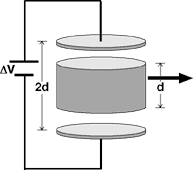
Two
parallel conducting plates form a capacitor. With a metal cylinder of
length half the plate separation inserted between the plates, it is
connected to a battery with potential ΔV. The cylinder is now removed.
Which of the quantities C, ΔV, Q, E, and U change?
(8) Since ΔV does not change, E must because the distance between
plates doubles. If E changes, so must Q. If Q changes, so must C.
Finally, that U chages can be seen in a variety of ways.
There are many good follow up questions, such as: How would the
quantities change if the cylinder was made of a dielectric material?
Goal: Hone the concept of line integral
Source: 283-CTQsas35
Three wires, each carrying the same current, I, are in a region of
space, as shown below. What could be the result of computing the left
hand side of Ampere’s law,  , for the
three Amperian Loops shown?
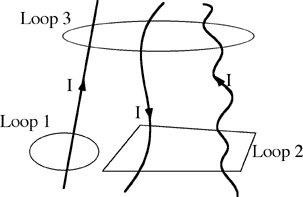
(4) The direction to integrate around the loop is not specified. The
only choice of responses that is possibly true is #2 and this would
require a clockwise integral around loop 1.
Goal: Reason regarding circuits
Source: 283 compare dissipated energy
Consider the following circuits. Two identical batteries are connected
to two identical capacitors in series with different resistors. The
capacitors are initially uncharged. Which statement is true regarding
the energy supplied by the batteries to charge the capacitor?
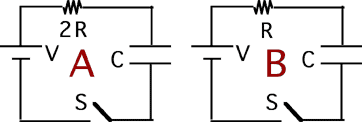
(3) The energy dissipated in the resistor is independent of the
resistance. Consider a time when the capacitor contains some charge Q.
If an additional charge dq is added, the battery does work dqV and the
increment of stored energy in the capacitor is (Q/C)dq. By conservation
of energy, the difference must have been dissipated in the resistor. The
difference, [V-(Q/C)]dq is independent of resistance.
Goal: Reason regarding circuits
Source: 283 Compare dissipated power with inductors
Consider the following circuits. Two identical batteries are
connected to two identical inductors in series with different resistors.
The switch is closed at t=0. Which is true regarding the energy
supplied by the battery to establish current I?
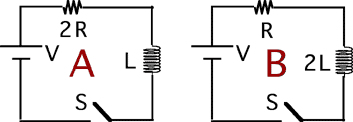
(4) It is not determined that either circuit can achieve the current I.
If I is to be interpreted as the ‘final’ current, then the answer is #2.
The lower the resistance the higher the final current. There is more
energy stored in the inductor if the final current is higher. In
addition, the energy dissipated in the resistor goes as i2R which is
larger for circuit B for every current larger than V/(2R).
Goal: Reason regarding power in a circuit
Source: 283 circuit powers
Consider the circuit below. Which resistor has the greatest power
consumption?
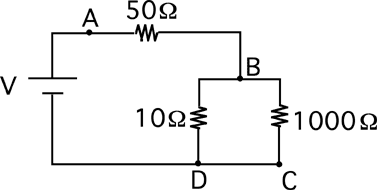
(1) The potential drop over the 10Ω and 1000Ω resistors is the same.
Since power goes as V^2^/R, more power is consumed in the 10Ω resistor
than the 1000Ω resistor. Further, since power also goes as I^2^R and only
a fraction of the current through the 50Ω resistor flows through the 10Ω
resistor, the 50Ω resistor must dissipate the most energy.
Goal: Reason with Lenz’s Law
Source: 238-730 Lenz’s Law 2
For which of the following situations will the current flow clockwise?
<table


1. No situations
2. A
3. A and B
4. A and C
5. A, B, and C
(4) There is usually a lot of confusion with Lenz’s Law. It is important
to determine what students are using to decide the direction of the
current. Some students despair of ever figuring it out and just guess.
Examining the microscopic motion of charges often helps.
Goal: Reason with Faraday’s law
Source: 283-720 Faraday’s Law
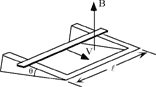
For which of the following is there an induced emf?
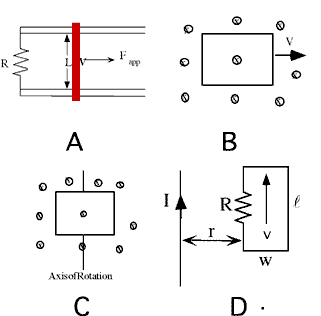
- A conducting rod is pulled on conducting
rails that are placed in a uniform magnetic field directed into the
page.- A conducting loop moves through a uniform magnetic field
directed into the page.- A conducting loop rotates in a uniform
magnetic field directed into the page.- A conducting loop moves
in a magnetic field produced by an infinite current-carrying wire.
(3) Viewing the various cases using the Lorentz force law helps students
understand why current flows in those loops experiencing a change of
magnetic flux.
Goal: Hone understanding of Faraday’s Law
Source: 283-715 bar with moving magnet
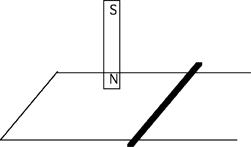
A
conducting bar is placed on a set of horizontal rails. A bar magnet is
positioned above the rails with its north pole facing the rails, and is
then released. While the magnet falls toward the rails, which of the
following statements are true.
- There is an electric field in the
bar- There is a current in the bar
- The bar remains
stationary
(4) As the bar magnet falls, the magnetic flux through the circuit will
change. This will cause an E field and current in the conducting bar.
The conducting bar will also experience a magnetic force due to the
current flowing in the bar.
Commentary:
Answer
(5) This is a good time to discuss with students the general form of
energy expressions as 1/2 something times (something else)^2^.