Category Archives: Introductory Physics

Items appropriate for use in an introductory-level undergraduate university physics course.

A2L Item 226

Goal: Reasoning regarding the Lorentz force

Source: 283-620 Moving bar magnet and charge
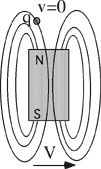
A bar
magnet moving with speed V passes below a stationary charge q. What can
be said about the magnitude of the magnetic force on the bar magnet and
the charge q.

  1. Fbar and Fq are both zero.

  2. Fbar is zero and Fq is not zero.

  3. Fbar is not zero and Fq is zero.

  4. Fbar and Fq are both non-zero.


Commentary:

Answer

(4) Many students have a lot of difficulty with this one. All of their
past experience has been with a moving charge in a magnetic field. They
may not think that it is equivalent to view the interaction from the
bar’s frame. Of course, they are correct, but the difference is
unimportant for purposes of recognizing that the force on the charge is
non-zero. They may invoke the third law by rote, without perceiving any
mechanism that could provide a force on the magnet. Discussing this in
some detail is a good idea.

A2L Item 222

Goal: Reasoning regarding circuits

Source: 283-565 circuit currents

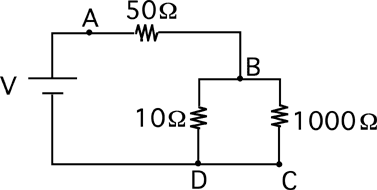
Consider the circuit below. Which statement(s) is correct?

  1. IAB = IBD +
    IBC
  2. IBC < IBD
  3. IBC > IBD
  1. 1 only
  2. 2 only
  3. 3 only
  4. 1 and 2
  5. 1 and 3

Commentary:

Answer

(4) Students should be encouraged to reason about the currents and not
calculate the value of the currents in circuits. Interestingly, if a
problem similar to this is given with the potential specified as a
number, many students will immediately calculate the currents.

A2L Item 220

Goal: Reason regarding resistance

Source: 283-550 Resistance and geometry

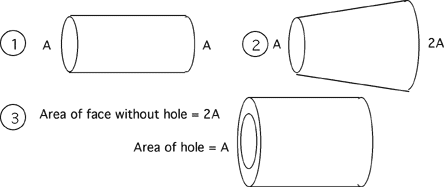
Which object below has the lowest resistance? All three have length L
and are made out of the same material.

  1. 1

  2. 2

  3. 3

  4. Both #1 and #3 have the same, and theirs is less than the resistance of
    #2.

Commentary:

Answer

(2) Students should be able to reason that the contribution to the total
resistance from a slice of material decreases as the area increases.

A2L Item 219

Goal: Reason regarding capacitors

Source: 283-545 Adding capacitors in parallel

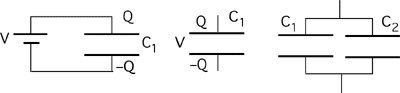
A capacitor having, C1, is connected to a battery until
charged, then disconnected from the battery. A second capacitor,
C2, is connected in parallel to the first capacitor. Which
statements below are true?

  1. Charge on C1 decreases.
  2. Total charge on C1 and C2 is the same as the original Q.
  3. The total energy stored in both capacitors is the same as the
    original U stored in C1.
  4. The potential (Voltage) across C1 decreases.
  5. All of the above.
  6. Only 1, 2, and 3 are true.
  7. Only 1, 2, and 4 are true.

Commentary:

Answer

(7) Statement #3 is the hardest for students to reason about. This is
most easily decided as incorrect if the two capacitors are taken as
equal.

A2L Item 217

Goal: Reason regarding capacitors and dielectrics.

Source: 283-535 inserting a dielectric changes a capacitor

A capacitor with capacitance C is connected to a battery until charged,
then disconnected from the battery. A dielectric having constant
κ is inserted in the capacitor. What changes occur in the charge,
potential and stored energy of the capacitor after the dielectric is
inserted?

  1. V stays same, Q increases, U increases
  2. V stays same, Q decreases, U stays same
  3. V increases, Q decreases, U increases
  4. V decreases, Q stays same, U decreases
  5. None of the above
  6. Cannot be determined

Commentary:

Answer

(4) It should be clear to students that the charge cannot change. Most
students recognize that capacitance increases when a dielectric is
inserted into a capacitor. The issue then becomes whether they
appreciate the relationships between C, Q, V and U.

A2L Item 218

Goal: Reason regarding capacitors

Source: 283-540 Adding capacitors in series

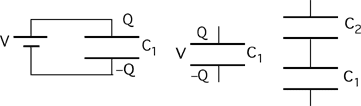
A capacitor, C1, is connected to a battery until charged, and
then disconnected from the battery. A second capacitor, C2,
is connected in series to the first capacitor. What changes occur in
capacitor C1 after C2 is connected as shown?

  1. V same, Q increases, U increases
  2. V same, Q decreases, U same
  3. V increases, Q decreases, U increases
  4. V decreases, Q same, U decreases
  5. None of the above
  6. Cannot be determined

Commentary:

Answer

(5) All quantities remain the same. Some students may consider the
capacitors to be connected in parallel despite the figure.

A2L Item 216

Goal: Hone the relationship between E and V

Source: 283-475 Must V=0 if E=0?

True or false: it is possible to have the electric field be 0 at some
point in space and the electric potential be non-zero at that same
point.

  1. True
  2. False

Commentary:

Answer

(1) Whichever answer students give, ask them to draw a charge
configuration which satisfies their answer. Often this is sufficient to
cause them to change their mind. If appropriate raise for discussion the
case of the interior of a uniformly charged spherical shell.

A2L Item 215

Goal: Relate flux and electric field

Source: 283-405 If phi = 0, is E=0?

True or False: If the electric flux = 0 over some closed Gaussian
surface, then this means that the electric field = 0 on that surface.

  1. True
  2. False

Commentary:

Answer

(2) A good followup question is; Even though the electric field is not
zero everywhere, can it be zero somewhere on the Gaussian surface? If
so, draw a charge configuration for which this is true?

A2L Item 213

Goal: Reasoning regarding electric fields due to distributed charges

Source: 283-395 Electric field from a rod, on its axis.

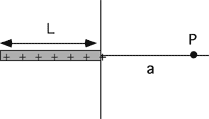
A rod of length L and charge +q
(uniformly distributed) is positioned along the x-axis, as shown to the
right. What is E at point P, a distance a from the origin?

1.

2.

3.

4.

5.


Commentary:

Answer

(3) It is worthwhile having students examine their choice for the
limiting case a->0. Students are inclined to immediately start a formal
calculation rather than think about the problem long enough to figure
out what they really need to know. In this case all but two of the
answers can be ruled out because they do not limit appropriately as the
point P moves toward the origin. If a>>L the field should drop off as
from a point charge. The only answer meeting both these requirements is
3.

A2L Item 214

Goal: Hone the concept of flux

Source: 283-400, Flux in and out of a balloon.

We construct a closed Gaussian surface in the shape of a sphericalWe construct a closed Gaussian surface in the shape of a spherical
balloon. Assume that a small glass bead with total charge Q is in the
vicinity of the balloon. Consider the following statements:

  1. If the bead is inside the balloon, the electric flux over the
    balloon’s surface can never be 0.

  2. If the bead is outside the balloon,
    the electric flux over the balloon surface must be 0.

Which of these statements is valid?

  1. Only A is valid.
  2. Only B is valid.
  3. Both A and B are valid.
  4. Neither one is valid.

Commentary:

Answer

(3) Students may accept statement A but still think that the value of
the flux depends upon location of the bead in the sphere. Transition
from just inside to just outside poses particular difficulty to some
students. This usually derives from lack of experience with vectors and
dot products. Having the student draw field lines does help, but only
after they comprehend that the formal definition of flux is equivalent
to counting the net number of lines of E crossing the surface.