Category Archives: Introductory Physics

Items appropriate for use in an introductory-level undergraduate university physics course.

A2L Item 200

Goal: Distinguishing components of the Lorentz force

Source: 283 – effects of magnetic force

A charged particle moves into a region containing both an electric and
magnetic field. Which of the statements below are true?

  1. The particle cannot accelerate in the
    direction of B.
  2. The path of the particle must be a circle.
  3. Any change in the particle’s kinetic energy is caused by the E
    field.
  1. Only A
  2. Only B
  3. Only C
  4. Both A&B
  5. Both A&C
  6. Both B&C
  7. All are true.
  8. None are true.

Commentary:

Answer

(3) The only cases that most students see is the one having E and B
perpendicular. As a result they discount the case of E and B parallel
and think statement A is also true.

A2L Item 201

Goal: Reason regarding electric fields

Source: 283-10, E at origin due to charged rods

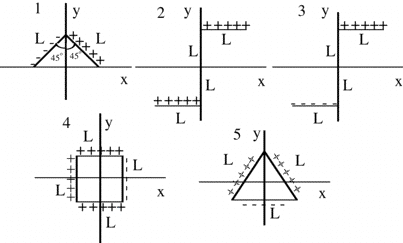
All of the configurations shown below consist of charged rods of the
same length L. The magnitude of the total charge is also the same for
each rod. The total charge in each rod is distributed uniformly.

For which
configuration(s) is the electric field vector at the origin in the
positive x direction?

  1. 2 only
  2. 1 and 3 only
  3. 5 only
  4. 4 only
  5. 1 and 5 only
  6. None of the above

Commentary:

Answer

(4) Because they are given lots of examples involving point charges,
spheres and rings, students often miss the fact that there are many
situations for which the direction of the field can be deduced even
though determining the value or formal expression for the field is way
beyond them.

A2L Item 199

Goal: Hone the concept of electric field

Source: UMPERG-283-365

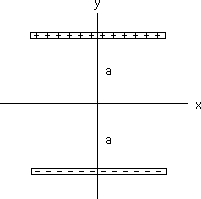
Two
uniformly charged rods are positioned horizontally as shown. The top
rod is positively charged and the bottom rod is negatively charged. The
total electric field at the origin

  1. is 0
  2. has both an x, and a y component
  3. points totally in the i direction
  4. points totally in the -i direction
  5. points totally in the j direction
  6. points totally in the -j direction

Commentary:

Answer

(6) By symmetry the field must point along the y-axis. Students
who do not understand that the field points away from positive charges
and towards negative charges would select #1 thinking that the fields
cancel.

A2L Item 197

Goal: Reasoning with magnetic forces

Source: UMPERG-283-626

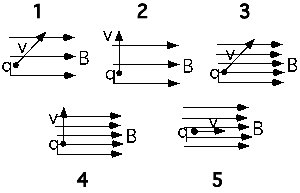
In the following situations a charge q moves in a uniform magnetic
field. The strength of the magnetic field is indicated by the density
of field lines. In all cases the speed of the charge is the same. For
which situation(s) will the charge q have the largest displacement in a
given time T.

  1. 1
  2. 2
  3. 3
  4. 4
  5. 5
  6. 1 & 3
  7. 2 & 4
  8. 1, 2, 3 & 4
  9. 1, 2, 3, 4 & 5
  10. Cannot be determined

Commentary:

Answer

(5) Since the speed cannot change, the greatest displacement will occur
when the path is a straight line. Some students may answer #10 thinking
that the time matters.

A2L Item 196

Goal: Reasoning with magnetic forces

Source: UMPERG-283-625

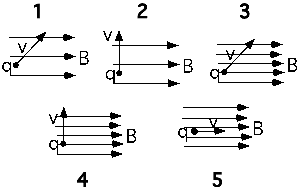
In the following situations a charge q moves in a uniform magnetic
field. The strength of the magnetic field is indicated by the density
of field lines. In all cases the speed of the charge is the same. For
which situation(s) will the charge q travel the greatest distance in a
given time T?

  1. 1
  2. 2
  3. 3
  4. 4
  5. 5
  6. 1 & 3
  7. 2 & 4
  8. 1, 2, 3 & 4
  9. 1, 2, 3, 4 & 5
  10. Cannot be determined

Commentary:

Answer

(9) The magnetic force can change the direction of the velocity but not
the speed. The distance traveled, therefore, cannot depend upon either
the strength or orientation of the magnetic field. It is important to
have students who pick one of the other choices verbalize their reasons.
Some students may interpret the question as asking for the
‘displacement’ and, thinking that the time is needed, respond #10.
Actually the result for displacement is #5.

A2L Item 194

Goal: Reasoning with thermodynamics

Source: UMPERG-ctqpe212

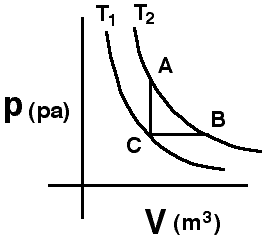
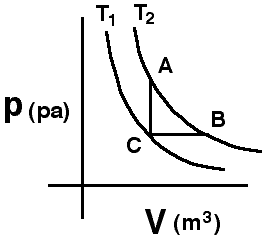
The
two curves shown are isotherms. A system is taken from state A to state
B along the T2 isotherm. State C has the volume of state A
and the pressure of state B.

Which of the following is true:

  1. QAB = 0
  2. QAB = ΔEAB
  3. QAB = -WAB
  4. QAB = QCA-QCB
  5. Not enough information

Commentary:

Answer

(5) This is the only answer that is definitely correct. Students
will likely assume that the system is an ideal gas. Many will choose #3
and this should engender a discussion of the sign of work. Physicists
use the convention that positive work is that done BY the system.
Chemists frequently use the opposite convention.

The one choice giving students the most reasoning difficulty is #4. A
reasoning path that eliminates that choice is as follows. Q(AB) is
positive: gas does positive work on surroundings, so heat has to be
added to keep energy the same. Q(CA) is positive: no work is done, so
heat has to be added to raise the temperature. Q (CB) is positive: heat
must be added to expand the gas and still maintain constant pressure. So
Q(CB) [constant pressure] > Q(CA) [constant volume]; Q(CA) – Q(CB) < 0
cannot equal Q(AB) > 0

A2L Item 195

Goal: Reasoning with thermodynamics

Source: ctqpe214

A
system consisting of a quantity of ideal gas has the two isotherms
shown. The system, initially at state C, can be taken along path CA to
final state A or along path CB to state B.

Which of the following is true:

  1. QCA < QCB
  2. QCA = QCB
  3. QCA > QCB
  4. Not enough information

Commentary:

Answer

(1) Since the internal energy of an ideal gas depends only on
temperature, states A and B have the same internal energy. Along path CB
the system does work requiring more heat to be added than along path CA.

A2L Item 193

Goal: Problem solving in thermodynamics

Source: UMPERG-ctqpe198

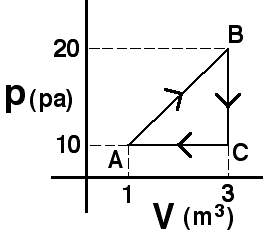
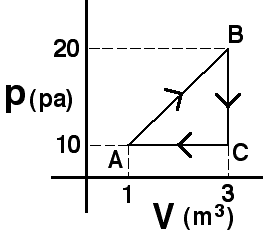
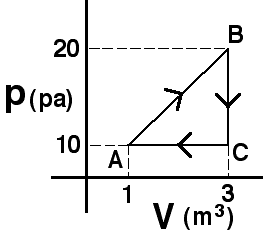
An
amount of an ideal gas is taken around the process shown.The amount of
heat extracted during process BC is

  1. 10 J
  2. 20 J
  3. 15 J
  4. 45 J
  5. 60 J
  6. none of the above
  7. cannot be determined

Commentary:

Answer

(4) Since no work is done the change in internal energy must be
due to heat extraction. Some students may think that the answer cannot
be determined because they do not know the number of moles. These are
likely thinking that they need to find the temperature at each state to
answer the question.

A2L Item 191

Goal: Reason with internal energy

Source: UMPERG-ctqpe194var

An
amount of an ideal gas is taken around the process shown. Which of the
following statements about the internal energy of the states is true?

  1. The internal energy of state B is twice that of state C.
  2. The internal energy of state B is equal to that of A and C combined.
  3. The internal energy of state A is half that of state C.
  4. The internal energy of state B is less than the internal energy of state
    A.
  5. none of the above
  6. cannot be determined

Commentary:

Answer

(1) Students need to know only that the internal energy depends
upon the product of p and V. Alternatively, they can reason that,
according to the Ideal Gas Law, this product is proportional to the
temperature and the temperature determines the internal energy

A2L Item 192

Goal: Link representations

Source: UMPERG-ctqpe196

A vertical cylinder with a movable cap is cooled. The process
corresponding to this is

  1. C-B
  2. A-B
  3. A-C
  4. C-A
  5. is not shown

Commentary:

Answer

(4) Interpreting process diagrams is a very important skill for
students. good followup questions include; Is work done during this
process? … by or on the gas? How does the temperature at A compare to
that at C? How much heat was extracted during this process?