Tag Archives: Electromagnetism

A2L Item 205

Goal: Hone the concept of a conductor

Source: 283-230 E in the cavity of a neutral conductor

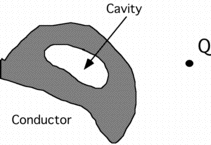
A positive charge +Q is placed outside a neutral conductor. Inside the
conductor is a cavity containing no charge. What is the electric field
at the “center” of the cavity, a distance D from the charge +Q?
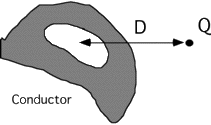
  1. kQ/D2, direction away from the charge Q
  2. kQ/D2, direction toward the charge Q
  3. kQ/D2, direction away from the center of the conductor
  4. kQ/D2, direction toward the center of the conductor
  5. E = 0
  6. Cannot determine the electric field
Commentary:

Answer

(5) Induced charges and resulting fields pose problems for most
students. Having students compare this case to one where the charge is
inside the cavity helps. They tend to get hung up on the problem of
envisioning the exact distribution of induced charge that will cancel
the field everywhere inside the conductor.

A2L Item 204

Goal: Hone the concept of a conductor

Source: 283-225, Charge induced in a neutral conductor

A positive charge +Q is placed outside a neutral conductor. Inside the
conductor is a cavity containing no charge. What is the net charge on
the surface bounding the cavity?

  1. A positive charge +Q
  2. A positive charge +q < +Q
  3. Zero charge
  4. A negative charge |-q| < |+Q|
  5. A negative charge -Q
  6. Cannot determine the charge.

Commentary:

Answer

(3) Students have difficulty envisioning induced charge distributions,
especially when the conductor has an irregular shape.

A2L Item 203

Goal: Reason regarding electric fields

Source: 283 –

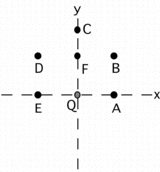
Charge, Q, is at the origin. Points A-E are positions where other
charges may be present. Etotal at point F is non-zero and
points in the +i direction. Which of the following situations
could account for this?

  1. Another charge is present at position
    A.
  2. Two other charges are present at C & D.
  3. Two other
    charges are present at D & B.
  4. Two other charges are present at
    E & A.
  1. A only
  2. B only
  3. C only
  4. D only
  5. A and B
  6. A, C and D
  7. A, B, and D
  8. A, B, C, and D

Commentary:

Answer

(2) Only a charge at C can counter the y component of the field of Q at
F. A charge at B or D can then create a field at F that points in the i
direction.

A2L Item 202

Goal: Reason regarding electric fields

Source: 283-11, E at origin due to charged rods

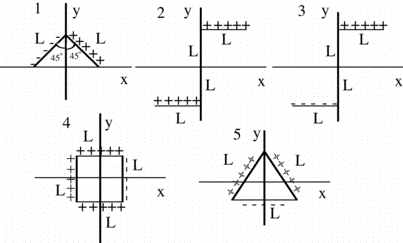
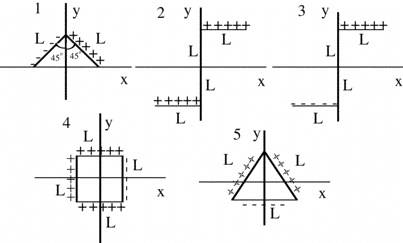
For which of the configuration(s) below does the total electric field
vector at the origin have non-zero components in both the x and y
directions?

  1. 2 only
  2. 1 and 3 only
  3. 5 only
  4. 4 only
  5. 1 and 5 only
  6. None of the above

Commentary:

Answer

(6) Only situation 3 meets the condition. A good exercise is to have
students draw the contribution to the field at the origin due to each
rod. The contributions should have the correct relative size and
direction.

A2L Item 201

Goal: Reason regarding electric fields

Source: 283-10, E at origin due to charged rods

All of the configurations shown below consist of charged rods of the
same length L. The magnitude of the total charge is also the same for
each rod. The total charge in each rod is distributed uniformly.

For which
configuration(s) is the electric field vector at the origin in the
positive x direction?

  1. 2 only
  2. 1 and 3 only
  3. 5 only
  4. 4 only
  5. 1 and 5 only
  6. None of the above

Commentary:

Answer

(4) Because they are given lots of examples involving point charges,
spheres and rings, students often miss the fact that there are many
situations for which the direction of the field can be deduced even
though determining the value or formal expression for the field is way
beyond them.

A2L Item 200

Goal: Distinguishing components of the Lorentz force

Source: 283 – effects of magnetic force

A charged particle moves into a region containing both an electric and
magnetic field. Which of the statements below are true?

  1. The particle cannot accelerate in the
    direction of B.
  2. The path of the particle must be a circle.
  3. Any change in the particle’s kinetic energy is caused by the E
    field.
  1. Only A
  2. Only B
  3. Only C
  4. Both A&B
  5. Both A&C
  6. Both B&C
  7. All are true.
  8. None are true.

Commentary:

Answer

(3) The only cases that most students see is the one having E and B
perpendicular. As a result they discount the case of E and B parallel
and think statement A is also true.

A2L Item 199

Goal: Hone the concept of electric field

Source: UMPERG-283-365

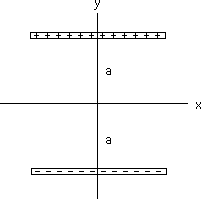
Two
uniformly charged rods are positioned horizontally as shown. The top
rod is positively charged and the bottom rod is negatively charged. The
total electric field at the origin

  1. is 0
  2. has both an x, and a y component
  3. points totally in the i direction
  4. points totally in the -i direction
  5. points totally in the j direction
  6. points totally in the -j direction

Commentary:

Answer

(6) By symmetry the field must point along the y-axis. Students
who do not understand that the field points away from positive charges
and towards negative charges would select #1 thinking that the fields
cancel.

A2L Item 198

Goal: Honing the right hand rule

Source: UMPERG-283 Mag Force

In a region of space there is a uniform magnetic field pointing in the
positive z direction. In what direction should a negative charge move
to experience a force in the positive x direction?

  1. In the positive z direction
  2. In the negative z direction
  3. In the positive x direction
  4. In the negative x direction
  5. In the positive y direction
  6. In the negative y direction
  7. It can move in any direction
  8. The force cannot be in the +x direction

Commentary:

Answer

(6) Students will likely forget that the charge is negative.

A2L Item 197

Goal: Reasoning with magnetic forces

Source: UMPERG-283-626

In the following situations a charge q moves in a uniform magnetic
field. The strength of the magnetic field is indicated by the density
of field lines. In all cases the speed of the charge is the same. For
which situation(s) will the charge q have the largest displacement in a
given time T.

  1. 1
  2. 2
  3. 3
  4. 4
  5. 5
  6. 1 & 3
  7. 2 & 4
  8. 1, 2, 3 & 4
  9. 1, 2, 3, 4 & 5
  10. Cannot be determined

Commentary:

Answer

(5) Since the speed cannot change, the greatest displacement will occur
when the path is a straight line. Some students may answer #10 thinking
that the time matters.

A2L Item 196

Goal: Reasoning with magnetic forces

Source: UMPERG-283-625

In the following situations a charge q moves in a uniform magnetic
field. The strength of the magnetic field is indicated by the density
of field lines. In all cases the speed of the charge is the same. For
which situation(s) will the charge q travel the greatest distance in a
given time T?

  1. 1
  2. 2
  3. 3
  4. 4
  5. 5
  6. 1 & 3
  7. 2 & 4
  8. 1, 2, 3 & 4
  9. 1, 2, 3, 4 & 5
  10. Cannot be determined

Commentary:

Answer

(9) The magnetic force can change the direction of the velocity but not
the speed. The distance traveled, therefore, cannot depend upon either
the strength or orientation of the magnetic field. It is important to
have students who pick one of the other choices verbalize their reasons.
Some students may interpret the question as asking for the
‘displacement’ and, thinking that the time is needed, respond #10.
Actually the result for displacement is #5.