Tag Archives: Electromagnetism

A2L Item 181

Goal: Recognizing forces on current elements

Source: 283 Force on a half-loop
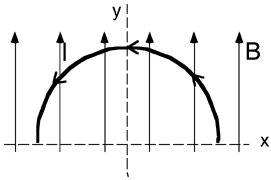
A
semicircular wire lies in a plane as shown. The positive z-direction is
out of the plane. The wire has current, I, in the counterclockwise
sense, and it is in a uniform external magnetic field, B, directed along
the +y axis. What is the direction of the net force, if any, acting on
the wire?

  1. +x
  2. -x
  3. +y
  4. -y
  5. +z
  6. -z
  7. None of the above.

Commentary:

Answer

(6) Since the current carrying semicircle lies in the x-y plane,
as does the magnetic field, the net force, if any, must point
perpendicular to the plane, or in the z direction. For the semicircular
wire, all force contributions add. There is no contribution to the net
force from current elements near the x-axis.

The force on the missing half of the loop would be out of the page.
Together both forces on a full loop would create a torque tending to
align the field of the current loop with the external field. If
appropriate relate this situation to the torque on a magnetic dipole.

A2L Item 180

Goal: Reason about magnetic fields

Source: 283 field of bar magnets

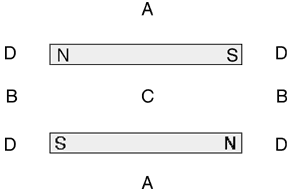
Two
identical bar magnets are placed rigidly and parallel to each other as
shown. At what locations, if any, is the net magnetic field close to
zero?

  1. A only
  2. B only
  3. C only
  4. D only
  5. A and B
  6. A, B, and C
  7. C and D
  8. None of the above.

Commentary:

Answer

(3) C is the point of weakest field. The field is weak at A also.
Find out student reasons is more important than the answer. Have
students sketch the field lines. Ask them how is the strength of the
field indicated on a field line diagram.

A2L Item 179

Goal: Recognizing the properties of magnetic fields

Source: 283 – field of wire

Oersted discovered that there is a magnetic field in the space
around wires carrying currents. Consider a long thin straight wire with
a current I. Which of the following statements about the magnetic field
lines is true?

  1. Field lines are parallel to the
    wire.
  2. Field lines are perpendicular to the wire.
  3. Field
    lines are directed radially away from the wire.
  4. Field lines are
    circles centered on any point on the wire.
  1. A only
  2. B only
  3. C only
  4. D only
  5. A and C only
  6. B and D only
  7. B and C only
  8. None of them is true.

Commentary:

Answer

(6) It is important to elicit reasons that students selected any
of the other responses. Rather than telling the correct answer have
students draw the field lines. Often they are able to reproduce pictures
they have seen but cannot describe the fields in words.

A2L Item 174

Goal: Reasoning about electric fields

Source: 283 ring, E on axis

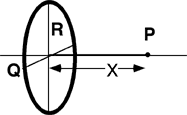
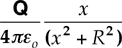
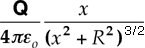
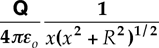
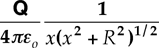
A ring
of radius R with charge +Q (uniformly distributed) is positioned as
shown. What is the electric field at a point on the axis, a distance x
from the origin?

  1. None of the above.


Commentary:

Answer

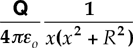
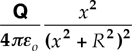
(4) Discuss how the form of the field can be reasoned from symmetry and units. Together with limiting value as x goes to zero, this uniquely singles out one answer.

A good follow-up activity is to have students sketch a graph of the field and potential along the x-axis.

A2L Item 171

Goal: Reason with electrical potential

Source: 283-470 Lowest voltage at origin

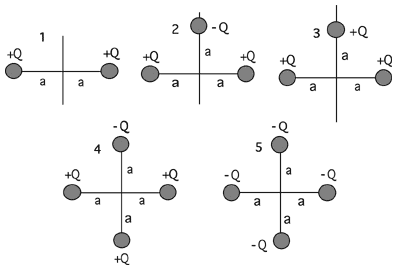
Which of the following charge distributions has the lowest electric
potential at the origin?


Commentary:

Answer

(5) This question serves to motivate a discussion of the
difference between potential energy in a configuration and the
electrostatic potential at a point. It is also important to stress that
potential when point charges are involved presumes that infinity is the
reference point.

A2L Item 170

Goal: Recognize macroscopic and microscopic quantities

Source: 283 Resistance variations with area.

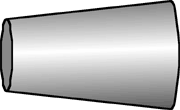
An
ohmic conductor is carrying a current. The cross-sectional area of the
wire changes from one end of the wire to the other. Which of the
following quantities vary along the wire?

  1. The resistivity
  2. The current
  3. The current density
  4. The electric field
  1. A only
  2. B only
  3. C only
  4. D only
  5. A and B only
  6. C and D only
  7. A, B, C, and D
  8. None of the above

Commentary:

Answer

(6) Students are likely to appreciate that the current density
varies and that the total current does not. Many will not recognize that
the electric field is related to the current density.

A2L Item 150

Goal: Link work and potential

Source: 283-465 Interpreting voltage

The potential at two points in space is: V1=200 Volts,
V2=300 Volts. Which of the following statements is true for
moving a point charge, q, from point 1 to 2?

  1. The work done by an external agent to
    move q from point 1 to 2 is positive.
  2. Can’t determine the work
    done because you don’t know the direction of V at the two points.
  3. The work done by the electrical force exerted on q in moving it from
    point 1 to 2 is: W = -q(100 Volts).
  1. A
  2. B
  3. C
  4. A and B
  5. A and C
  6. A, B, and C
  7. None of the above

Commentary:

Answer

(3) is the best response. Statement A is true only if the charge
is positive. The important thing is to see if students correctly
envision the electric field lines as directed from higher potential to
lower.

Any response involving statement B should be discussed thoroughly as it
indicates confusion between fields and potentials.

A2L Item 140

Goal: Link potential energy with work needed to assemble a charge configuration.

Source: 283-460 Lowest potential energy

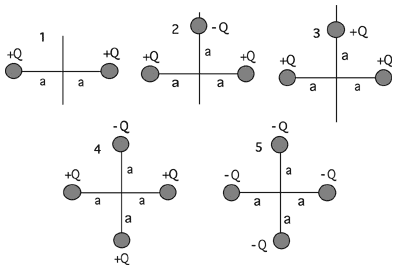
Which of the following charge distributions has the lowest potential
energy?


Commentary:

Answer

(2) Encourage students to reason to the answer rather than write
formal expressions for each case. They should be able to perceive that
cases #1, #3 and #5 all have positive PE. Situation #4 has zero energy
as can be seen by assembling subunits, then moving the two positive
charges along the zero equipotential of the charges on the y-axis.
Finally, situation #2 is clearly negative.

A good follow-up question is to ask students to order the cases
according to increasing potential energy.

A2L Item 135

Goal: Link electric fields, work and potential energy

Source: 283-455 Change in Potential Energy when moving a charge

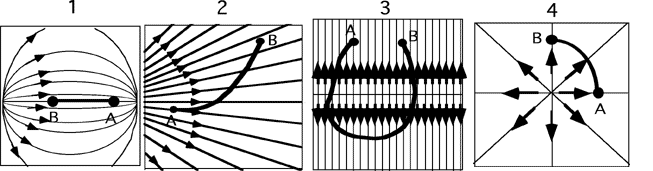
In each of the situations below a negative charge is moved along a path
from point A to point B in the presence of an electric field, as shown.
For which situation is the increase in potential energy the greatest?


Commentary:

Answer

(2) In case 1 the charge moves to a lower potential energy. In
case 3 the charge returns to a point having the same distance to the
plane of charge as it originally had, meaning no net work. In case 4 the
charge moves along an equipotential and no work is done. Students should
be asked to identify the charge configuration that could account for
each of these field situations. They can also be asked for which case is
the electrostatic potential change the greatest.

A2L Item 134

Goal: Link work and potential change

Source: 283-450 Move q, do most work

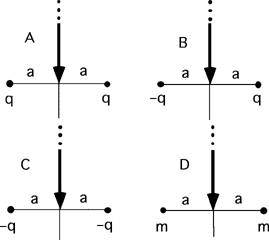
For
the following situations consider moving a positive charge from very far
away to the origin along the y-axis. For which situation would you do
the most work?

  1. A
  2. B
  3. C
  4. D
  5. A & C
  6. None of the above.
  7. Cannot be determined

Commentary:

Answer

(1) Students indicating #7 because they do not know if the masses
are charged should not be disconfirmed. If students key on magnitude
only they will likely choose answer #5.