Tag Archives: Electromagnetism

A2L Item 132

Goal: Link energy conservation and electromagnetism

Source: 283-421 Change of total energy
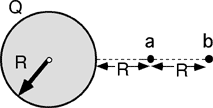
A
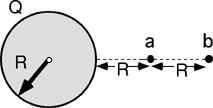
uniform volume distribution of charge has radius R and total charge Q.
A point charge -q is released from rest at point b, which is a distance
3R from the center of the distribution. When the point charge reaches a,
which of the following is true regarding the total energy, E?

  1. Ea = -Eb
  2. Ea = -2Eb/3
  3. Ea = -3Eb/2
  4. Ea = -9Eb/4
  5. Ea = Eb
  6. Ea = 2Eb/3
  7. Ea = 3Eb/2
  8. Ea = 9Eb/4
  9. None of the above
  10. Cannot be determined

Commentary:

Answer

(5) Students often forget to include the kinetic energy,
especially after a lot of discussion of potential energy. Many will
simply misinterpret the energy to mean potential energy. Teasing apart
these issues is important.

A2L Item 129

Goal: Hone the concept of electrostatic potential

Source: 283-420 Change of PE

A uniform volume distribution of
charge has radius R and total charge Q. A point charge -q is released
from rest at point b, which is a distance 3R from the center of the
distribution. When the point charge reaches a, which of the following is
true regarding the potential energy, U?

  1. Ua = -Ub
  2. Ua = -2Ub/3
  3. Ua = -3Ub/2
  4. Ua = -9Ub/4
  5. Ua = Ub
  6. Ua = 2Ub/3
  7. Ua = 3Ub/2
  8. Ua = 9Ub/4
  9. None of the above
  10. Cannot be determined

Commentary:

Answer

(7) Many students use an inverse square dependence appropriate
for fields. Others will take the field at b and multiply by the
displacement. Still others will assert that the potential doubles
because they are using the distance to the surface of the sphere.

A2L Item 127

Goal: Link flux to field lines.

Source: 283-415 nonzero flux?

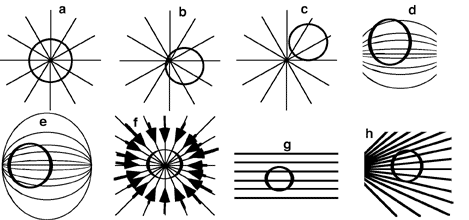
The circles in the picture below are Gaussian surfaces. All other lines
are electric field lines. For which cases is the flux non-zero?

  1. a
  2. a, b, and f
  3. a, b, e, and f
  4. a, b, d, e, and h
  5. a and b
  6. All but g
  7. All of them
  8. None of the above
  9. Cannot be determined

Commentary:

Answer

(2) As “follow-up” it is good to ask questions about comparisons
between two or more of the situations. For example, which is flux is
larger, a or f? Such questions help determine what students are focused
upon; are they keying on number of lines, do they understand that the
flux can be negative.

A2L Item 124

Goal: Link flux and enclosed charge.

Source: 283-410 Flux greatest?

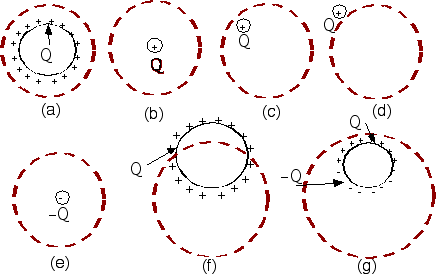
Consider the flux through the following spherical Gaussian surfaces.
Take each charge distribution to be either a point charge or a spherical
shell of charge (uniformly distributed). For which situation is the flux
greatest?

  1. a and c
  2. a, b, and c
  3. b
  4. a
  5. b, c, and e
  6. a, f, and g
  7. b, c, and g
  8. Other

Commentary:

Answer

(2) All these have the same flux. Some students do not read the question
carefully and think the number of ‘+’ signs matter.

A2L Item 123

Goal: Reasoning with electric fields.

Source: UMPERG-A2LEM7

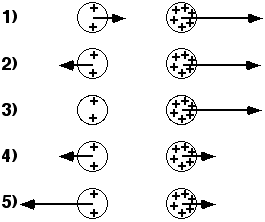
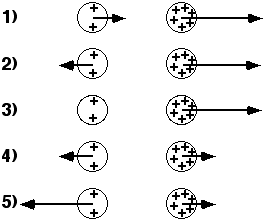
The diagrams show two uniformly charged spheres. The charge on the
right sphere is three times as large as the charge on the left sphere.
Each vector represents the electric field at the center of one sphere
caused by the other sphere
. Which choice best represents the
magnitude and direction of the electric field vectors caused by one
sphere at the position of the other sphere?


Commentary:

Answer

(5) The electric field at the sphere with smaller charge is three times
larger than the field at the sphere with larger charge.

A2L Item 122

Goal: Reasoning with Coulomb’s law

Source: UMPERG-A2LEM6

The diagrams show two uniformly charged spheres. The charge on the
right sphere is three times as large as the charge on the left sphere.
The arrows on each charge represent the force on the charge. Which
force diagram best represents the magnitude and direction of the
electric forces on the two spheres?


Commentary:

Answer

(4) By Newton’s third law the forces are equal and opposite.

A2L Item 118

Goal: Hone the vector nature of electric force.

Source: UMPERG-A2LEM2

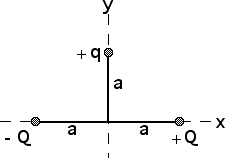
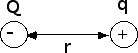
Two charges, a negative charge Q, and a positive charge q, are
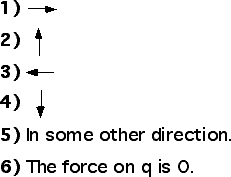
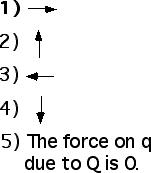
positioned as shown in the diagram. What is the direction of the
electrical force on q due to Q?


Commentary:

Answer

(3) The force is attractive.