Tag Archives: Forces

A2L Item 094

Goal: Problem solving

Source: UMPERG-ctqpe162
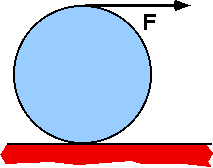
A uniform disk with R=0.2m rolls without slipping on a horizontal
surface. The string is pulled in the horizontal direction with force
15N. The disk’s moment of inertia is 0.4 kg-m2. The friction
force on the disk is:

  1. 0
  2. 15N, to the right
  3. 10N, to the left
  4. 5N, to the right
  5. 5N, to the left
  6. None of the above
  7. Cannot be determined

Commentary:

Answer

(4) This problem can be done without the arithmetic complication of
finding the mass from the center-of-mass moment of inertia. This is an
excellent problem for stressing multiple solution methods. This is a
situation where two equations are needed. They can be either the linear
dynamical relation and a rotational dynamical relation, or just two
rotational relationships about different points. Some students may
answer (7) because they are unfamiliar with the expression for moment of
inertia about the CM or because they do not know the Parallel Axis
theorem.

A2L Item 084

Goal: Reasoning with dynamics.

Source: UMPERG

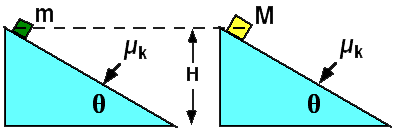
Two masses (M > m) are on an incline. Both surfaces have the same
coefficient of kinetic friction. Both objects start from rest, at the
same height. Which mass has the largest speed at the bottom?

  1. m
  2. M
  3. Both have the same speed.
  4. Cannot be determined

Commentary:

Answer

(3) Both will have the same speed. All the forces acting on the mass
(normal, friction, gravity) are proportional to the mass so the mass
cannot affect the acceleration experienced by the mass.

A2L Item 077

Goal: Contrast the concepts of impulse and work.

Source: UMPERG-ctqpe127

Consider the following statements:

A. If an object receives an impulse, its kinetic energy must change.

B. An object’s kinetic energy can change without it receiving any impulse.

C. An object can receive a net impulse without any work being done on it.

D. A force may do work on an object without delivering any impulse.

Which of the following responses is most appropriate?

  1. None of the statements are true.
  2. Only statement A is true.
  3. Only statement B is true.
  4. Only statement C is true.
  5. Only statement D is true.
  6. Two of the statements are true.
  7. Three of the statements are true.
  8. All of the statements are true.
  9. Cannot be determined.

Commentary:

Answer

(4) We consider only a simple object with no internal structure. A mass
traveling in a circle with constant speed (mass on a string, satellite
in circular orbit or marble rolling around a hoop on a horizontal
surface) receives a net impulse, say, every quarter circle without any
work being done because the force is perpendicular to the motion.

Background

Students need to sort out the difference between impulse (integral of
force over time) and work (integral of force over displacement). This
question is most easily answered considering the impulse-momentum
theorem and the work-kinetic energy theorem. The example mentioned in
the answer to demonstrate the truth of statement C also serves to
demonstrate the falseness of statement A. As for statement B, if an
object’s KE changes its momentum must change so it must have received an
impulse. Statement D is also false because if a force does work on the
object it must have acted over time.

Questions to Reveal Student Reasoning

A book sits at rest on a table. Does gravity do work on the book? Does
gravity provide an impulse?

Compare a satellite in circular orbit around the Earth with a simple
pendulum. Does gravity deliver an impulse over a quarter cycle? a half
cycle? a whole cycle? Does gravity do work on the object over a quarter
cycle? a half cycle? a whole cycle?

Suggestions

Ask students to create physical situations meeting certain
specifications. E.g. A situation for which a force acts over a
particular time causing a change of momentum but no change in kinetic
energy (mass on a spring).

A2L Item 071

Goal: Recognize forces that do work, that is those with associated displacement.

Source: UMPERG-ctqpe52

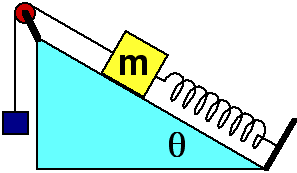
A block having mass m moves along an incline having friction as shown in
the diagram above. The spring is extended from its relaxed length. As
the block moves a small distance up the incline, how many forces do work
on the block?

  1. One force
  2. Two forces
  3. Three forces
  4. Four forces
  5. Five forces
  6. Six forces
  7. Seven forces
  8. None of the above
  9. Cannot be determined

Commentary:

Answer

(4) Four forces do work on the block: gravitation, rope, spring, kinetic
friction (because you are told the block moves). The normal force does
no work.

Background

Recognizing those forces that do work is an important skill for students
to master. They also need to recognize whether the work is positive or
negative.

Questions to Reveal Student Reasoning

As the block moves up the plane, which forces do positive work? negative
work? How are you determining which it is? How would your answer to the
above question change if the spring were compressed rather than
extended.

Suggestions

Set up some situations with blocks, springs and ropes and let students
practice identifying all the forces doing work. This is a good activity
to do in conjunction with drawing free body diagrams.

A2L Item 070

Goal: Recognizing the presence of forces.

Source: UMPERG

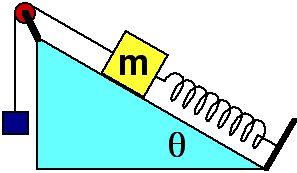
A block having mass m moves along an incline having friction as shown in
the diagram above. As the block moves a small distance along the
incline, how many forces act on the block?

  1. One force
  2. Two forces
  3. Three forces
  4. Four forces
  5. Five forces
  6. Six forces
  7. Seven forces
  8. None of the above
  9. Cannot be determined

Commentary:

Answer

(5) Five forces act on the block: gravitation, rope, spring, kinetic
friction (because you are told the block moves), and normal due to the
incline. Many student errors are due to the failure to identify all of
the forces acting on a body.

Background

It is helpful to classify forces into action-at-a-distance forces, such
as gravity and electromagnetism, and contact forces. Students can then
employ a strategy for identifying all the forces since every object
touching a body will give rise to a force. The only exceptions are the
fundamental forces, which is an easily exhausted list.

Questions to Reveal Student Reasoning

Does it matter if the block is moving up the plane or down? If the block
is at rest, how many forces MUST be acting on the block? How many forces
may be acting but you can’t be sure?

Suggestions

Set up some situations with blocks, springs and ropes and let students
practice identifying all the forces. This is a good activity to do in
conjunction with drawing free body diagrams.

A2L Item 067

Goal: Recognize physical conditions under which conservation principles hold.

Source: UMPERG-ctqpe144

A
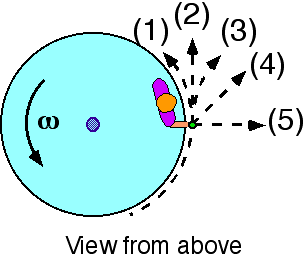
child is standing at the rim of a rotating disk holding a rock. The
disk rotates without friction. The rock is thrown in the RADIAL
direction at the instant shown. What quantities are conserved during
this process?

  1. Only angular momentum is conserved.
  2. Only mechanical energy is conserved.
  3. Both angular momentum and mechanical energy are conserved.
  4. Neither is conserved.
  5. cannot be determined.

Commentary:

Answer

(1) is the correct response if the rock is thrown radially. The change
in velocity of the rock and, therefore its change in momentum, is in the
radial direction. The net torque on the system is zero so the angular
momentum cannot change. Some students may be tempted to choose (3) but,
since the rock is thrown via biological processes (as opposed to
mechanical processes), mechanical energy is not conserved.

Background

Throwing the rock radially, clearly increases the kinetic energy but not
the angular momentum. This item provides a mechanism for a rich
discussion of the source of the kinetic energy.

Questions to Reveal Student Reasoning

Does the rock have angular momentum (or energy) just before it is
thrown? just after it is thrown?

If energy (angular momentum) is gained, where does it come from?

Changes in angular momentum are caused by a net torque. What torques
act on the system during the process of throwing?

Suggestions

Have the students do a ‘thought’ experiment by considering a spring
loaded gun mounted on a rotating turntable aimed outward along a radius.
The spring is released firing a small ball outward. This situation
makes it easier for some students to identify the source of additional
kinetic energy. Further, since the force applied is parallel to the
radius, there is no angular impulse and no change in angular momentum in
the system. Have students relate their answer to this question to the
previous one. Also contrast this and the previous one to items 64 and
65.

A2L Item 061

Goal: Hone the vector nature of force.

Source: UMPERG

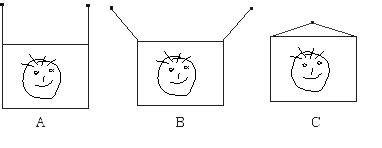
Three picture frames having the same mass are each hung from a wall
using two pieces of string.

For which situation is the tension in the two strings the greatest?

  1. A
  2. B
  3. C
  4. The tension in the two strings is the same for all three situations
  5. None of the above
  6. The tension cannot be compared

Commentary:

Answer

(3) The tension will be largest on the wires that are
most nearly horizontal. The minimum tension is in the vertical wires,
and each wire has a tension equal to half the weight of the picture.
Some students may think that the tension is the same no matter how the
wires are arranged. One way to convince them that this is not the case
is to have two students support a heavy object by pulling on ropes
attached to the object. As they move apart they easily perceive the
need to pull harder.

A2L Item 060

Goal: Hone the vector nature of force and identify all the forces.

Source: UMPERG

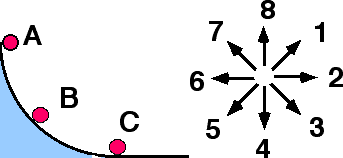
A small ball is released from rest at position A and rolls down a
vertical circular track under the influence of gravity as depicted
below.

When the ball reaches position B, which of the indicated directions most
nearly corresponds to the direction of the net force on the ball?

Enter (9) if the direction cannot be determined.


Commentary:

Answer

(9) The net force is the sum of the forces acting on the ball. If the
ball rolls along the track there is a normal force, a friction force and
a gravitational force being exerted on the ball. Although a best answer
can be determined it would require a good understanding of dynamics,
energy, and circular motion to achieve and we assume the student is
addressing this question before all these elements are in place. [The
actual answer is (2) but few students are able to appreciate that
without much thought.]

Background

To become adept at identifying forces, students should consider a wide
array of situations, even if the situations are too complex for them to
fully analyze. To determine the direction of the net force students
need to be able to judge the relative sizes of forces.

Questions to Reveal Student Reasoning

What forces are being exerted on the ball? What are the directions of
these forces? What are the relative sizes of the different forces?

Suggestions

Consider a block sliding down an incline at 450? How does
the block on an incline compare to the ball on the curved track? What
are some similarities and differences?

A2L Item 056

Goal: Honing the concept of normal force and reasoning.

Source: UMPERG-MOP

Consider the five situations appearing below. All the blocks have the
same size and density.

Which of the following statements is true regarding the normal force
that the table or incline exerts on the block in contact with it?

  1. ND > NC = NA = NE > NB
  2. ND = NA > NC > NE = NB
  3. NC > ND > NA > NE > NB
  4. ND = NA = NC > NE > NB
  5. NA > ND = NC > NB > NE
  6. ND = NA = NE > NC > NB
  7. More than one of the above is true.
  8. None of the above is true.
  9. Cannot be determined.

Commentary:

Answer

(8) All that can be said with certainty is that none of the above is
true. First, it is impossible to determine the relationship between
NB and NE. Both are less than the weight, but
which is least depends upon unknown angles and the tension in the rope.
Further, NC is largest because all of the other cases have a
buoyancy force due to air. Some students may indicate (9) for the same
reasons as stated above. However, technically, the truth or falsity of
(1) to (7) can be determined.

Background

Students often think that the Normal force must be vertical because all
of the examples they have seen are of this type. Other students may
think that the deformed table is indicative of a greater (or lesser)
normal force. A subtle issue is that the block under the bell jar will
not have a buoyant force due to the air. While this is a small force,
its absence means that the normal force in case C is largest of all.

Suggestions

Have students identify the basis of falseness of each of the statements.

A2L Item 055

Goal: Classify forces and hone the concept of contact force.

Source: UMPERG

A person throws a ball straight up in the air. The ball rises to a
maximum height and falls back down so that the person catches it. What
forces are being exerted on the ball when it is half way to the maximum
height? Ignore air resistance.

  1. The gravitational force only.
  2. The force of the person’s hand only.
  3. Both the gravitational force and the force of the person’s hand.
  4. The gravitational force, the force of the person’s hand, and a third
    force.
  5. None of the above
  6. Cannot be determined

Commentary:

Answer

(1); nothing is in contact with the ball (we ignore forces due to the
air), and so the earth’s gravitational force is the only
“action-at-a-distance” force present.

Background

It is common for students to think that motion requires a force; in some
cases this misconception is more specific, namely, that motion requires
a force in the direction of motion. For this assessment item, the
misconception manifests itself in the belief that there is a “force of
the hand” that propels the ball up during flight.

Questions to Reveal Student Reasoning

Ask students to state what forces are acting on the ball and what object
exerts each force.

How do you know when a force is being exerted by one object on another?

Do the sizes of the forces change? Do the directions of the forces
change? Describe how and why.

Do you have any control over the force of the hand on the ball while the
ball is in the air? Can you make it larger or smaller or change its
direction once you release the ball?

Suggestions

Have students brainstorm situations in which two objects interact
without touching each other. Use as the criteria for an interaction
that an object move or change shape. Have students divide their
situations into two groups: those for which the objects interact
directly, and those for which the objects interact through some other
object (e.g., two blocks “interact” through a spring placed between
them).

Eventually raise the point that in physics the term force refers to
direct interactions only and that most objects interact only when placed
in contact. Demonstrate electric and magnetic forces as examples of
“action-at-a-distance” forces.