Tag Archives: Forces

A2L Item 043

Goal: Identifying and classifying forces.

Source: UMPERG

Three blocks are stacked as shown below.
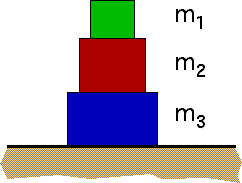
How many forces are acting on the bottom block (m3)?

  1. One force
  2. Two forces
  3. Three forces
  4. Four forces
  5. Five forces
  6. Six forces
  7. More than six forces
  8. No forces act on the block
  9. Cannot be determined

Commentary:

Answer

(3); The gravitational force exerted by the earth, the normal force
exerted by the horizontal surface, and the normal force exerted by the
block with mass m2.

Background

Some students have difficulty distinguishing between direct and indirect
interactions. Students may take the view that m1 directly
exerts a force on m3. This view is often verbalized as “the
weight of block m1 is exerted on m3.”

It is helpful to classify forces into action-at-a-distance forces, such
as gravity and electromagnetism, and contact forces. Students can then
employ a strategy for identifying all the forces since every object
touching a body will give rise to a force. The only exceptions are the
fundamental forces, which is an easily exhausted list.

Questions to Reveal Student Reasoning

Does m3 exert a force on m1?

What part of m2 interacts with m3? What part of
m1 interacts with m3?

Is weight a force? If so, what object exerts the force?

Can an object interact with another object without touching it? If so,
when? If not, why not?

Is the normal force exerted by m2 on m3 less than,
equal to, or greater than the weight of m2?

Suggestions

If one pushes on both sides of a bathroom scale the scale reading will
change. What does the scale measure. How is the reading related to the
forces exerted on the scale?

If bathroom scales are placed between the blocks, what forces would each
scale measure (assuming that the scales themselves have very little mass
compared to the mass of the blocks)?

A2L Item 039

Goal: Reasoning.

Source: UMPERG-ctqpe28

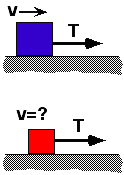
A block is on a horizontal surface. When the block is pulled by a rope under
tension T, the block moves with constant speed. If the same tension were
applied to a smaller block made of the same material and at rest on the
same surface, the block would:

  1. Remain at rest.
  2. Accelerate.
  3. Move with constant speed.
  4. None of the above.
  5. Cannot be determined.

Commentary:

Answer

(5); in the first case, the net force is 0, so T=μkMg. In
the second case, the static friction force must be overcome for m to
move. Since μsk, but m<M, it cannot
be determined if μsmg is smaller or larger than T.

Background

This item requires that students combine knowledge from different
topics: Static Friction, Kinetic Friction, and Newton’s Second Law.
Students have to deduce information (e.g., in the first situation
students must deduce that the kinetic friction force is balanced by the
tension force to give a net force of 0). Students must also know that,
since the static friction coefficient is larger than the kinetic
friction coefficient, the maximum static friction force is larger than
the kinetic friction force. Finally, students must be able to reason
about compensating quantities-in this case, although m goes down, μ
goes up, so the product of m, μ, and g may, or may not, be larger
than T. The relationship between students’ answers and their
assumptions should be the focus of the class discussion, not the
correctness of any particular answer.

Questions to Reveal Student Reasoning

Why does the block of mass M move with constant speed? If the block of
mass M were at rest would the tension force cause it to move?

What quantities affect the size of the friction force?

What determines whether the block of mass m will move?

Suggestions

Ask students to consider the limiting case where m is less than, but
almost equal to M. What would happen if m were pulled with tension T.
Students should be able to reason (perhaps with some coaching) that m
will remain stationary since the maximum static friction force is larger
than T.

Then ask them to consider the limiting case where m is much less than M.
What would happen if m were pulled with tension T. Students should be
able to reason that m will accelerate.

Finally, ask what happens “in between” these two limiting cases.

A2L Item 037

Goal: Translate a verbal description of physical motion to graph of force.

Source: UMPERG

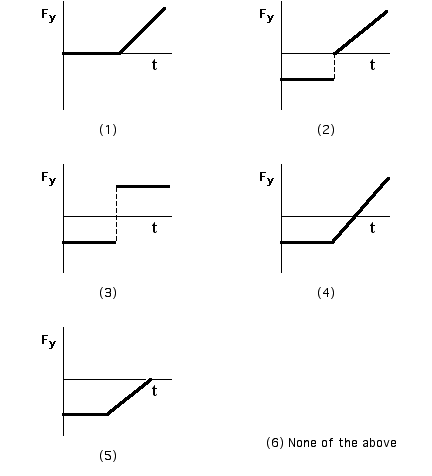
A block is dropped onto a vertical spring. Which net force vs. time
graph best represents the net force on the block as a function of time?
Consider only the motion of the block from the time it is dropped until
it first comes to rest.


Commentary:

Answer

(4); Some students may select (5) confusing the equilibrium point with the point where the block comes to rest. Students selecting (2) are ignoring gravity after the block hits the spring.

A2L Item 035

Goal: Interpreting strobe diagrams in conjunction with verbal information.

Source: UMPERG

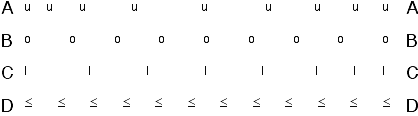
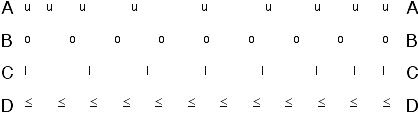
Below is shown a strobe diagram indicating the position of four objects
at successive time intervals. The objects move from left to right.

Each of the objects shown experiences a constant friction force as they
slide across the floor. Which of the objects definitely experiences a
force in addition to sliding friction?

  1. Object A only
  2. Object B only
  3. Object C only
  4. Object D only
  5. Objects A and B
  6. Objects B and C
  7. Objects A and C
  8. None of the above
  9. Cannot be determined

Commentary:

Answers

(8); Object (C) slows down and this could be due to a sliding friction force acting to the left. Given that there is a friction force, the objects moving with constant velocity (B and D) must have an additional force. Likewise (A), which accelerates duting the first part of its motion, must have an additional force to the right.

A2L Item 034

Goal: Comparing the relative size of forces from changes in position.

Source: UMPERG

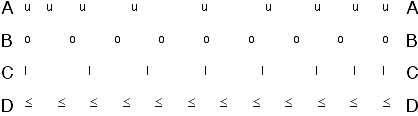
Below is shown a strobe diagram indicating the position of four objects
at successive time intervals. The objects move from left to right.

During the intervals shown, which of the objects experiences the largest
net force?

  1. Object A only
  2. Object B only
  3. Object C only
  4. Object D only
  5. Objects A and B
  6. Objects B and C
  7. Objects A and C
  8. None of the above
  9. Cannot be determined

Commentary:

Answer

(9); It is not possible to determine the size of the net forces without
knowledge of the masses of the objects. Because the horizontal force in
(A) points initially to the left, then to the right, students may say
that the net force is zero, which is true only for a time average.

A2L Item 033

Goal: Perceiving the presence of forces from changes in position.

Source: UMPERG

Below is shown a strobe diagram indicating the position of four objects
at successive time intervals. The objects move from left to right.

During the intervals shown, which of the objects experience no net force
in the horizontal direction?

  1. Object A only
  2. Object B only
  3. Object C only
  4. Object D only
  5. Objects A and B
  6. Objects B and C
  7. Objects A and C
  8. None of the above
  9. Cannot be determined

Commentary:

Answer

(8); Objects with no net horizontal force will move with constant velocity. The objects moving with constant velocity are B and D. This question helps to reinforce the idea that it is change in motion, not motion itself, that requires a force.

A2L Item 032

Goal: Hone the vector nature of force and how the net force can be determined from the 2nd law.

Source: UMPERG

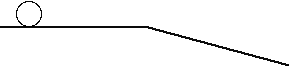
A soccer ball rolls across the road and down a hill as shown below.

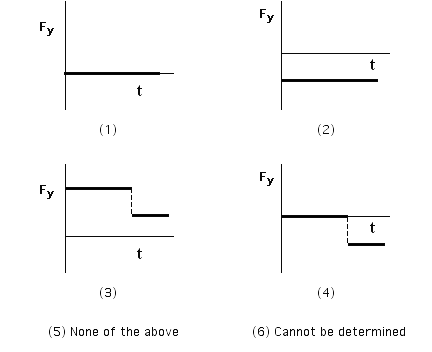
Which of the following sketches of Fy vs. t represents the net vertical
force on the ball as a function of time?


Commentary:

Answer

(4); on the horizontal partion there is no net force, and therefore no Fy. On the slope the net force in the y direction is due to gravity and a component of the normal force. Alternatively, since the ball accelerates along the slope, the net force must be parallel to the slope and have a component in the vertical direction.

A2L Item 031

Goal: Hone the vector nature of force and interrelate model and procedure forces.

Source: UMPERG

A marble rolls on to a piece of felt and slows down.

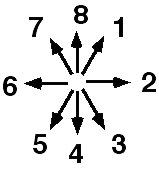
Indicate the direction that most nearly corresponds to the direction of
the force that the marble exerts on the felt. If none of the directions
are appropriate, or if the answer cannot be determined, respond (9).


Commentary:

Answer

(3) The force the felt exerts on the marble is up (normal force) and to
the left (friction force). Newton’s third law tells us that the force
the marble exerts on the felt must be down and to the right. Students
may focus on the normal force alone (4) or the friction force alone (2).
These are not two forces, but the components of a single force.
Students also find it difficult to extract some information from the
dynamical statement “slows down” and integrate this with the familiar
normal force.

Background

This presents an interesting twist to students. The friction force is
usually formulated in terms of a moving object and a fixed surface.
Students may not know for sure whether there is a friction force on the
felt – the felt is not moving. The analysis on the marble is reasonably
straightforward. Newton’s third law can be used to determine the force
on the felt if the force cannot be determined from the situation
directly.

Questions to Reveal Student Reasoning

Question students about how they got their answer. Did they use the
force laws that they learned previously? Did they use Newton’s second
or third laws?

Suggestions

Instead of a marble consider a sliding block and see if students think
differently – some students will have difficulty thinking about friction
with a rolling object.

A2L Item 030

Goal: Reasoning with 2nd law and honing of the concept of tension.

Source: UMPERG

Consider the three cases presented below. Assume the friction force
between the table and block in situations (B) and (C) can be ignored.

Which of the following statements about the tensions in the strings is
true?

  1. TA = TB = TC
  2. TB = TC < TA
  3. TA < TB < TC
  4. TB < TC < TA
  5. TA = TC < TB
  6. None of the above
  7. The relationship of the tensions cannot be determined

Commentary:

Answer

(4) By applying Newton’s second law to the hanging block one obtains a
relationship between the tension in the string and the acceleration of
the hanging block: The larger the acceleration the smaller the tension
force. The acceleration is determined by the total mass of the system.

Background

This is a good problem for challenging students to reason without
resorting to writing down a lot of equations. As one of the procedure
forces (tension, normal, static friction), the value of tension requires
application of the 2nd law.

Questions to Reveal Student Reasoning

What is the tension in situation (A)? Explain. Is the tension equal to
the weight in situation (B)? (If some students think so explore what
the net force is on the hanging mass, which will lead to a net force of
O, and a contradiction since this implies O acceleration.) Of systems
(A) and (B), which has the larger acceleration?

Suggestions

Ask students to consider limiting cases. What if the string was not
attached to a block on the table (or if the block had almost no mass)?
What would happen if the block on the table had a very large mass ?

A2L Item 029

Goal: Analyze the role of internal and external forces and the difference between static and kinetic friction.

Source: UMPERG

A person sits in an office chair with small wheels that swivel. The
person claims she can move the chair across the room without touching
anything but the chair, simply by kicking her legs outward. This claim:

  1. Is consistent with Newton’s laws and can be done.

  2. Is consistent with Newton’s laws but cannot be done.

  3. Is not consistent with Newton’s laws and, therefore, cannot be done.

  4. Is not consistent with Newton’s laws but nevertheless can be done.

  5. It is not possible to determine the correctness of the claim.


Commentary:

Answer

(1); the process is possible because sudden impulse due to internal
forces can exceed the static friction limit. By rapidly extending legs,
alternated by slow retraction, the chair can be moved. Students are
often aware of this but find it difficult to explain in terms of forces
and dynamics.