Tag Archives: Forces

A2L Item 028

Goal: Reasoning using the 2nd law.

Source: UMPERG

A tow truck (2,000kg) pushing a car (1000kg) experiences an average
friction force of 13,000N while accelerating from rest to a final
velocity of 36 mi/hr (16 m/s). The air and the road exert an average
resistive force of 1,000N on the car. What force does the car exert on
the tow truck?

  1. 1,000N
  2. 2,000N
  3. 4,000N
  4. 5,000N
  5. 6,000N
  6. 12,000N
  7. 14,000N
  8. None of the above
  9. Cannot be determined

Commentary:

Answer

(4) The net force on the car and tow truck is 12,000N (13,000N –
1,000N). The acceleration is 4m/s2. The magnitude of the force between
the two vehicles is 5,000N.

Background

Answers are not as important as approach. What did students do to
understand the physical situation? Did they draw pictures. Did they
draw a free-body diagram.

Questions to Reveal Student Reasoning

Ask a couple of students to describe how they approached the problem.
Ask them to describe the steps they took without getting into
mathematical details. For example, did they draw a free-body diagram?
What forces did they consider? What system did they analyze?

Suggestions

After a couple of descriptions of how to approach solving the problem,
work through the problem with help from the class.

A2L Item 027

Goal: Contrast internal, external forces and net force.

Source: UMPERG

A toy
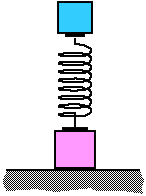
is made from two blocks and a spring as shown at right. When the spring
is compressed and suddenly released, the toy will jump off the table
surface. Which of the following is true about the net force on the toy
just after it is released?

  1. The net force is zero.
  2. The net force points up.
  3. The net force points down.
  4. The direction of the net force cannot be determined.

Commentary:

Answer

(2); This question seems difficult but it is available
to beginning students. Students can analyze the problem considering the
entire toy as a single system or decompose into the separate masses.
Viewed as a single system, since the center of mass accelerates up, the
net force must point up. Free body diagrams for each mass individually
would show no net force on the bottom mass (because the normal force
assumes a value necessary to balance gravity and spring force) and a
large net force on the upper mass (spring force exceeds gravity). If
sketched to scale, the two can be added showing that the net force
derives from the normal force on the lower block.

Background

This question is intended to have students distinguish between internal
and external forces. The question also can be approached in a variety
of ways.

Questions to Reveal Student Reasoning

Can the toy ever leave the surface? Would there be a net force if it
did leave the surface?

A2L Item 026

Goal: Reasoning with 2nd law.

Source: UMPERG

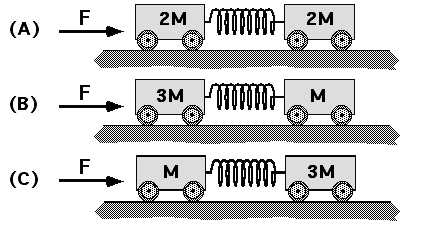
Consider the three situations shown below. In each case two small carts
are connected by a spring. A constant force F is applied to the
leftmost cart in each case. In each situation the springs are
compressed so that the distance between the two carts never changes.

Which of the following statements must be true regarding the compression
of the spring in each case? Assume the springs are identical.

  1. Compression A = Compression B = Compression C
  2. B = C < A
  3. A < B = C
  4. A < B < C
  5. B < A < C
  6. C < A < B
  7. A < C < B
  8. None of the above
  9. Cannot be determined

Commentary:

Answer

(5) The total mass is the same so the acceleration of the systems must
be the same. In each case the spring exerts the only horizontal force
on the cart to the right. The spring force must be largest for the 3M
cart and smallest for the M cart: B < A < C.

Background

This item requires students to reason. It is difficult to resort to
equation manipulation to answer this question. One difficulty with the
problem is that it involves a complex system (two carts connected by a
spring).

Questions to Reveal Student Reasoning

Is it really possible to compress the carts so that they stay a fixed
distance apart? What forces act on each cart? Will the carts
accelerate or move with a constant velocity? Compare the carts
acceleration.

Suggestions

Draw a free-body diagram for each cart.

Define a new problem in terms of the carts on the right: Each cart is
given an applied force so that each has the same acceleration. How do
the applied forces compare?

A2L Item 025

Goal: Relate position/time graphs to force.

Source: UMPERG

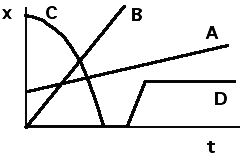
Position vs. time graphs are given below for four different objects.

Which of the objects experiences a net force sometime during the time
period shown?

  1. Only object A
  2. Only object B
  3. Only object C
  4. Only object D
  5. Objects B and D
  6. Objects A and C
  7. Objects B and C
  8. None of the above
  9. Cannot be determined

Commentary:

Answer

(8) is the appropriate response because both C and D experience a force
during the time interval. A and B have constant velocity because the
slope of their x vs. t plot is constant. Some students may not realize
that D experiences a force because they will reason that D has constant
velocity at any given time. However, D must experience a force to
change its velocity.

Background

Recognizing the signature of acceleration from a plot of position vs.
time is an important skill for students to develop. Because of
familiarity, they may recognize the plot of position for a falling body
and reason that the object experiences a gravitational force. This
question requires two logical steps. First recognizing the consequence
of constant velocity and second recognizing that a change of velocity
indicates acceleration and therefore force.

Questions to Reveal Student Reasoning

Which objects have constant velocity throughout the time interval?

Which of the objects has the largest speed sometime during the time
interval?

Are all of the objects moving away from the origin?

Suggestions

Have students plot the velocity of each object over the same time
interval.

Have students move objects in a manner in accord with the plots. This
may cause them to realize when a force must be applied.

A2L Item 023

Goal: Develop good problem solving practices. Determining the value of procedure forces, those requiring use of the 2nd law.

Source: UMPERG

A child is walking along the sidewalk at a constant speed of 1 m/s while
pulling his dog sitting in a wagon. The dog has a mass of 30kg and the
wagon weighs 50N. If the child pulls the wagon with a force of 60N at an
angle of 30°, what is the frictional force exerted by the wagon on
the dog?

  1. 0N
  2. 2N
  3. 5N
  4. 10N
  5. 15N
  6. 20N
  7. 32N
  8. None of the above
  9. Cannot be determined

Commentary:

Answer

(1) The dog is moving at a constant speed, presumably in a straight
line. The net force on the dog must be zero. Since there are no other
possible horizontal forces (if we ignore air resistance) other than the
friction force, the friction force must be zero.

Background

This problem provides students with a lot of information. The challenge
of the problem (and most real problems) is to come to an understanding
of the situation independent of the specific details. Then based on an
understanding of the situation one can attempt to address specific
questions and make use of detailed information.

Questions to Reveal Student Reasoning

Ask students to describe the situation. Ask them to describe how they
approached the problem. Did you describe all the forces? Did you draw
any free-body diagrams?

Suggestions

Have students draw a free-body diagram (drawing all possible forces) for
the dog. Have them describe the motion for the dog. Ask them to
re-answer the question.

A2L Item 021

Goal: Develop the ability to identify 3rd-Law Pairs, the parts of an interaction.

Source: UMPERG-ctqpe42

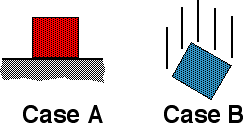
The two blocks shown below are identical. In case A the block sits on a horizontal surface and in case B the block is in free fall.

Which of the following statements are true regarding the reaction force to the gravitational force exerted on each block?

  1. In case A the reaction force is the Normal force.
  2. In case B the reaction force is zero.
  3. The reaction force is larger in A than B.
  4. All the above are true.
  5. Only (1) & (2) are true.
  6. None of the above are true.
  7. Cannot be determined.

Commentary:

Answer

(6) The reaction force to the gravitational force exerted (by the
earth) on a block is the gravitational force exerted (by the block) on
the earth. In both cases the reaction force is non zero and because the
blocks are identical the reaction forces for the two cases are
equal.

Background

Newton’s third law can be counter intuitive to many students and the
concept of reaction force can be very confusing. Students often think
that the reaction force to some force exerted on an object is a
balancing force on the same object.

(1) Many students will think the normal force is the reaction force
because it is equal and opposite to the gravitational force exerted on
the block.

(2) Some students may reason that since there is no balancing force
there is no reaction force.

Questions to Reveal Student Reasoning

What is a reaction force? What are some examples? Do action-reaction
force pairs act on the same, or different bodies? Why is reaction force
an important idea?

Suggestions

Reaction force is an abstract concept. It cannot be demonstrated. One
needs to make sure students understand its definition. The first step is
to make sure students understand the idea of an interaction: When two
objects affect each other (i.e., influence each others motion, or shape)
then we say that the objects interact. We find that all interactions are
two-way: if the motion/shape of one of the interacting objects is
affected then the motion/shape of the other object is always affected.
We ultimately quantify the effects and refer to the causes of these
effects as forces. An interaction involves two forces, one on each
object. Action-reaction pair refer to the two parts (forces) of an
interaction. Newton’s third law states the relationship between the two
parts (forces) of an interaction: the two forces are equal in magnitude
and point opposite in direction.

A2L Item 020

Goal: Recognizing how the concept of force relates to interactions.

Source: UMPERG

A bowling ball rolls down an alley and hits a bowling pin. Which
statement below is true about the forces exerted during the impact?

  1. The bowling pin exerts a larger force on the ball than the ball does
    on the pin.
  2. The bowling ball exerts a larger force on the pin than the pin does
    on the ball.
  3. The force that they exert on each other is the same size.
  4. One of the two forces is larger, but which is larger can’t be
    determined unless more information is provided.
  5. None of the above.
  6. Cannot be determined

Commentary:

Answer

(3); The forces are equal (independent of the masses and motions of the
interacting objects), as required by Newton’s Third Law .

Background

In situations where a heavier, moving object collides with a lighter,
stationary object, students have a very strong intuition that the
heavier, moving object exerts a larger force on the lighter, stationary
object. This intuition is based on experiences like the following: when
a bowling ball hits a pin, the ball continues to move forward and the
pin goes flying off the lane. Students interpret the large change in the
pin’s motion as evidence that the ball (which is heavier than the pin)
exerts a larger force on the pin than vice versa. Often, when a car and
a truck collide, the car suffers much more damage than the truck, and so
students interpret this as evidence that the truck exerts a larger force
on the car. For background reading on helping students overcome this
persistent misconception see Thornton and Sokoloff: Sokoloff, D.R.
& Thornton, R.K. (1997), Using interactive lecture demonstrations to
create an active learning environment, The Physics Teacher, 27, No. 6,
340; and Thornton, R.K. and Sokoloff, D.R. (1998), Assessing student
learning of Newton’s Laws: The force and motion conceptual evaluation
and the evaluation of active learning laboratory and lecture curricula,
American Journal of Physics, 64, 338-352 (1998).

Questions to Reveal Student Reasoning

Which object, the bowling ball or the bowling pin, has the larger
acceleration? How do you know?

Which object experiences the larger net force? How do you know?

Would your answer to the original question change if a moving pin hit a
stationary bowling ball?

Suggestions

If you have MBL equipment and force probes, collide a moving cart with a
stationary cart of the same mass. Ask students to compare the forces
exerted on the two carts. Ask students to compare the velocities and
accelerations of the two carts. Repeat using different initial
conditions.

Draw a picture of a large moving cart colliding with a small stationary
cart. Draw a spring between the carts. Ask students how they would
determine the force on each cart given the spring constant and spring
compression.

Take a bathroom scale, place it between two students (a large strong
student and a slight student) and have them push as hard as they can
from either end without making the scale accelerate–observe the scale
reading. Repeat with the scale reversed. Ask if there is much
difference in the scale reading depending on which way the front of the
scale is facing. What does this imply about the forces exerted by the
strong and the slight student on each other?