Tag Archives: Friction

A2L Item 084

Goal: Reasoning with dynamics.

Source: UMPERG
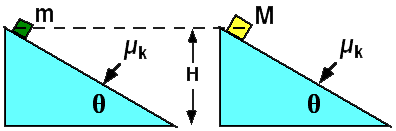
Two masses (M > m) are on an incline. Both surfaces have the same
coefficient of kinetic friction. Both objects start from rest, at the
same height. Which mass has the largest speed at the bottom?

  1. m
  2. M
  3. Both have the same speed.
  4. Cannot be determined

Commentary:

Answer

(3) Both will have the same speed. All the forces acting on the mass
(normal, friction, gravity) are proportional to the mass so the mass
cannot affect the acceleration experienced by the mass.

A2L Item 083

Goal: Reasoning with dynamics.

Source: UMPERG

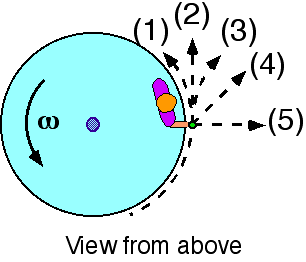
A child stands on a spinning disk. Suppose that there is friction
between the child’s shoes and the surface of the disk. While holding a
rock the child stands at the largest radius possible for the current
angular velocity without slipping. After releasing the rock, the child
will…

  1. lose traction and slide off the disk.
  2. lose traction, slide towards center.
  3. remain on disk and able to move out.
  4. remain on disk, unable to move out.

Commentary:

Answer

(4) There should be no consequence of dropping the rock. Because the
normal force changes, so does the friction force. The new friction force
is still able to provide the necessary centripetal force for the
circular motion.

A2L Item 082

Goal: Problem solving

Source: UMPERG

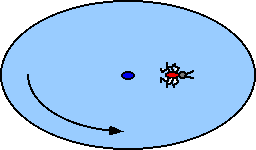
A bug sits on a disk at a point 0.5 m from the center. If the
coefficient of friction between the bug and disk is 0.8, the maximum
angular velocity the disk can have before the bug slips off the disk is
most nearly:

  1. 2 rad/s
  2. 4 rad/s
  3. 5.2 rad/s
  4. 16 rad/s
  5. None of the above
  6. Cannot be determined

Commentary:

Answer

(2) Some students may respond (6) thinking that the mass of the bug is
needed for solution.

A2L Item 071

Goal: Recognize forces that do work, that is those with associated displacement.

Source: UMPERG-ctqpe52

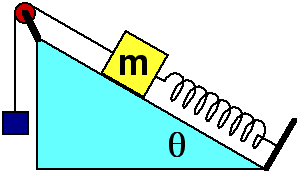
A block having mass m moves along an incline having friction as shown in
the diagram above. The spring is extended from its relaxed length. As
the block moves a small distance up the incline, how many forces do work
on the block?

  1. One force
  2. Two forces
  3. Three forces
  4. Four forces
  5. Five forces
  6. Six forces
  7. Seven forces
  8. None of the above
  9. Cannot be determined

Commentary:

Answer

(4) Four forces do work on the block: gravitation, rope, spring, kinetic
friction (because you are told the block moves). The normal force does
no work.

Background

Recognizing those forces that do work is an important skill for students
to master. They also need to recognize whether the work is positive or
negative.

Questions to Reveal Student Reasoning

As the block moves up the plane, which forces do positive work? negative
work? How are you determining which it is? How would your answer to the
above question change if the spring were compressed rather than
extended.

Suggestions

Set up some situations with blocks, springs and ropes and let students
practice identifying all the forces doing work. This is a good activity
to do in conjunction with drawing free body diagrams.

A2L Item 070

Goal: Recognizing the presence of forces.

Source: UMPERG

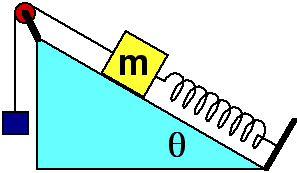
A block having mass m moves along an incline having friction as shown in
the diagram above. As the block moves a small distance along the
incline, how many forces act on the block?

  1. One force
  2. Two forces
  3. Three forces
  4. Four forces
  5. Five forces
  6. Six forces
  7. Seven forces
  8. None of the above
  9. Cannot be determined

Commentary:

Answer

(5) Five forces act on the block: gravitation, rope, spring, kinetic
friction (because you are told the block moves), and normal due to the
incline. Many student errors are due to the failure to identify all of
the forces acting on a body.

Background

It is helpful to classify forces into action-at-a-distance forces, such
as gravity and electromagnetism, and contact forces. Students can then
employ a strategy for identifying all the forces since every object
touching a body will give rise to a force. The only exceptions are the
fundamental forces, which is an easily exhausted list.

Questions to Reveal Student Reasoning

Does it matter if the block is moving up the plane or down? If the block
is at rest, how many forces MUST be acting on the block? How many forces
may be acting but you can’t be sure?

Suggestions

Set up some situations with blocks, springs and ropes and let students
practice identifying all the forces. This is a good activity to do in
conjunction with drawing free body diagrams.

A2L Item 060

Goal: Hone the vector nature of force and identify all the forces.

Source: UMPERG

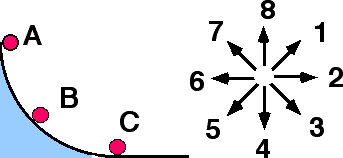
A small ball is released from rest at position A and rolls down a
vertical circular track under the influence of gravity as depicted
below.

When the ball reaches position B, which of the indicated directions most
nearly corresponds to the direction of the net force on the ball?

Enter (9) if the direction cannot be determined.


Commentary:

Answer

(9) The net force is the sum of the forces acting on the ball. If the
ball rolls along the track there is a normal force, a friction force and
a gravitational force being exerted on the ball. Although a best answer
can be determined it would require a good understanding of dynamics,
energy, and circular motion to achieve and we assume the student is
addressing this question before all these elements are in place. [The
actual answer is (2) but few students are able to appreciate that
without much thought.]

Background

To become adept at identifying forces, students should consider a wide
array of situations, even if the situations are too complex for them to
fully analyze. To determine the direction of the net force students
need to be able to judge the relative sizes of forces.

Questions to Reveal Student Reasoning

What forces are being exerted on the ball? What are the directions of
these forces? What are the relative sizes of the different forces?

Suggestions

Consider a block sliding down an incline at 450? How does
the block on an incline compare to the ball on the curved track? What
are some similarities and differences?

A2L Item 054

Goal: Recognize forces and the correct free body diagram.

Source: UMPERG

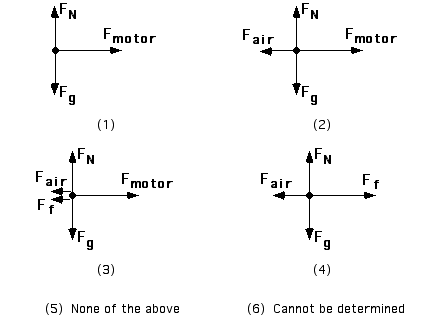
A car accelerates down a straight highway. Which of the free-body
diagrams shown below best represents this situation?


Commentary:

Answer

(4) is the best response. Students often think of the motor as the source of force propelling the car when it is the friction force on the tires that enable the car to move forward. Sometimes it helps to discuss the process of walking on a perfectly slippery surface (ice) to enable students to see the role of friction for forward motion.

A2L Item 051

Goal: Reasoning about the vector nature of force.

Source: UMPERG

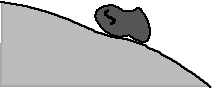
A rock sits on a hillside. The slope of the hillside is inclined to the
horizontal at approximately 30°.

Which of the forces exerted on the rock is smallest in magnitude?

  1. Friction force due to the ground
  2. Gravitational force due to the Earth
  3. Normal force due to the ground
  4. The Friction, Gravitational and Normal force are equal in magnitude
  5. Cannot be determined
  6. None of the above

Commentary:

Answers

(1). The smallest force is the friction force. The normal force
balances the component of gravity perpendicular to the hillside and the
friction force balance the component of gravity parallel to the
hillside. Since the hillside has a slope of 30°, the tangential
component of gravity is smaller.

Background

Many students fail to perceive that the static situation implies a
relationship between the forces. They may think that one requires
information such as the mass, and coefficient of friction to compute the
forces before the forces can be compared.

Questions to Reveal Student Reasoning

Can you determine the gravitational force? …normal force? …
friction force? Are there any relationships between these forces? If
so, what are they? Why doesn’t the rock slide down the hill?

Suggestions

Draw a free-body diagram.

Set up a demonstration using a block on a plane with adjustable angle.

A2L Item 039

Goal: Reasoning.

Source: UMPERG-ctqpe28

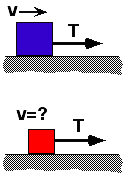
A block is on a horizontal surface. When the block is pulled by a rope under
tension T, the block moves with constant speed. If the same tension were
applied to a smaller block made of the same material and at rest on the
same surface, the block would:

  1. Remain at rest.
  2. Accelerate.
  3. Move with constant speed.
  4. None of the above.
  5. Cannot be determined.

Commentary:

Answer

(5); in the first case, the net force is 0, so T=μkMg. In
the second case, the static friction force must be overcome for m to
move. Since μsk, but m<M, it cannot
be determined if μsmg is smaller or larger than T.

Background

This item requires that students combine knowledge from different
topics: Static Friction, Kinetic Friction, and Newton’s Second Law.
Students have to deduce information (e.g., in the first situation
students must deduce that the kinetic friction force is balanced by the
tension force to give a net force of 0). Students must also know that,
since the static friction coefficient is larger than the kinetic
friction coefficient, the maximum static friction force is larger than
the kinetic friction force. Finally, students must be able to reason
about compensating quantities-in this case, although m goes down, μ
goes up, so the product of m, μ, and g may, or may not, be larger
than T. The relationship between students’ answers and their
assumptions should be the focus of the class discussion, not the
correctness of any particular answer.

Questions to Reveal Student Reasoning

Why does the block of mass M move with constant speed? If the block of
mass M were at rest would the tension force cause it to move?

What quantities affect the size of the friction force?

What determines whether the block of mass m will move?

Suggestions

Ask students to consider the limiting case where m is less than, but
almost equal to M. What would happen if m were pulled with tension T.
Students should be able to reason (perhaps with some coaching) that m
will remain stationary since the maximum static friction force is larger
than T.

Then ask them to consider the limiting case where m is much less than M.
What would happen if m were pulled with tension T. Students should be
able to reason that m will accelerate.

Finally, ask what happens “in between” these two limiting cases.

A2L Item 038

Goal: Reason qualitatively. Consider alternate solution paths.

Source: UMPERG

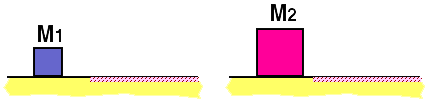
Two blocks, M2 > M1, having the same speed move
from a frictionless surface onto a surface having friction coefficient
μk as shown below.

Which block stops in the shorter time?

  1. M1
  2. M2
  3. Both blocks stop in the same time.

Commentary:

Answer

(3); both blocks have the same acceleration and the same initial
velocity, so they must stop in the same length of time.

Background

This problem can be reasoned through without the use of equations.
However, the problem can be solved easy enough algebraically. The item
provides an opportunity for students to reflect on different approaches
for solving problems.

Questions to Reveal Student Reasoning

Which block experiences the largest net force?

Which block experiences the largest acceleration?

What determines which block stops first?

Suggestions

Ask students to consider the following questions, and to determine if
their answer to the problem is inconsistent with their answers to these
questions:

If two blocks enter the rough region side by side and have the same
mass, which one will stop first?

If the blocks are connected by a rope, will the time it takes for the
blocks to stop change? Would the time it takes to stop change if the
blocks were glued together?