Tag Archives: Graphing

A2L Item 035

Goal: Interpreting strobe diagrams in conjunction with verbal information.

Source: UMPERG

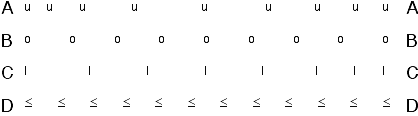
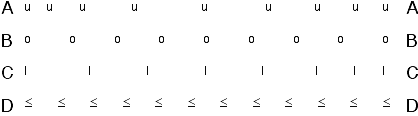
Below is shown a strobe diagram indicating the position of four objects
at successive time intervals. The objects move from left to right.
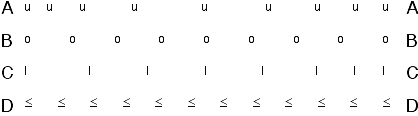
Each of the objects shown experiences a constant friction force as they
slide across the floor. Which of the objects definitely experiences a
force in addition to sliding friction?

  1. Object A only
  2. Object B only
  3. Object C only
  4. Object D only
  5. Objects A and B
  6. Objects B and C
  7. Objects A and C
  8. None of the above
  9. Cannot be determined

Commentary:

Answers

(8); Object (C) slows down and this could be due to a sliding friction force acting to the left. Given that there is a friction force, the objects moving with constant velocity (B and D) must have an additional force. Likewise (A), which accelerates duting the first part of its motion, must have an additional force to the right.

A2L Item 034

Goal: Comparing the relative size of forces from changes in position.

Source: UMPERG

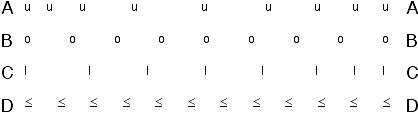
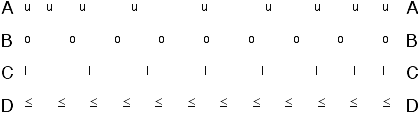
Below is shown a strobe diagram indicating the position of four objects
at successive time intervals. The objects move from left to right.

During the intervals shown, which of the objects experiences the largest
net force?

  1. Object A only
  2. Object B only
  3. Object C only
  4. Object D only
  5. Objects A and B
  6. Objects B and C
  7. Objects A and C
  8. None of the above
  9. Cannot be determined

Commentary:

Answer

(9); It is not possible to determine the size of the net forces without
knowledge of the masses of the objects. Because the horizontal force in
(A) points initially to the left, then to the right, students may say
that the net force is zero, which is true only for a time average.

A2L Item 033

Goal: Perceiving the presence of forces from changes in position.

Source: UMPERG

Below is shown a strobe diagram indicating the position of four objects
at successive time intervals. The objects move from left to right.

During the intervals shown, which of the objects experience no net force
in the horizontal direction?

  1. Object A only
  2. Object B only
  3. Object C only
  4. Object D only
  5. Objects A and B
  6. Objects B and C
  7. Objects A and C
  8. None of the above
  9. Cannot be determined

Commentary:

Answer

(8); Objects with no net horizontal force will move with constant velocity. The objects moving with constant velocity are B and D. This question helps to reinforce the idea that it is change in motion, not motion itself, that requires a force.

A2L Item 025

Goal: Relate position/time graphs to force.

Source: UMPERG

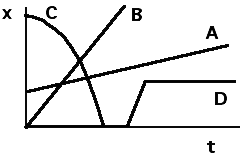
Position vs. time graphs are given below for four different objects.

Which of the objects experiences a net force sometime during the time
period shown?

  1. Only object A
  2. Only object B
  3. Only object C
  4. Only object D
  5. Objects B and D
  6. Objects A and C
  7. Objects B and C
  8. None of the above
  9. Cannot be determined

Commentary:

Answer

(8) is the appropriate response because both C and D experience a force
during the time interval. A and B have constant velocity because the
slope of their x vs. t plot is constant. Some students may not realize
that D experiences a force because they will reason that D has constant
velocity at any given time. However, D must experience a force to
change its velocity.

Background

Recognizing the signature of acceleration from a plot of position vs.
time is an important skill for students to develop. Because of
familiarity, they may recognize the plot of position for a falling body
and reason that the object experiences a gravitational force. This
question requires two logical steps. First recognizing the consequence
of constant velocity and second recognizing that a change of velocity
indicates acceleration and therefore force.

Questions to Reveal Student Reasoning

Which objects have constant velocity throughout the time interval?

Which of the objects has the largest speed sometime during the time
interval?

Are all of the objects moving away from the origin?

Suggestions

Have students plot the velocity of each object over the same time
interval.

Have students move objects in a manner in accord with the plots. This
may cause them to realize when a force must be applied.

A2L Item 019

Goal: Relating physical motion with graphical representation

Source: UMPERG

Which of the velocity vs. time plots shown below might represent the
velocity of a cart projected up an incline?

Select one of the above or:

(7) None of the above

(8) Cannot be determined


Commentary:

Answer

(3) or (4). Initially the cart has a non-zero velocity pointing up the
incline. The speed of the cart decreases as it moves up the incline,
reaching zero at its maximum height. The speed of the cart increases as
the cart moves down the incline. The velocity at the bottom of the
incline points down the incline. Graph (3)/(4) is correct if up/down
the incline is taken as the positive direction.

Background

Students will often associate velocity time graphs with features of the
terrain. Many will pick either (5) because they neglect the vector
nature of velocity and think about the speed.

Questions to Reveal Student Reasoning

Is the velocity ever zero? Is the velocity ever positive? … negative?
When? Is the velocity constant? How do you know?

Suggestions

Plotting the position vs. time may help students come up with the
correct plot of velocity vs. time.

A2L Item 017

Goal: Relating physical understanding of an object’s behavior to a graphical representation of acceleration.

Source: UMPERG

A soccer ball rolls across the road and down a hill as shown below. At
the bottom of the hill the ball is given a quick kick so that the ball
goes back up the hill and across the road. The initial and final speed
of the ball is the same.

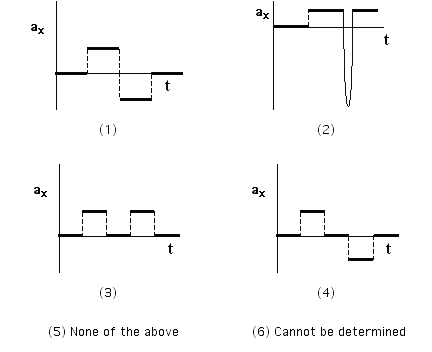
Which of the following sketches of ax vs. t is a reasonable
representation of the horizontal acceleration of the ball as a function
of time for period of time shown?


Commentary:

Answer

(2) The acceleration of the ball while on the slope is the same whether
it is going down or going up. Also, taking the positive direction to
the right, the kick would appear as a negative spike in the
acceleration.

Background

This item is related to item 1. See comments there. Students need to
note that the plots are for the xcomponent of the acceleration.

Questions to Reveal Student Reasoning

How is the acceleration related to the velocity? Suppose the hill were
more inclined. What feature of the acceleration vs. time graph would
change? What is the direction of the velocity just before the kick?
just after?

Suggestions

Have students make a graph of velocity vs. time for each of the given
plots of acceleration vs. time. Have students generate a plot of the
acceleration and velocity in the y direction.

A2L Item 016

Goal: Differentiate between instantaneous and average acceleration.

Source: UMPERG

Below is shown a strobe diagram indicating the position of four objects
at successive time intervals. The objects move from left to right.

During the intervals shown, which object would you estimate has the
largest average acceleration?

  1. Object A
  2. Object B
  3. Object C
  4. Object D
  5. Objects A, B, & D
  6. Cannot estimate for (A) because its acceleration is changing
  7. Cannot estimate average acceleration from a strobe diagram
  8. None of the above
  9. Cannot be determined

Commentary:

Answer

(3) Assuming that the question is referring to magnitude, the largest
average acceleration is experienced by object (C). The other three
objects appear to start and end with approximately the same velocity.
For object (C) the velocity decreases in magnitude as the object moves
to the right. Students who answer (5) because they realize that the
average acceleration of C is negative and think zero is larger should
not be considered wrong.

Background

It is important for students to develop multiple ways of interpreting
concepts. This ensures that students are not just following rote
procedures to answer questions. Once an idea is understood students
should be able to use their understanding in a variety of contexts and
with a variety of representations.

The concept of average acceleration depends only on the initial and
final velocity over some specified time interval. Some students will
make their judgments on the basis of changes in the velocity at
different points in the motion.

Questions to Reveal Student Reasoning

How is the average acceleration determined? What is the difference
between average acceleration and instantaneous acceleration? Where is
the instantaneous acceleration greatest?

Suggestions

Draw velocity vs. time graphs for the objects (A) and (B). Analyze the
average acceleration (instantaneous acceleration) for different time
intervals (times).

A2L Item 014

Goal: Analyze and evaluate a solution to a given problem.

Source: UMPERG

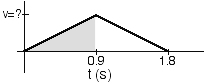
A skateboarder heads straight up a steep bank angled at 45°, the whole time experiencing a constant acceleration. She manages to move 1.6m up the incline before rolling back down. The entire maneuver takes her 1.8 s, half of which is going up, the other half going down. What magnitude acceleration did she experience while on the incline?

Consider the steps in the following procedure. If the procedure is incorrect, respond with the number of the first incorrect step; if not, respond with step 7.

  1. The velocity vs. time graph for the situation is as shown.
  2. It takes the skateboarder 0.9 s to reach the highest point.
  3. The shaded area of the graph equals her displacement along the incline which is 1.6m.
  4. Equate this area (1/2 (0.9)v) to 1.6 and solve for v.
  5. Use v to find the slope of the velocity vs. time graph.
  6. The slope is equal to the acceleration.
  7. The procedure is correct.

Commentary:

Answer

(1) The graph does not describe the situation. The acceleration is constant. The velocity is not zero at t=0s, but is zero at t=.9s.

Background

This question requires students to make decisions and judgements which are needed when solving kinematics problems with understanding. This provides another opportunity to check students skills interpreting graphs and connecting the graph to the physical situation. Students may still be looking at superficial features of the graph to determine its validity.

Questions to Reveal Student Reasoning

Where is the skateboarder’s velocity zero? … velocity largest? Does this information match the graph?

What is her initial position? … her final position? Does this information match the graph?

Suggestions

Write out the appropriate solution plan. Ask students to compare the answers for the two approaches. Does an invalid plan necessarily lead to an incorrect answer? Why or why not? Does a valid plan necessarily lead to a correct answer? Why or why not?

A2L Item 013

Goal: Perceiving acceleration from changes in position.

Source: UMPERG

Below is shown a strobe diagram indicating the position of four objects
at successive (equal) time intervals. The objects move from left to
right.

During the intervals shown, which of the objects are accelerating?

  1. Object A only
  2. Object B only
  3. Object C only
  4. Object D only
  5. Objects A and B
  6. Objects B and C
  7. Objects A and C
  8. None of the above
  9. Cannot be determined

Commentary:

Answer

(7) (A) and (C) are clearly accelerating since the displacement is
different for different time intervals (implying different average
velocities). For (B) and (D) the average velocity is the same for each
time interval.

If there is something quirky about the motions of (B) and (D), it is
possible that these objects are accelerating even though their average
velocity is always the same for the time intervals observed. Therefore
students could be justified in selecting (9). Students should realize
that (A) and (C) are accelerating.

Background

It is important for students to develop multiple ways of interpreting
concepts. This ensures that students are not just following rote
procedures to answer questions. Once an idea is understood students
should be able to use their understanding in a variety of contexts and
with a variety of representations.

Questions to Reveal Student Thinking

Which objects have a non-zero velocity? How do you know? How can you
determine from an object’s position at several times whether it is
accelerating? What features of a strobe diagram indicate that an object
has a non-zero velocity? a non-zero acceleration?

What are some physical situations that correspond to the different
motions in the strobe diagram.

Suggestions

Draw position vs. time graphs and velocity vs. time graphs for the
motion of objects that are difficult for students to analyze.

A2L Item 012

Goal: Recognizing acceleration in graphs of position vs. time

Source: UMPERG

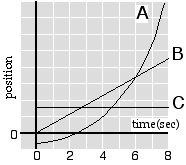
The plot of position versus time is shown for three objects. Which object has the largest acceleration at t = 2.5s?

  1. Object A only
  2. Object B only
  3. Object C only
  4. Both B and C
  5. Both A and C
  6. Both A and B
  7. All three have the same acceleration at t = 2.5s
  8. None of the above
  9. Cannot be determined

Commentary:

Answer

(1); the slope of position v. time is velocity, and the slope of
velocity v. time is acceleration. The only plot with a non-zero
(positive) acceleration is A. Plot C denotes zero velocity, and plot B
denotes a constant velocity.

Background

It is important for students to develop multiple ways of interpreting
concepts. Graphical representations are often more useful than
algebraic representations in solving kinematic problems. In this
instance students must recognize the signature of acceleration in a plot
of position vs time.

Questions to Reveal Student Thinking

How can you determine if an object is accelerating? For which objects
is the velocity changing. What are some examples of objects moving
according to the graphs?

What features about a position vs. time graph indicate that an object
has a zero velocity? a zero acceleration? What features indicate a
negative acceleration? a positive acceleration?

Suggestions

Draw a graph of velocity vs. time for each object. Then draw the graph
of acceleration vs. time.

Follow up question: Can the position vs. time of an object have a
negative slope at some specific time, and yet the acceleration be
positive at that same time?