Tag Archives: Mechanics

A2L Item 064

Goal: Hone the concept of angular velocity and link to rotational inertia and angular momentum

Source: UMPERG-ctqpe122
A child is standing at the rim of a
rotating disk holding a rock. The disk rotates without friction. The
rock is dropped at the instant shown. As a result of dropping the rock,
what happens to the angular velocity of the child and disk?

  1. The angular velocity increases.
  2. The angular velocity stays the same.
  3. The angular velocity decreases.
  4. cannot be determined

Commentary:

Answer

(2) is the correct response if the rock is simply dropped. However, some
students selecting this choice may think that the angular velocity is
maintained by some external agency. Students selecting answer (1) are
likely misapplying conservation of angular momentum.

Background

This question is useful for revealing whether students understand the
concept of moment of inertia and its relationship to angular momentum.
Many students reason that after the rock is dropped, the moment of
inertia is smaller and the angular velocity must increase to conserve
angular momentum.

RevealingQ

When dropped, does the rock have angular velocity? Just before being
dropped does the rock have angular momentum? Just after being dropped
does the rock have angular momentum?

Suggestions

It is possible to do a traditional demonstration of the role of moment
of inertia in angular momentum and then just drop the weights when arms
are extended.

A2L Item 063

Goal: Understanding the first law.

Source: UMPERG-ctqpe120

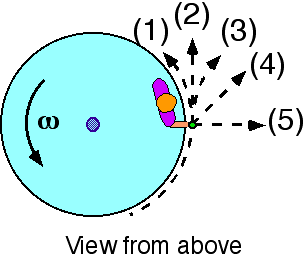
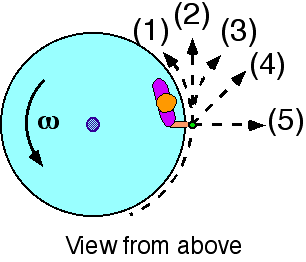
A
child is standing at the rim of a rotating disk holding a rock. The
disk rotates without friction. If the rock is dropped at the instant
shown, which of the indicated paths most nearly represents the path of
the rock as seen from above the disk?

  1. path (1)
  2. path (2)
  3. path (3)
  4. path (4)
  5. path (5)
  6. cannot be determined

Commentary:

Answer

(2) is the correct path if the rock is simply dropped. Some students
selecting answer (3) may be viewing the rock from the child’s
perspective. Some students indicating choice (5) may interpret this
path as ‘straight down’.

Background

This question is similar to others which seek to reveal student
perceptions about path persistence. It is a slightly different context
from the purely horizontal case of a ball rolling on a horizontal
surface around an semicircular section of hoop.

Questions to Reveal Student Reasoning

What path would the child see?

What is the velocity of the rock just before it is dropped? just after?

What would the path of the rock have been if the child continued to hold
it?

Suggestions

There are a variety of demonstrations that can be done as followup to
this question. It is important that students perceive the similarity
between the demonstration context and the problem situation.

A2L Item 062

Goal: Interlink several dynamical concepts and associate with a physical process.

Source: UMPERG-ctqpe98

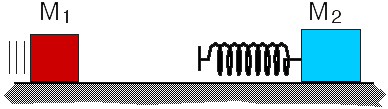
Mass M1 is traveling along a smooth horizontal surface and
collides with a mass M2 (stationary) which has a spring
attached as shown below.

The spring between the blocks is most compressed when

  1. all the energy in the system is potential energy stored in the spring.
  2. the net momentum of the system is zero.
  3. the velocity of the center of mass has its smallest value.
  4. mass M1 is no longer delivering an impulse to Mass M2.
  5. the only kinetic energy in the system is that of the center of mass.
  6. none of the above
  7. cannot be determined

Commentary:

Answer

5: When the spring is maximally compressed, both masses have the same
velocity which is the velocity of the center of mass.

Background

The total energy of an isolated system can be decomposed into three
categories; kinetic energy associated with center of mass motion,
kinetic energy of bodies in the center of mass coordinate frame and
potential energy associated with the interaction of bodies comprising
the system.

Questions to Reveal Student Reasoning

Is M2 ever traveling faster than M1?

Do the masses ever have the same velocity?

How would you find Pcm, the momentum of the center of
mass?

How is the kinetic energy of the center of mass related to its
momentum?

Suggestions

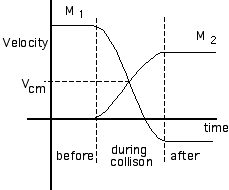
A
sketch of the velocities of the two masses over time would look
something like the graph at the right. [Note that the velocity of
M1 can be negative after the collision if it is less massive
than M2.] Such a graph helps make the relationships between
Vcm, the relative velocity of the masses and the spring
compression clear.

A2L Item 061

Goal: Hone the vector nature of force.

Source: UMPERG

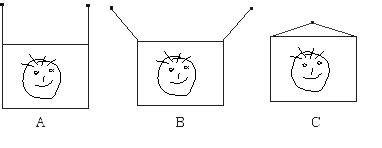
Three picture frames having the same mass are each hung from a wall
using two pieces of string.

For which situation is the tension in the two strings the greatest?

  1. A
  2. B
  3. C
  4. The tension in the two strings is the same for all three situations
  5. None of the above
  6. The tension cannot be compared

Commentary:

Answer

(3) The tension will be largest on the wires that are
most nearly horizontal. The minimum tension is in the vertical wires,
and each wire has a tension equal to half the weight of the picture.
Some students may think that the tension is the same no matter how the
wires are arranged. One way to convince them that this is not the case
is to have two students support a heavy object by pulling on ropes
attached to the object. As they move apart they easily perceive the
need to pull harder.

A2L Item 060

Goal: Hone the vector nature of force and identify all the forces.

Source: UMPERG

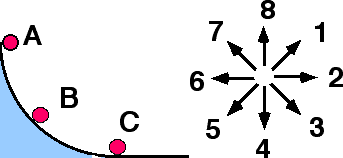
A small ball is released from rest at position A and rolls down a
vertical circular track under the influence of gravity as depicted
below.

When the ball reaches position B, which of the indicated directions most
nearly corresponds to the direction of the net force on the ball?

Enter (9) if the direction cannot be determined.


Commentary:

Answer

(9) The net force is the sum of the forces acting on the ball. If the
ball rolls along the track there is a normal force, a friction force and
a gravitational force being exerted on the ball. Although a best answer
can be determined it would require a good understanding of dynamics,
energy, and circular motion to achieve and we assume the student is
addressing this question before all these elements are in place. [The
actual answer is (2) but few students are able to appreciate that
without much thought.]

Background

To become adept at identifying forces, students should consider a wide
array of situations, even if the situations are too complex for them to
fully analyze. To determine the direction of the net force students
need to be able to judge the relative sizes of forces.

Questions to Reveal Student Reasoning

What forces are being exerted on the ball? What are the directions of
these forces? What are the relative sizes of the different forces?

Suggestions

Consider a block sliding down an incline at 450? How does
the block on an incline compare to the ball on the curved track? What
are some similarities and differences?

A2L Item 059

Goal: linking acceleration and velocity graphically.

Source: UMPERG

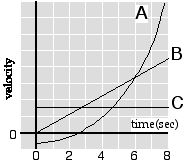
The
plot of velocity versus time is shown at right for three objects. Which
object has the largest acceleration at t = 2.5s?

  1. Object A only
  2. Object B only
  3. Object C only
  4. Both B and C
  5. Both A and C
  6. Both A and B
  7. All three have the same acceleration at t = 2.5s
  8. None of the above
  9. Cannot be determined

Commentary:

Answer

(6) Objects (A) and (B) have the same acceleration (i.e., they have the
same slope for the velocity vs. time graph at t=2.5s) Object (C) has a
constant velocity (zero slope).

Background

After students have been introduced to acceleration, but before they are
given a procedure for determining the acceleration from a graph of
velocity vs. time. Students should answer this question after they have
gained an understanding of the definition of acceleration, but before
they are given any explicit instruction for how acceleration relates to
a velocity vs. time graph.

Questions to Reveal Student Reasoning

How can you determine if an object is accelerating? For which objects
is the velocity changing. What are some examples of objects moving
according to the graphs?

What features about a velocity vs. time graph indicate that an object
has a zero velocity? Zero acceleration? What features indicate a
negative acceleration? Positive acceleration?

Suggestions

Redraw the velocity vs. time graph for object (A) twice more. In one
drawing approximate the curve with three straight line segments. In the
second approximate the curve with 6 straight line segments.

A2L Item 058

Goal: Perceiving acceleration from description of motion.

Source: UMPERG Core A.4

How many of the objects below are NOT accelerating?
(A) A race car going around a circular track at 150 MPH
(B) A sky diver falling at a constant speed
(C) A heavy box sliding across the floor, after being released
(D) A bowling ball colliding with a pin
(E) A vibrating guitar string
(F) A baseball flying through the air
(G) A child swinging on a swing

  1. 1
  2. 2
  3. 3
  4. 4
  5. 5
  6. 6
  7. 7

Commentary:

Answer

(1) Only the skydiver, who has reached terminal velocity, has zero
acceleration. In each of the other situations either the speed or
direction of motion is changing.

Background

Students may use a variety of factors in deciding whether an object
accelerates.

The goal is to focus students more narrowly on changes in the speed
and/or direction of an object’s motion.

Questions to Reveal Student Reasoning

How do you know whether an object is accelerating? What are some
examples of objects undergoing an acceleration?

Suggestions

Play a “challenge game” with the class where two teams of students take
turns challenging each other with situations in which an object
undergoes some motion, and the other team needs to determine whether or
not the object is accelerating.

Have students write out how they determine whether an object is
accelerating. After listening to the different method students use,
have students vote on which method they think is best.

Related Items

002

A2L Item 057

Goal: Associate velocity graph with physical motion.

Source: UMPERG

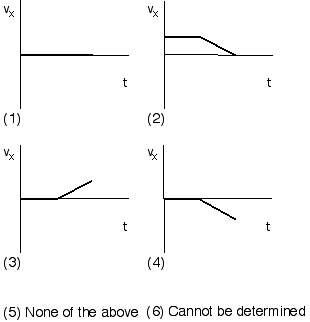
A soccer ball rolls across the road and down a hill as shown below.

Which of the following sketches of vx vs. t represents the
horizontal velocity of the ball as a function of time?


Commentary:

Answer

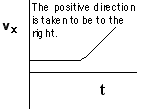
(5) None of the above. The ball crosses the road in a straight line at
a more-or-less constant speed (perhaps slowing down slightly) provided
that the road is in good condition and the rolling friction between the
ball and road is sufficiently small. As the ball rolls down the hill it
will speed up, and so there will be an acceleration in the direction of
motion, with a non zero component to the right. The following graph is
a reasonable representation of the horizontal velocity as a function of
time.

Background

This problem could challenge students in several areas: (1) Can
students recognize how the velocity is changing? What criteria do they
use? (2) Do students realize that as the ball moves down the hill it
speeds up and the x-component of velocity increases? Students may
associate the increase in velocity with the y-direction only. (3) Do
students associate the graph with the terrain over which an object
travels? The process of translation of a motion quantity to a graph can
be very difficult for students. (4) Will students confuse motion
quantities? When students analyze the graphs of velocity vs. time they
may be interpreting the graphs in terms of position instead of velocity.

Questions to Reveal Student Reasoning

Is the velocity ever zero? Where does the ball speed up? …slow down?
What is the direction of the velocity while the ball is on the sloped
section? Does the velocity have a non-zero horizontal component?

Suggestions

Set up a demonstration with a horizontal surface and a ramp, both with
the same net horizontal displacement. Roll a ball slowly across the
horizontal surface and down the ramp. Ask students to judge which
horizontal displacement took more time. Over what section (horizontal
surface or ramp) is the velocity larger on average?

A2L Item 056

Goal: Honing the concept of normal force and reasoning.

Source: UMPERG-MOP

Consider the five situations appearing below. All the blocks have the
same size and density.

Which of the following statements is true regarding the normal force
that the table or incline exerts on the block in contact with it?

  1. ND > NC = NA = NE > NB
  2. ND = NA > NC > NE = NB
  3. NC > ND > NA > NE > NB
  4. ND = NA = NC > NE > NB
  5. NA > ND = NC > NB > NE
  6. ND = NA = NE > NC > NB
  7. More than one of the above is true.
  8. None of the above is true.
  9. Cannot be determined.

Commentary:

Answer

(8) All that can be said with certainty is that none of the above is
true. First, it is impossible to determine the relationship between
NB and NE. Both are less than the weight, but
which is least depends upon unknown angles and the tension in the rope.
Further, NC is largest because all of the other cases have a
buoyancy force due to air. Some students may indicate (9) for the same
reasons as stated above. However, technically, the truth or falsity of
(1) to (7) can be determined.

Background

Students often think that the Normal force must be vertical because all
of the examples they have seen are of this type. Other students may
think that the deformed table is indicative of a greater (or lesser)
normal force. A subtle issue is that the block under the bell jar will
not have a buoyant force due to the air. While this is a small force,
its absence means that the normal force in case C is largest of all.

Suggestions

Have students identify the basis of falseness of each of the statements.

A2L Item 055

Goal: Classify forces and hone the concept of contact force.

Source: UMPERG

A person throws a ball straight up in the air. The ball rises to a
maximum height and falls back down so that the person catches it. What
forces are being exerted on the ball when it is half way to the maximum
height? Ignore air resistance.

  1. The gravitational force only.
  2. The force of the person’s hand only.
  3. Both the gravitational force and the force of the person’s hand.
  4. The gravitational force, the force of the person’s hand, and a third
    force.
  5. None of the above
  6. Cannot be determined

Commentary:

Answer

(1); nothing is in contact with the ball (we ignore forces due to the
air), and so the earth’s gravitational force is the only
“action-at-a-distance” force present.

Background

It is common for students to think that motion requires a force; in some
cases this misconception is more specific, namely, that motion requires
a force in the direction of motion. For this assessment item, the
misconception manifests itself in the belief that there is a “force of
the hand” that propels the ball up during flight.

Questions to Reveal Student Reasoning

Ask students to state what forces are acting on the ball and what object
exerts each force.

How do you know when a force is being exerted by one object on another?

Do the sizes of the forces change? Do the directions of the forces
change? Describe how and why.

Do you have any control over the force of the hand on the ball while the
ball is in the air? Can you make it larger or smaller or change its
direction once you release the ball?

Suggestions

Have students brainstorm situations in which two objects interact
without touching each other. Use as the criteria for an interaction
that an object move or change shape. Have students divide their
situations into two groups: those for which the objects interact
directly, and those for which the objects interact through some other
object (e.g., two blocks “interact” through a spring placed between
them).

Eventually raise the point that in physics the term force refers to
direct interactions only and that most objects interact only when placed
in contact. Demonstrate electric and magnetic forces as examples of
“action-at-a-distance” forces.