Goal: Recognize forces and the correct free body diagram.
Source: UMPERG
A car accelerates down a straight highway. Which of the free-body
diagrams shown below best represents this situation?
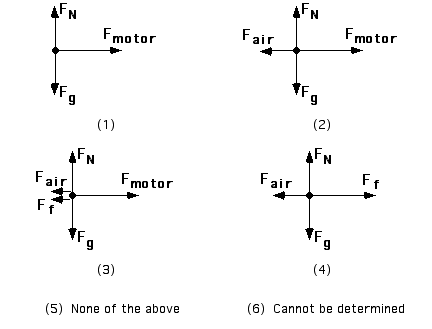
Goal: Recognize forces and the correct free body diagram.
Source: UMPERG
A car accelerates down a straight highway. Which of the free-body
diagrams shown below best represents this situation?
Goal: Hone the concept of force.
Source: UMPERG
Consider three identical blocks as shown below. In case A the block
sits on the bottom of a beaker filled with oil. In case B the block
floats on water. In case C the block is free-falling.
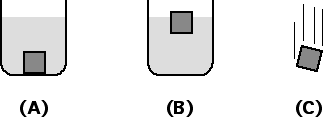
Which block or blocks experience the smallest gravitational force?
(7). The gravitational force is approximately the same for all three
blocks assuming that they are about the same height above the surface of
the earth. The gravitational force on an object near the surface of the
earth depends only on the mass of the object.
Students’ models concerning what factors influence a force can be quite
complex. Introducing students to a force law (conceptually or
mathematically) is usually not enough to correct any false associations.
Only through discussion of the force law in a variety of contexts will
the student develop a model more consistent with the physicists’ model.
What causes the gravitational force? What are some factors that
influence the gravitational force? Make a list. What is the
gravitational force law? Which of the listed factors are contained in
the force law?
What would be the gravitational force on the block if it were sitting on
a table?
Suppose the block was falling through oil or that you dropped the beaker
in case A. Would the gravitational force change?
Goal: Reasoning and comparing the sizes of forces.
Source: UMPERGA block attached to the end of a spring is hanging at rest from the
A block attached to the end of a spring is hanging at rest from the
ceiling as shown at the left below. After the block is pulled down and
released it moves up and down for an extended period of time. The
motion during one cycle is shown in the graph at right below.
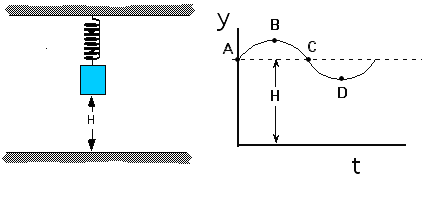
Several points are indicated on the graph. At which point is the spring
force exerted on the block the greatest?
(4). The spring force is largest at the position where it is compressed
or stretched the most relative to its natural length. The spring is
already stretched when it is at a height H because there must be an
upward spring force to balance the gravitational force on the block. As
the height of the block is decreased the spring is stretched further.
As the height of the block is increased the spring is stretched less –
if raised enough the spring would start to compress.
Many students will attempt to apply the spring force law without real
understanding. This problem requires students to understand the
physical situation and to interpret graphical information about the
height of the block to reason out an answer.
What is the force law for a spring? How does the spring force compare
to the weight of the block? At what points is the spring stretched? …
compressed?
Demonstrate with a spring that a vertical spring stretches when a weight
is attached. Show that as the weight moves up and down that the spring
need never get back to its natural length (i.e., it is always stretched)
Draw free-body diagrams, especially for points B and D.
Goal: Reasoning about the vector nature of force.
Source: UMPERG
A rock sits on a hillside. The slope of the hillside is inclined to the
horizontal at approximately 30°.
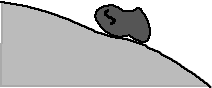
Which of the forces exerted on the rock is smallest in magnitude?
(1). The smallest force is the friction force. The normal force
balances the component of gravity perpendicular to the hillside and the
friction force balance the component of gravity parallel to the
hillside. Since the hillside has a slope of 30°, the tangential
component of gravity is smaller.
Many students fail to perceive that the static situation implies a
relationship between the forces. They may think that one requires
information such as the mass, and coefficient of friction to compute the
forces before the forces can be compared.
Can you determine the gravitational force? …normal force? …
friction force? Are there any relationships between these forces? If
so, what are they? Why doesn’t the rock slide down the hill?
Draw a free-body diagram.
Set up a demonstration using a block on a plane with adjustable angle.
Goal: Recognize the presence of a force.
Source: UMPERG
A monkey hangs on a rope. What forces act on the monkey? (Ignore
forces due to the air.)
(1); Assuming the monkey hangs from a vertical rope
the only forces can be gravity and friction. Students should realize
that there is only one action-at-a-distance force in this case, that of
gravity, and that there must be some contact force(s) to balance that.
Goal: Hone the vector nature of force.
Source: UMPERG
A thin wire is stretched horizontally between two walls. If a weight, W,
is hung on the wire, what is true about the tension, T, in the wire?
(3); The vertical component of the tension force exerted on the weight
must equal half the gravitational force. For a nearly horizontal wire
this means the tension must exceed the weight.
The intent is to get students to use their intuitive notions of
balancing force to reason how directions of forces change the value of
forces.
How do you determine the tension force? What direction does the tension
force point? In (A) what does the tension force equal? Does it matter
what angle the strings point? Explain.
Have some students try to lift an object with strings straight up and at
an angle. Which is easier.
Set up a demonstration with spring scales.
Goal: Hone the concept of force, recognize the presence of force.
Source: UMPERG
A water balloon is shown at rest in three different situations. In each
case the water balloon is in contact with a system that supports it.
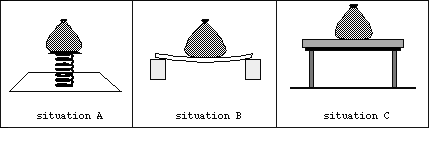
Which system exerts the largest force on the balloon?
(5). Each system exerts the same magnitude force on the balloon. The
size of the force equals the weight of the balloon.
Context for Use: Give to students before they receive a formal
introduction to interactions.
Assessment Issues: (1) What are students’ naive views about
interactions? (2) Can students perceive when an interaction is
occurring? (3) What factors do students attend to when determining
whether a force is present? (4) What factors do students use to compare
the relative magnitude of two forces?
Which systems exert a force on the balloon? How did you decide whether
the system exerts a force on the balloon? In each case how did the
force affect the balloon? How did the interaction between the balloon
and system affect the system? When comparing two forces, how can you
tell which force is larger?
Recognizing the presence of an interaction is a difficult problem for
students. One must return to the topic repeatedly as additional
understanding and principles are learned by the students. Initially
focus students on the effects of interaction: (1) Do the motions of the
objects change? (2) Do the shapes of the objects change?
Goal: Hone the concept of force, classify forces as contact and action-at-a-distance.
Source: UMPERG
A baseball is struck by a bat. While the ball is in the air, what
objects exert forces on the ball?
(6); the earth’s gravitational force (an “action-at-a-distance” force),
and air resistance (a contact force) are the only two forces being
exerted on the ball while in the air.
It is common for students to think that motion requires a force; in some
cases this misconception is more specific, namely, that motion requires
a force in the direction of motion. For this assessment item, the
misconception manifests itself in the belief that there is a “force of
the bat” that propels the ball up during flight.
Ask students to state what forces are being exerted on the ball and what
object exerts each force.
How do you know when a force is being exerted by one object on another?
Do the sizes of the forces change? Do the directions of the forces
change? Describe how.
Do you have any control over the force of the bat on the ball? Can you
make it larger or smaller or change its direction once the ball is
flying through the air?
Ask students if they have a way of exerting a force on an object without
touching it. Invite them to move an object in the front of the room
without leaving their seats and touching the item.
If Newton’s Second Law has been introduced, attempt to relate the forces
exerted on the ball to the ball’s acceleration. See if students agree
that, if air resistance can be neglected, the ball has a constant
acceleration of 9.8 m/s2 toward the earth during its entire
trajectory. If they agree ask what they can conclude about the net
force on the ball while airborne.
Goal: Recognize appropriate free body diagram.
Source: UMPERG
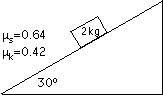
A
block of mass 2 kg is at rest on the surface of a wedge that makes an
angle of 30° with the horizontal as shown. The coefficient of
static friction is 0.64 and of kinetic friction is 0.42.
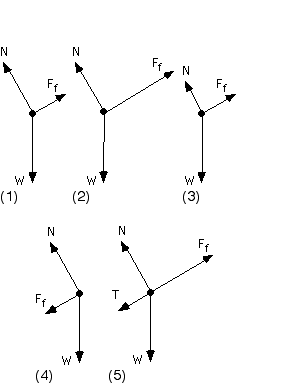
Which figure below best represents the free-body diagram for the block?
6. None of the above
7. Cannot determine the free-body diagram
(1). The component of the gravitational force parallel to the incline
will balance the frictional force in this situation. The component of
the gravitational force perpendicular to the incline must balance the
normal force.
Even in static situations students can be confused about the relative
sizes of forces.
What forces are present? What determines how big the gravitational
force is? … the normal force is? … the gravitational force is?
Goal: Reason using 2nd law.
Source: UMPERG-ctqpe24
Consider the two situations presented below. T1 is the tension in the string in case A and T2 is the tension in the string in case B.
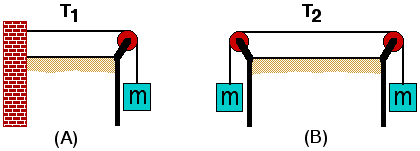
Which of the following statements is correct?
(2). The force exerted on each block by the attached string must
balance the weight of the block. Since the blocks all weigh the same
amount, the tension in the in the two strings must be equal.
This item does not require formal knowledge of Newton’s Second Law. It
can be used after students can identify the tension and gravitational
force, provided they appreciate that for static situations the forces
exerted on each object must balance. Try asking students to answer the
question individually and without discussion, giving their initial
reaction. Then ask students to re-answer the question after discussing
it briefly in small groups.
Students commonly think that T2 is greater than
T1 because the rope in situation 2 “supports” two masses.
This incorrect intuition can even exist in students who are capable of
drawing correct free-body diagrams and who know that the “tension” force
exerted on each block must balance the weight of the block. The
coexistence of conflicting intuition and formal knowledge is common
among novices.
What is tension? How do you measure tension?
For situation (A) consider placing a spring scale between the string and
the block in the vertical region. What force is the spring scale
measuring? For situation (A) consider cutting the string in the middle
of the horizontal region and inserting a spring scale. What force is
this spring scale measuring? How would the readings on the two spring
scales compare?
If spring scales were placed similarly in situation (B), how would their
readings compare to the readings on the spring scales in situation (A)?
Consider the original situations and two variations: (a) In (A)
consider a person holding the string in place of the wall; (b) In (B)
consider a person holding the string in place of the block on the left.
In each situation, what force is being exerted on the string so that the
hanging mass at the other end does not move?
Set up the two situations depicted in the item. Insert spring scales at
appropriate points. Discuss the readings on the scales.
Commentary:
Answer
(4) is the best response. Students often think of the motor as the source of force propelling the car when it is the friction force on the tires that enable the car to move forward. Sometimes it helps to discuss the process of walking on a perfectly slippery surface (ice) to enable students to see the role of friction for forward motion.