Tag Archives: Mechanics

A2L Item 153

Goal: Hone the concept of impulse

Source: UMPERG-ctqpe80

A MOVING car collides with a STATIONARY truck. Which of the following
statements is true about the magnitudes of the impulse on each due to
the other?

  1. The impulse on the car is larger than the impulse on the truck.
  2. The impulse on the truck is larger than the impulse on the car.
  3. The magnitudes of the two impulses are equal.
  4. Answer depends upon circumstances of the collision.
Commentary:

Answer

(3) The 3rd law requires that the impulses be equal. Even
students who understand the 3rd law have difficulty realizing that the
magnitude of the impulse on two interacting bodies is the same. Many
students, however, do not understand impulse enough to recognize the
association. Others do not read the problem carefully enough and answer
with regard to ALL the forces, not just the one due to the other
vehicle.

A2L Item 151

Goal: Reason with kinematics

Source: UMPERG-ctqpe75

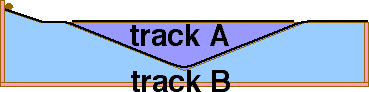
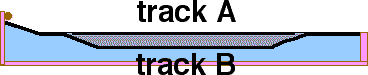
Two identical steel balls are released from rest from the same height,
and travel along tracks as shown and labeled below.

Which ball reaches the end of its track first?

  1. ball on track A
  2. ball on track B
  3. they reach the end at the same time
  4. not enough information

Commentary:

Answer

(2) The ball on track B accelerates down the second slope. A
component of this acceleration is in the x-direction. This means that
the x component of ball B’s velocity is never smaller than that of ball
A. Since the tracks have the same x-dimension, ball B gets there first.

A large majority of students choose answer C incorrectly thinking that
since the balls return to the same height, they have the same speed and,
therefore, arrive at the same time.

A2L Item 152

Goal: Reason with kinematics

Source: UMPERG-ctqpe76

Two identical steel balls are released from rest from the same height,
and travel along tracks as shown and labeled below.

Which reaches the end of its track first?

  1. Ball on track A
  2. Ball on track B
  3. They reach the end at the same time
  4. Not enough information

Commentary:

Answer

(2) The ball on track B accelerates down the second slope. A component
of this acceleration is in the x-direction. This means that the x
component of ball B’s velocity is never smaller than that of ball A.
Since the tracks have the same x-dimension, ball B gets there first.

A large majority of students choose answer C incorrectly thinking that
since the balls return to the same height, they have the same speed and,
therefore, arrive at the same time.

A2L Item 149

Goal: Reason with potential energy

Source: UMPERG-ctqpe68

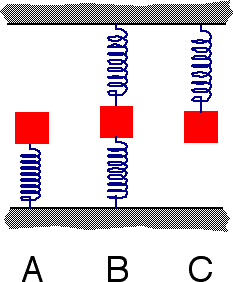
Consider three spring systems having identical springs and
masses. Which of the 3 systems has the largest amount of stored energy?

  1. A
  2. B
  3. C
  4. A and C
  5. All have the same potential energy
  6. Cannot be determined

Commentary:

Answer

(2) Students often forget to include the gravitational potential
energy and also have difficulty selecting a good reference point.

A2L Item 147

Goal: Relate force to potential energy function

Source: UMPERG-ctqpe66

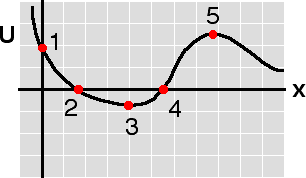
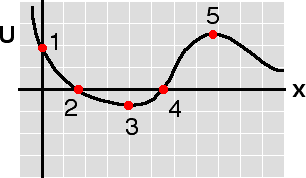
The
potential energy function for a certain body is shown at right. For
which points is Fx = 0?

  1. Point 1 only
  2. Points 2 and 4
  3. Points 1 and 5
  4. Points 3 and 5
  5. Point 3 only
  6. Fx not equal to 0 anywheree

Commentary:

Answer

(4) The force is given by the negative of the slope of the
potential function. Points 3 and 5 are equilibrium points, but only 3 is
a stable equilibrium point. Students frequently choose answer #2
thinking that the force is zero at these points.

A2L Item 148

Goal: Hone the concept of conservative force

Source: UMPERG-ctqpe67

The
potential energy function for a certain body is shown at right. The
force associated with this potential is …

  1. conservative.
  2. dissipative.
  3. neither conservative or dissipative.
  4. Cannot be determined

Commentary:

Answer

(1) It is remarkable how many students will select one of the
other answers. Many students do not recognize that you cannot have a
potential function unless the force is conservative.

A2L Item 145

Goal: Reasoning with energy

Source: UMPERG-ctqpe64

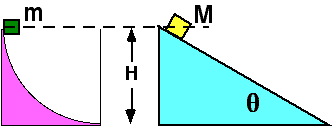
Two
masses, M > m, travel down the surfaces shown. Both surfaces are
frictionless. Which mass has the largest speed at the bottom?

  1. m
  2. M
  3. Both have the same speed
  4. Cannot be determined

Commentary:

Answer

(3) By energy considerations, both would have the same speed.
Students frequently get confused about the mass, thinking that the
larger mass has the greatest potential energy change and therefore has
the greatest speed.

A2L Item 146

Goal: Hone the concept of potential energy functions

Source: UMPERG-ctqpe65

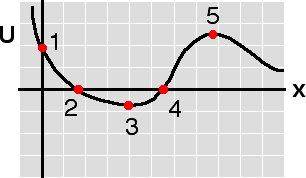
The
potential energy function for a certain body is shown at right. If the
body is released from rest at a location corresponding to point 4, the
object would …

  1. move towards larger values of x.
  2. move towards smaller values of x.
  3. remain stationary.
  4. oscillate back and forth.
  5. None of the above
  6. Cannot be determined

Commentary:

Answer

(2) At position 4 the object experiences a force toward the
origin given by the negative of the slope of the potential curve.
Frequently students interpret the fact that U is zero at point 4 to mean
that there is no force.

A2L Item 144

Goal: Reasoning with kinematics

Source: UMPERG-ctqpe63

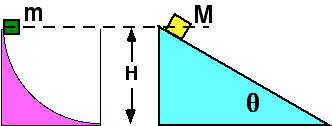
Two
masses, M > m, travel down the surfaces shown. Both surfaces are
frictionless. Which mass has the largest average speed during
their motion?

  1. m
  2. M
  3. Both have the same average speed
  4. Cannot be determined

Commentary:

Answer

(1) This problem is intended to promote discussion of average
speed. Both masses have the same speed at the bottom. Mass m has a
larger acceleration in the beginning because the circular track is
vertical at the outset. Although the angle of the incline is not
specified, the angle is irrelevant. All inclines will have the same
average speed. A simple graph of the speed of each mass versus time
shows that m will have the larger average speed.

A2L Item 143

Goal: Reasoning with energy

Source: UMPERG-ctqpe62

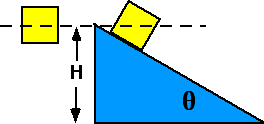
Two
identical blocks fall a distance H. One falls directly down, the other
slides down a frictionless incline. Which has the largest speed at the
bottom?

  1. The one falling vertically
  2. The one on the incline
  3. Both have the same speed
  4. Cannot be determined

Commentary:

Answer

(3) The only force doing work is gravity and both block undergo
the same vertical displacement.