Tag Archives: Mechanics

A2L Item 142

Goal: Reasoning with forces and kinematics

Source: UMPERG-ctqpe60 variant
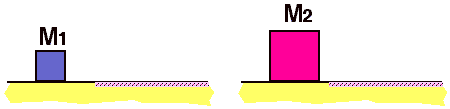
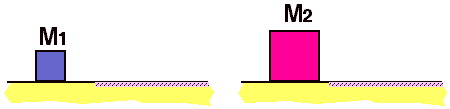
Two
blocks, M2 = M1 but of different sizes, having the
same speed, move from a frictionless surface onto a surface having
friction coefficient μk.

Which stops in the shorter time?

  1. M1
  2. M2
  3. Both stop in the same time
  4. Cannot be determined

Commentary:

Answer

(3) Both blocks will experience the same acceleration. If they
have the same initial velocity, they will stop in the same time.

A2L Item 141

Goal: Reasoning with kinetic energy and work

Source: UMPERG-ctqpe58

Two
blocks, M2 > M1, having the same kinetic energy
move from a frictionless surface onto a surface having friction
coefficient μk.

Which goes further before stopping?

  1. M1
  2. M1
  3. Both go the same distance
  4. Cannot be determined

Commentary:

Answer

(1) For a given amount of kinetic energy M1 will have a larger
velocity. The penetration distance depends upon the square of the
velocity.

Many students will notice that the relationship equating the kinetic
energy to work by friction has mass as a factor on both sides and will
answer #3. They are assuming that the masses have the same velocity, not
the same kinetic energy.

A2L Item 139

Goal: Reasoning with work

Source: UMPERG-ctqpe50

In which case would you do the least amount of work?

  1. You push a box 10 m across a floor.
  2. You pick up the box, walk 10 m and put the box down on the floor.
  3. You pick up the box, walk 10 m and drop the box.
  4. Both 2 and 3
  5. Work done is the same in all cases.
  6. Cannot be determined from info given.

Commentary:

Answer

(6) This problem is intended to elicit a vigorous discussion of
work. Students have a difficult time reconciling the formal definition
of work with the colloquial one. Every one of the answers is defensible
depending upon one’s perspective. Lifting a heavy box requires doing
work against gravity. Putting it down actually requires that you do the
same amount of work. Gravity does no net work, but humans are not
conservative systems. Depending upon the surface it may be more
advantageous to push the box.

A2L Item 138

Goal: Problem solving with momentum

Source: UMPERG-ctqpe46

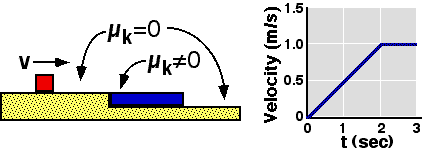
A
block slides along a frictionless surface and onto a slab with a rough
surface. The plot on the right shows the velocity of the blue slab as a
function of time. The slab has mass of 4kg and the block has mass of
2kg. If the block remains on top of the slab, what was its initial
speed?

  1. 2 m/s
  2. 4 m/s
  3. 6 m/s
  4. 8 m/s
  5. 12 m/s
  6. None of the above
  7. Cannot be determined

Commentary:

Answer

(6) The block initially has velocity 3 m/s. This problem is
difficult for students. They generally have difficulty obtaining
relevant information from a diagram. In this case they must use the plot
to tell that the final velocity is 1 m/s.

A2L Item 137

Goal: Problem solving

Source: UMPERG-ctqpe44-46

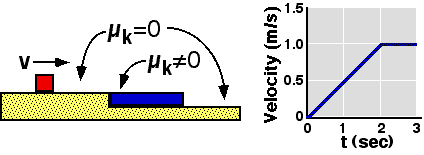
A
block slides along a frictionless surface and onto a slab with a rough
surface. The plot on the right shows the velocity of the blue slab as a
function of time. The slab has mass of 4kg and the block has mass of
2kg. What is the friction force on the small block at t = 1 second?

  1. 0.5 kg-m/s2
  2. 0 kg-m/s2
  3. 1 kg-m/s2
  4. 4 kg-m/s2
  5. 2 kg-m/s2
  6. None of the above
  7. Cannot be determined

Commentary:

Answer

(5) The acceleration of the slab can be found from the plot. The
only force on the slab in the horizontal direction is the friction force
so it must be responsible for the acceleration. The force on the block
can then be found using the 3rd law.

A2L Item 136

Goal: Reasoning with dynamics

Source: UMPERG-ctqpe43

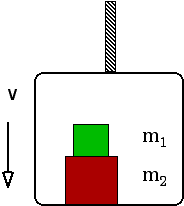
Block
m1 sits on block m2 and both sit on the floor of
an elevator at rest. When the elevator starts to move down, the normal
force on the upper block will …

  1. increase.
  2. remain the same.
  3. decrease.
  4. Cannot be determined

Commentary:

Answer

(3) As it starts the elevator must accelerate downward and so
will the upper block. The only forces on the block are gravity and the
normal force. The normal force must diminish so gravity can provide the
downward acceleration.

Students answering #2 may have interpreted the question to mean ‘as the
elevator moves’ and think that the elevator moves with constant velocity.

A2L Item 133

Goal: Reasoning with circular motion

Source: UMPERG-ctqpe37

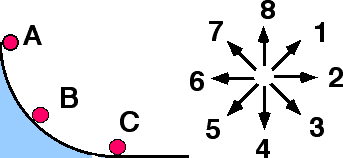
A small ball is released from rest at position A and rolls down a
vertical circular track under the influence of gravity.

When
the ball reaches position B, which of the indicated directions most
nearly corresponds to the direction of the ball’s acceleration?

Enter (9) if the direction cannot be determined.


Commentary:

Answer

(2) At position B the acceleration has a tangential component and
a radial component. Both components can be determined at position B.
Worked out carefully one gets 18 degrees above position #2. It is common
for students to neglect one component or the other.

A2L Item 131

Goal: Reasoning with dynamics

Source: UMPERG-ctqpe30

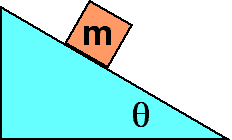
A
block of mass m, when placed on a rough inclined plane and moved, moves
down the plane with constant speed. If a block of mass 2m were placed
on the same incline and moved, it would …

  1. return to rest.
  2. accelerate until the speed is half.
  3. move with some constant speed.
  4. None of the above.
  5. Cannot be determined

Commentary:

Answer

The block will have the same motion. Both the gravitational force
and the friction force scale with the mass so there is no net force in
either case.

A2L Item 130

Goal: Hone the concept of static friction

Source: UMPERG-ctqpe29

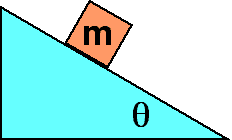
A block of mass m sits at rest on a
rough incline of angle θ. The coefficient of static friction is
μ.

The friction force on the block is

  1. mgcos(θ), down the incline.
  2. mgsin(θ), up the incline.
  3. μmgsin(θ), down the incline.
  4. μmgcos(θ), up the incline.
  5. none of the above.
  6. cannot be determined

Commentary:

Answer

(2) this is all that is needed to hold the block at rest. Some
students will give #4 as the answer having specified the maximum static
friction force.

It helps to classify forces as model forces obtainable from a formula,
and procedure forces. Static friction is an example of a procedure
force, one that cannot be determined without application of the 2nd law.

A2L Item 128

Goal: Hone the concept of static friction

Source: UMPERG-ctqpe27

A mass of 5 kg sits at rest on an incline making an angle of 30° to
the horizontal.

If μs = 0.7 the friction force on the block is

  1. 43.3N, down the incline
  2. 25N, up the incline
  3. 10N, down the incline
  4. 30.3N, up the incline
  5. none of the above
  6. cannot be determined

Commentary:

Answer

(2) this is all that is needed to hold the block at rest. Some
students will give #4 as the answer having calculated the maximum static
friction force.

It helps to classify forces as model forces obtainable from a formula,
and procedure forces. Static friction is an example of a procedure
force, one that cannot be determined without application of the 2nd law.