In order to solve the problem:
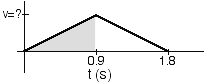
An airplane accelerates down a runway in order to take off
but aborts and applies brakes causing the plane to stop. The plane
speeds up at a constant rate for 5 seconds, then slows down at the same
rate when the brakes are applied. The plane stops at a point that is
100 meters from its initial position. What was the acceleration of the
airplane during the first 5 seconds?
Someone suggests the following procedure:
(A) The acceleration of the plane is constant and the same for the
entire motion.
(B) The entire process takes 10 seconds and the displacement is 100
meters.
(C) It is possible, therefore, to use the formula “change in x =
vo,x t + 1/2 ax t2“, where
vo,x is zero and t = 10s.
(D) The only unknown in this equation is ax, so solve for it.
Which of the following is true?
- The procedure is invalid because statement A is incorrect.
- The procedure is invalid because statement B is incorrect.
- The procedure is invalid because statement C is incorrect.
- The procedure is invalid because statement D is incorrect.
- The procedure is invalid because more than one statement is incorrect.
- The procedure is valid.
Commentary:
Answer
(4) The net force on the car and tow truck is 12,000N (13,000N –
1,000N). The acceleration is 4m/s2. The magnitude of the force between
the two vehicles is 5,000N.
Background
Answers are not as important as approach. What did students do to
understand the physical situation? Did they draw pictures. Did they
draw a free-body diagram.
Questions to Reveal Student Reasoning
Ask a couple of students to describe how they approached the problem.
Ask them to describe the steps they took without getting into
mathematical details. For example, did they draw a free-body diagram?
What forces did they consider? What system did they analyze?
Suggestions
After a couple of descriptions of how to approach solving the problem,
work through the problem with help from the class.