Tag Archives: Reasoning

A2L Item 042

Goal: Reasoning

Source: UMPERG

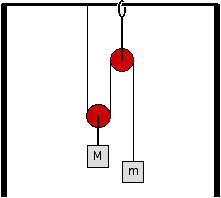
Consider the arrangement of pulleys and masses shown below. The masses
of the pulleys are small. Ignore friction.
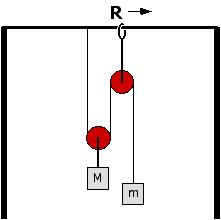
This system is initially at rest. What will happen if the ring R is
moved to the right?

  1. Nothing will happen.
  2. Mass M will go up and m will go down.
  3. Mass M will go down and m will go up.
  4. Both masses will go down.
  5. Both masses will go up.
  6. Cannot be determined because what happens depends on the masses.
Commentary:

Answer

(3) If the ring is moved to the right the upward force on M is
decreased,so M will accelerate downward. Initially the tension is Mg/2.
When the strings are at an angle the tension is insufficient to support
M.

Background

Answers are not as important as approach. What did students do to
understand the physical situation? Did they draw pictures? Did they draw
a free-body diagram?

Questions to Reveal Student Reasoning

Does the tension stay the same? …increase? …decrease? After moving
the ring, would I need a smaller or larger mass M to keep the system
from moving?

Suggestions

After students make predictions and discuss their reasoning have
students vote a second time. Then demonstrate what happens.

A2L Item 041

Goal: Reasoning qualitatively.

Source: UMPERG

Consider the arrangement of pulleys and masses shown below. The masses
of the pulleys are small. Ignore friction.

For what relationship of the masses would the masses remain at rest?

  1. m/M > 2
  2. m/M = 2
  3. m/M = 1.5
  4. m/M = 1
  5. m/M = 0.5
  6. m/M = 0.25
  7. m/M < 0.25
  8. none of the above
  9. Cannot be determined

Commentary:

Answer

(5); This problem can be reasoned although it is easy enough to solve algebraically. The problem is useful for demonstrating the value of free body diagrams for reasoning.

A2L Item 038

Goal: Reason qualitatively. Consider alternate solution paths.

Source: UMPERG

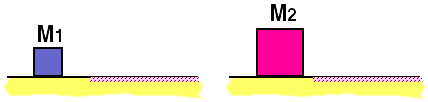
Two blocks, M2 > M1, having the same speed move
from a frictionless surface onto a surface having friction coefficient
μk as shown below.

Which block stops in the shorter time?

  1. M1
  2. M2
  3. Both blocks stop in the same time.

Commentary:

Answer

(3); both blocks have the same acceleration and the same initial
velocity, so they must stop in the same length of time.

Background

This problem can be reasoned through without the use of equations.
However, the problem can be solved easy enough algebraically. The item
provides an opportunity for students to reflect on different approaches
for solving problems.

Questions to Reveal Student Reasoning

Which block experiences the largest net force?

Which block experiences the largest acceleration?

What determines which block stops first?

Suggestions

Ask students to consider the following questions, and to determine if
their answer to the problem is inconsistent with their answers to these
questions:

If two blocks enter the rough region side by side and have the same
mass, which one will stop first?

If the blocks are connected by a rope, will the time it takes for the
blocks to stop change? Would the time it takes to stop change if the
blocks were glued together?

A2L Item 027

Goal: Contrast internal, external forces and net force.

Source: UMPERG

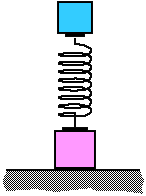
A toy
is made from two blocks and a spring as shown at right. When the spring
is compressed and suddenly released, the toy will jump off the table
surface. Which of the following is true about the net force on the toy
just after it is released?

  1. The net force is zero.
  2. The net force points up.
  3. The net force points down.
  4. The direction of the net force cannot be determined.

Commentary:

Answer

(2); This question seems difficult but it is available
to beginning students. Students can analyze the problem considering the
entire toy as a single system or decompose into the separate masses.
Viewed as a single system, since the center of mass accelerates up, the
net force must point up. Free body diagrams for each mass individually
would show no net force on the bottom mass (because the normal force
assumes a value necessary to balance gravity and spring force) and a
large net force on the upper mass (spring force exceeds gravity). If
sketched to scale, the two can be added showing that the net force
derives from the normal force on the lower block.

Background

This question is intended to have students distinguish between internal
and external forces. The question also can be approached in a variety
of ways.

Questions to Reveal Student Reasoning

Can the toy ever leave the surface? Would there be a net force if it
did leave the surface?

A2L Item 026

Goal: Reasoning with 2nd law.

Source: UMPERG

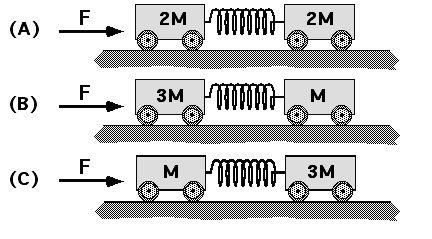
Consider the three situations shown below. In each case two small carts
are connected by a spring. A constant force F is applied to the
leftmost cart in each case. In each situation the springs are
compressed so that the distance between the two carts never changes.

Which of the following statements must be true regarding the compression
of the spring in each case? Assume the springs are identical.

  1. Compression A = Compression B = Compression C
  2. B = C < A
  3. A < B = C
  4. A < B < C
  5. B < A < C
  6. C < A < B
  7. A < C < B
  8. None of the above
  9. Cannot be determined

Commentary:

Answer

(5) The total mass is the same so the acceleration of the systems must
be the same. In each case the spring exerts the only horizontal force
on the cart to the right. The spring force must be largest for the 3M
cart and smallest for the M cart: B < A < C.

Background

This item requires students to reason. It is difficult to resort to
equation manipulation to answer this question. One difficulty with the
problem is that it involves a complex system (two carts connected by a
spring).

Questions to Reveal Student Reasoning

Is it really possible to compress the carts so that they stay a fixed
distance apart? What forces act on each cart? Will the carts
accelerate or move with a constant velocity? Compare the carts
acceleration.

Suggestions

Draw a free-body diagram for each cart.

Define a new problem in terms of the carts on the right: Each cart is
given an applied force so that each has the same acceleration. How do
the applied forces compare?

A2L Item 024

Goal: Reason and evaluate statements about a real-world situation.

Source: UMPERG

At the scene of an accident the car causing the crash left skid marks of
a length D. The accident reconstruction team did a test and found that a
police cruiser traveling at the speed limit produces skid marks of
length d < D. Which of the following statements is valid?

  1. Since D > d the car must have been traveling over the speed limit.
  2. One cannot conclude that the car was speeding because the test failed
    to take reaction time into account.
  3. One cannot conclude that the car was speeding because the test failed
    to take the mass of the car into account.
  4. One cannot conclude that the car was speeding because the test failed
    to take into account possible differences in the coefficient of friction
    for different tires.
  5. Two of the above statements are valid.
  6. None of the above statements is valid.
  7. It cannot be determined if any of the statements is valid.

Commentary:

Answer

(4) is valid assuming that the usual kinetic friction model is
applicable. Some students may think that (3) is valid and indicate (3)
or (5). All of the others are definitely invalid. Since (1) is
invalid, (7) is also invalid.

Background

This question seeks to encourage students to reason and analyze the
situation. It offers the opportunity to engage the students in a
discussion of the meaning of validity as well as the physics underlying
the various assertions.

Questions to Reveal Student Reasoning

How would reaction time influence the skid marks?

Suppose the car had several people inside. Would that have affected the
skid marks?

Suppose the test had been made with the same model car as the one in the
accident. Would that make the test more valid?

Suggestions

Allow students to form small groups according to their views and let
them present their arguments to the class. Have student ‘consultants’
suggest appropriate tests to determine if the car was speeding.

A2L Item 009

Goal: Relate friction, velocity, and time.

Source: UMPERG

A cart rolls across a table two meters in length. Half of the length of
the table is covered with felt which slows the cart at a constant rate.
Where should the felt be placed so that the cart crosses the table in
the least amount of time?

  1. On the first half of the table
  2. Centered on the table
  3. On the second half of the table
  4. It doesn’t matter where the felt is placed
  5. None of the above
  6. Cannot be determined

Commentary:

Answer

The
felt should be placed on the second half of the table. After the cart
rolls across the felt it will travel at a lower speed. To minimize the
time to cross the table one must minimize the time the cart spends at
the lower speed. The graph to the right illustrates the point for the
two extreme cases: felt on first half (gray curve) and felt on second
half (black curve). The velocity vs. time graph for the case where the
felt is on the second half of the table is above the velocity vs. time
graph for all other possibilities. Answer (3) is the best choice.

Background

Students should have some experience using the concepts of velocity and
acceleration to solve kinematics problems and analyze graphs. The
question students need to answer is what configuration will permit the
cart to travel at a higher speed for the longest period of time (or the
lowest speed for the shortest period of time). A graph provides support
for a conceptual argument.

Issues to consider: (1) Can students reason and analyze a situation
involving constant acceleration. (2) Do students try to solve the
problem using algebraic methods? (2) Can students use graphical methods
and conceptual reasoning? (3) Can students verbalize the central idea —
an object will travel a certain distance in less time if its speed is
higher?

Questions to Reveal Student Thinking

Where is the cart moving the fastest? … the slowest?

What does a graph of the velocity vs. time look like?

How do you determine when the cart has reached the end of the table from
a graph of velocity vs. time?

Suggestions

Try some limiting cases. If the piece of felt were small (say 10 cm)
but slowed the cart from 1 to .8 m/s on a 3m table. Approximately how
long would the trip take if the felt were placed at the beginning of the
table?…at the end of the table?